Category: Learning Routines

  • How to Build a 15-Minute Learning Ritual at Home

    How to Build a 15-Minute Learning Ritual at Home

    15 minutes
    1 picture or short sequence
    1 story
    1 child-generated question
    1 complete sentence
    1 closing reflection

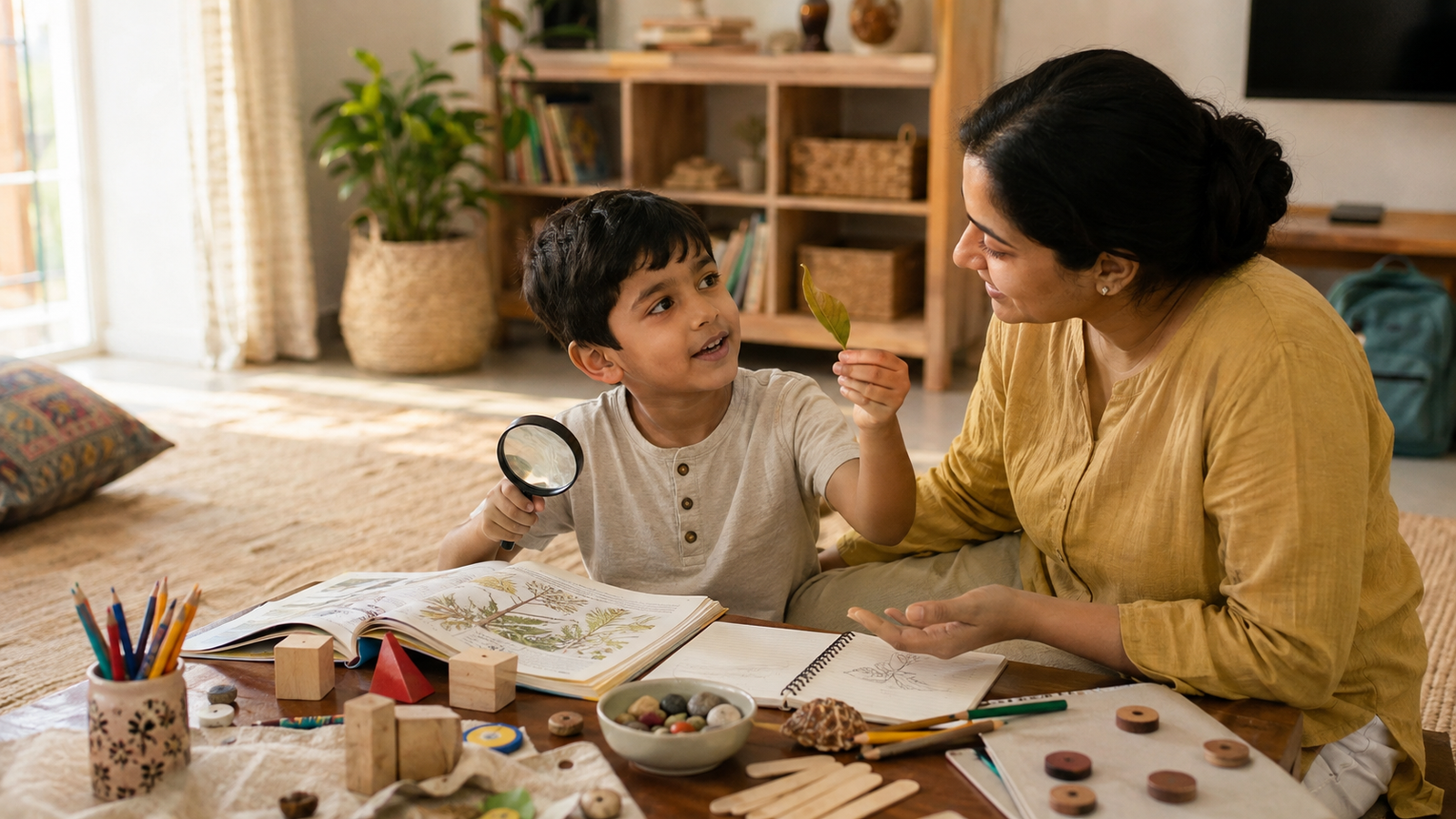
    A useful home-learning ritual does not need a large setup. It needs a familiar beginning, a small challenge, genuine conversation and a clear ending.

    How can parents create a 15-minute learning routine at home? Choose one picture or short card sequence, tell one story, encourage one meaningful question, build one complete sentence and close with one reflection.

    Why a Ritual Is Different from an Activity Plan

    An activity plan asks the parent to keep deciding what to teach, collect and explain. In a ritual, the structure stays familiar while the picture, question and conversation change.

    The routine stays the same. The thinking inside it changes.

    The minute markers below are flexible. One beat may take longer, and the family can still stop after fifteen minutes.

    0:00–4:00 — The Story Beat

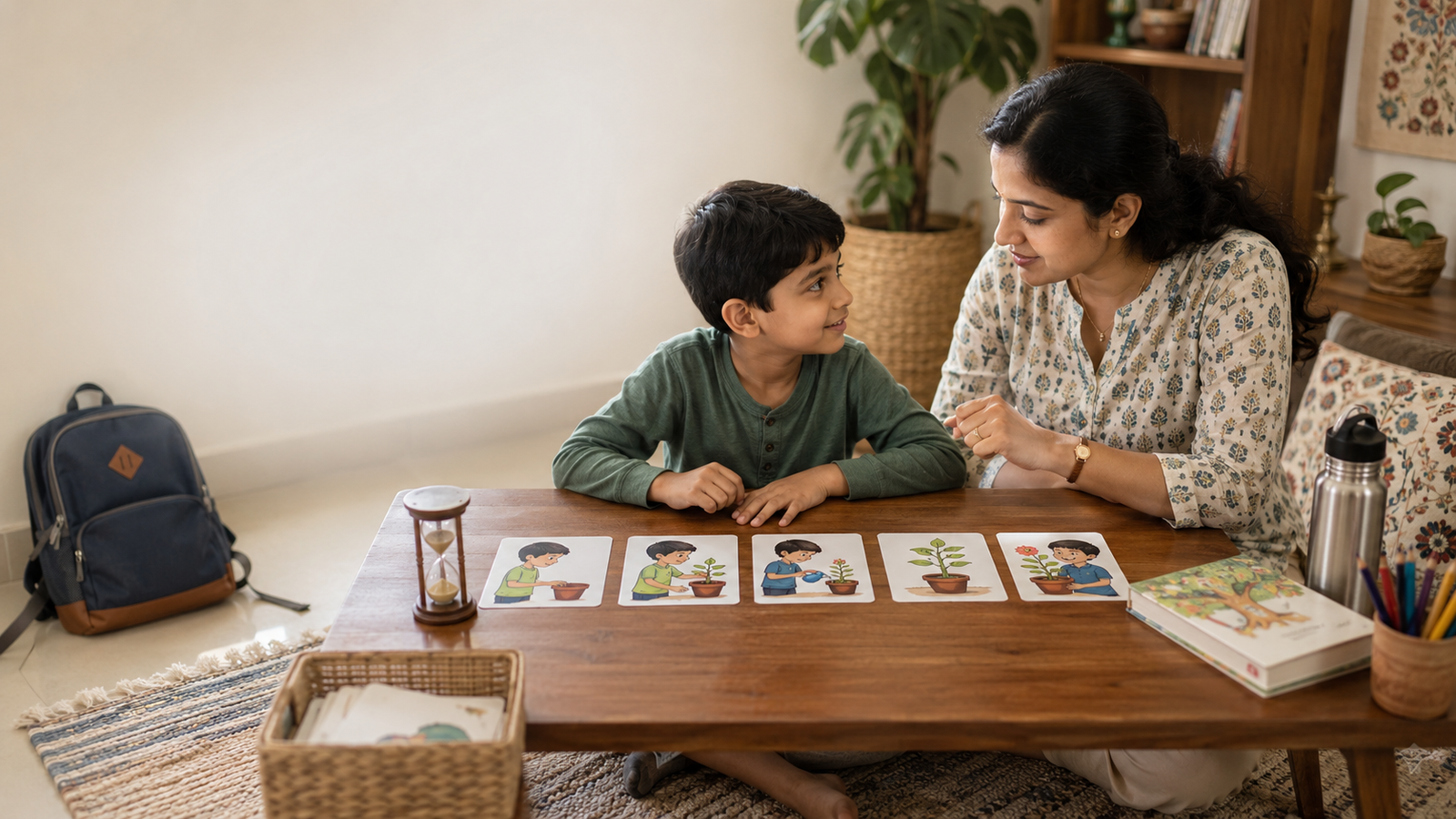
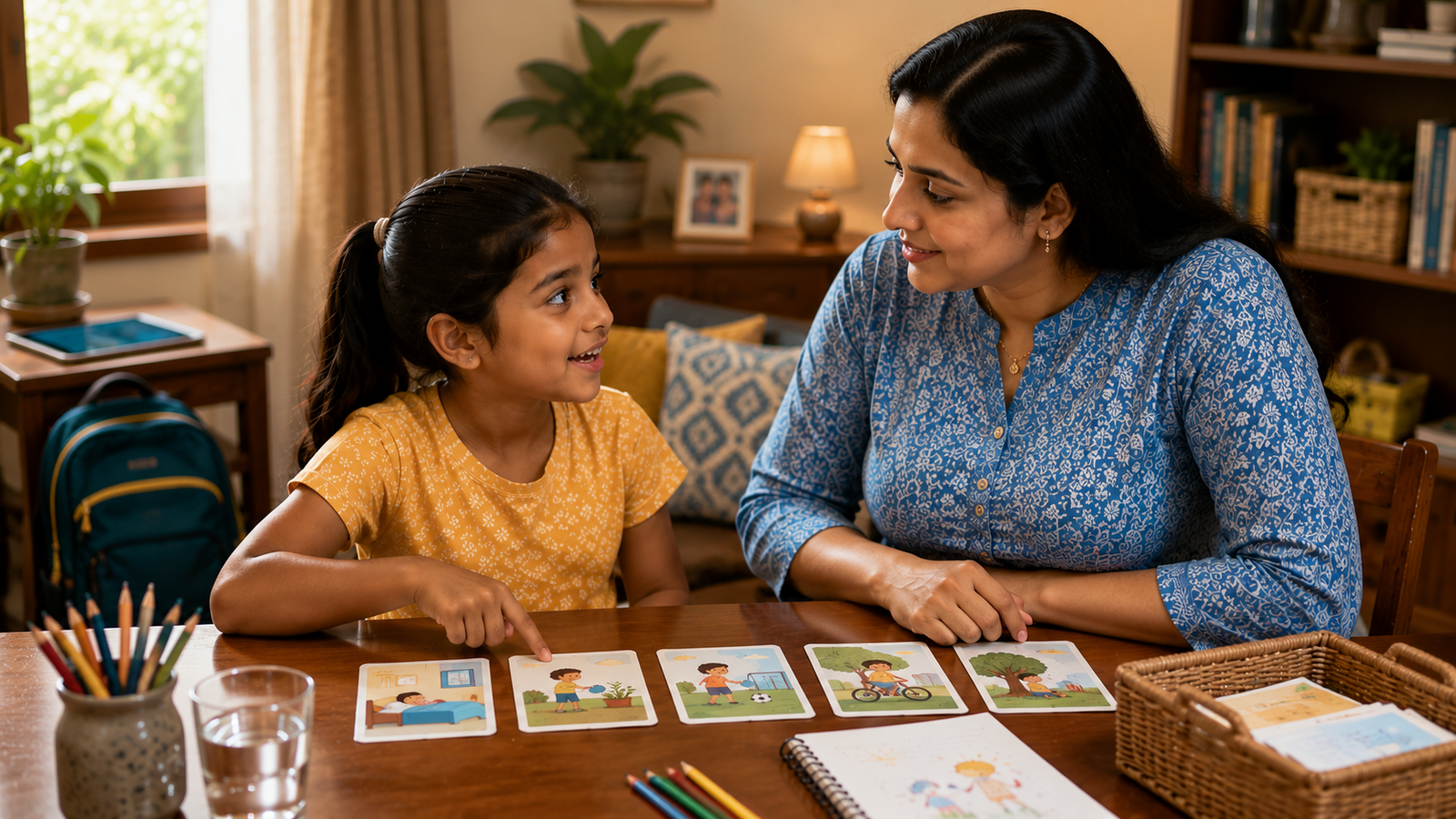
    Begin with a short picture sequence, situation card, object card, book illustration or family photograph.

    Invite the child to arrange or narrate what they see. They might identify the beginning, explain the problem, create a title or invent a missing event.

    Parent: Which picture should come first?
    Child: The one where the boy sees the fallen plant.
    Parent: What happens next?
    Child: He picks it up and adds more soil.

    4:00–7:00 — The Question Beat

    Ask the child to generate one question about the story or picture. When needed, prompt gently:

    • What are you curious about?
    • What information is missing?
    • Why might this have happened?
    • What could happen next?

    From the observation, “The girl is carrying a bag,” a child might ask, “Where is she going?”, “Why is the bag so full?” or “Who packed it?”

    This is not a quiz with one answer. The child is learning to notice what is unknown and participate actively in conversation.

    7:00–11:00 — The Sentence Beat

    Choose one idea, action or object and help the child express it as a complete sentence.

    Use a simple Sentence Stretch:

    “Matka.”

    • It is a matka.
    • The matka is made of clay.
    • The family keeps drinking water in the clay matka during summer.

    Or stretch “Helping” into:

    “The child is helping his grandmother carry the basket.”

    A useful framework is:

    Who or what + action or description + object or place + one useful detail

    Aim for one thoughtful sentence, not ten repetitive ones.

    11:00–15:00 — The Reflection Beat

    Close with one predictable prompt:

    • What was most interesting today?
    • Did anything remind you of our family?
    • Which word would you like to remember?
    • What should tomorrow’s story be about?

    The child may answer aloud, draw, choose a favourite card, act out one moment or place a card in a “tomorrow” basket.

    Reflection gives the child ownership and a calm ending. An object picture may prompt:

    • Have you seen this at your grandparents’ home?
    • Does our family use another word for it?
    • What modern object serves a similar purpose?

    The conversation can include culture without turning into a formal cultural lesson.

    One Picture, Fifteen Minutes: A Complete Example

    A child sees pictures of an overturned plant pot and a boy helping his grandmother restore the plant.

    Story

    “The pot fell. The boy saw it. He helped his grandmother put the plant back.”

    Question

    “Why did the pot fall?”

    The parent welcomes different possibilities and asks which one seems most likely.

    Sentence

    “Boy helping” becomes:

    “The boy is helping his grandmother put the plant back into the pot.”

    Reflection

    The child remembers watering a balcony plant and chooses a garden for tomorrow’s story.

    This is a flow to adapt, not a script to follow word for word.

    Keep the Rhythm. Change One Element.

    Keep the pattern familiar while changing one part:

    • use a new picture;
    • ask a different question;
    • retell the scene from another viewpoint;
    • choose a new object word;
    • let the child lead.

    A grandparent can join the reflection, or the child can draw instead of speaking.

    No reward chart or perfect streak is required. Missing a day is not failure. Return when the next calm fifteen-minute window appears.

    Adapt the Ritual to the Child

    For a Child Who Prefers Short Responses

    Accept pointing, choosing, acting or one-word answers before modelling a fuller sentence.

    For a Child Who Talks at Length

    Ask for a four-sentence story, one important question and one sentence to improve.

    For Siblings

    Let one child arrange, another ask, and both share a reflection.

    For Older Children

    Explore motives, alternative explanations, stronger vocabulary and changes in perspective.

    Build a LernZeit Ritual Basket

    Choose Storytelling & Sequencing for narration, order, prediction and cause-and-effect thinking.

    Choose Learn to Ask Questions for closer observation and child-generated curiosity.

    Choose Everyday Bharat Objects for vocabulary, description and family connections.

    Two sets can be combined, or different sets can be rotated across the week. All three are not required. The ritual also works with one card, photograph or book illustration.

    Frequently Asked Questions

    Is fifteen minutes enough for a meaningful learning activity?

    It can be. The value comes from genuine observation, thinking and conversation, not the number of tasks completed.

    Does the ritual need to happen at the same time every day?

    No. A familiar sequence matters more than a fixed time. Use it whenever the family has a calm fifteen-minute window.

    What should I do when my child does not want to speak?

    Allow pointing, arranging, drawing or acting. Model a sentence without pressure and let the child participate quietly.

    Can the same picture cards be reused regularly?

    Yes. Change the question, viewpoint, ending, sentence detail or reflection. Familiar pictures can still lead to new thinking.

    The Closing Line

    One story.
    One question.
    One sentence.
    One reflection.

    The goal is not to complete a large amount of work. It is to create a small space in which the child can notice, organise, wonder, speak and connect.

    Choose one picture and try the ritual once without planning an entire week. LernZeit Creations’ visual prompts can help families find new stories, questions, sentences and reflections while keeping the rhythm familiar.
  • How Festivals Can Make English Practice Feel Like Play

    How Festivals Can Make English Practice Feel Like Play

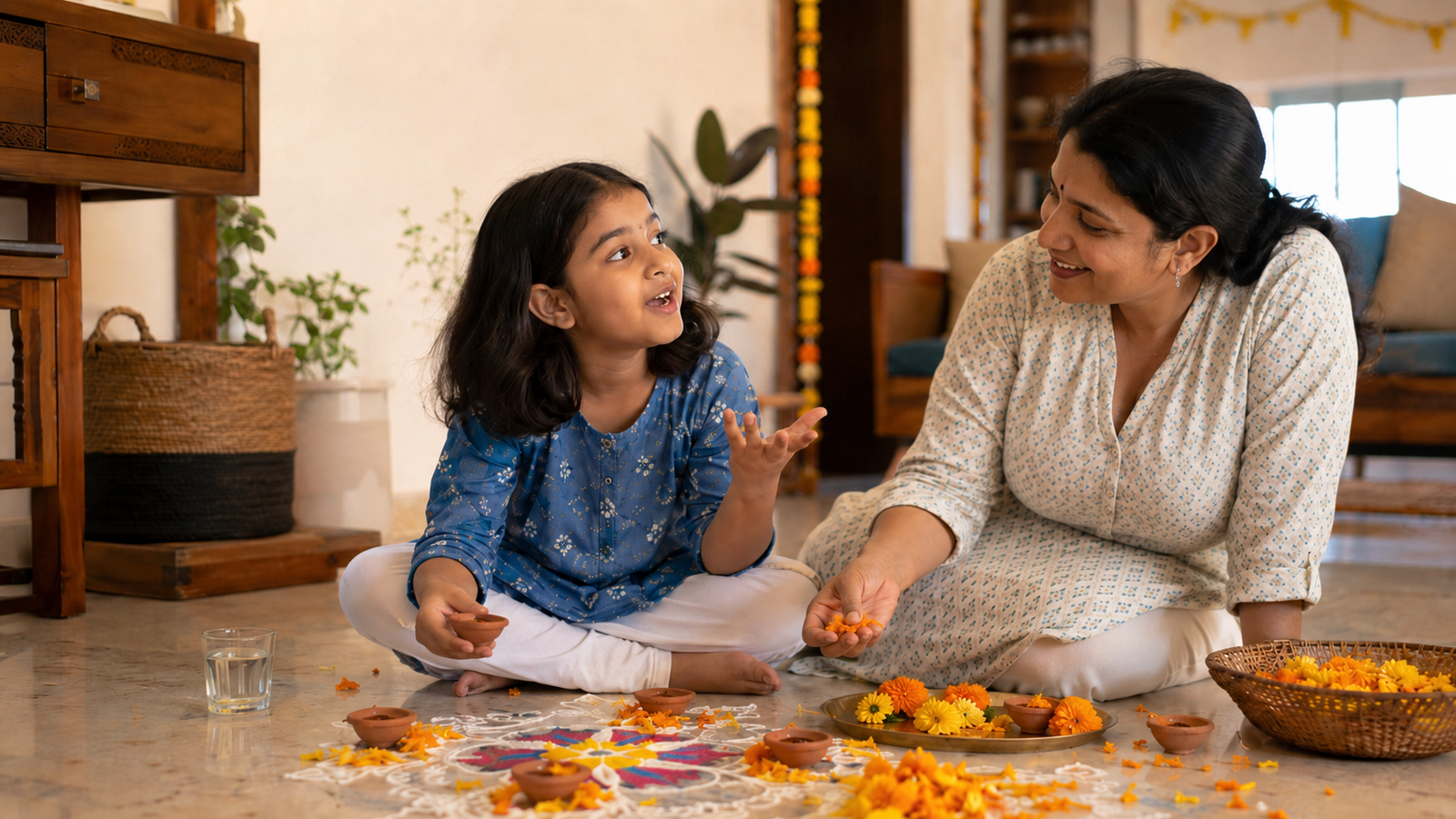
    A child studies a picture of a family preparing for a celebration. Someone is hanging flowers. Another person is carrying a tray. A grandparent is stirring something in the kitchen.

    The parent does not ask, “Which tense is this?”

    Instead, she asks, “What is happening now?”

    “The girl is hanging flowers.”

    “What happened before this?”

    “They cleaned the doorway.”

    “What will they do next?”

    “They will light the lamps.”

    The child has moved through past, present, and future without opening a grammar workbook. Festivals offer familiar actions, memories, routines, and plans that can be described naturally. The language has a purpose: the child is discussing something recognisable.

    Welcome to the Festival Language Studio

    Imagine placing one festival picture in the middle of three playful language zones.

    In Yesterday, the child recalls what already happened.

    In Today, the child describes what is happening now – or what the family usually does.

    In Tomorrow, the child talks about plans, preparations, and possibilities.

    Parents do not need to begin with terms such as simple past or present continuous. Begin with time and action: What happened? What is happening? What usually happens? What will happen next?

    The child gradually notices that the sentence changes when the time changes. This treats grammar as communication rather than a hunt for the correct label; language instruction is most useful when children can communicate meaning, not only pursue grammatical perfection.

    Festival contexts also give sentence-building a cultural and emotional setting instead of leaving actions inside isolated exercises.

    Zone One: Yesterday – Replay a Festival Memory

    Yesterday is the zone of completed actions.

    Choose a memory from a celebration familiar to your family: visiting relatives, preparing food, making a kolam, exchanging greetings, attending a community event, carrying flowers, listening to music, or decorating a room.

    Ask, “What did we do first?”

    A conversation may unfold like this:

    Parent: What did we do in the morning?Child: We made sweets.Parent: Who helped you?Child: Grandma helped me.Parent: What happened after that?Child: I decorated the box.

    Festival Memory Replay

    Invite your child to choose one moment and describe where they were, who was present, what happened first, what they did, and how they felt.

    When the child says, “We decorated,” add a little language without treating the answer as a mistake:

    “Yes, we decorated the doorway with flowers.”

    Expansion lets children hear a fuller sentence while keeping their idea intact. Communication guidance similarly recommends adding to what a child says and talking about pictures and everyday experiences.

    You can then invite one more detail:

    “When did we decorate it?”

    “We decorated it in the evening.”

    Zone Two: Today – Catch the Festival in Motion

    Today is the busiest part of the studio.

    Look closely at a festival scene and describe the actions in progress:

    Mother is arranging the flowers.

    The children are carrying the lamps.

    Grandpa is telling a story.

    My cousin is playing the dhol.

    The family is preparing food.

    We are decorating the room.

    Then ask what the family usually does:

    We visit our relatives.

    Our family prepares this sweet every year.

    We exchange greetings with our neighbours.

    A picture can support two conversations: what is happening now and what commonly happens in the family’s tradition. Choose examples relevant to your own celebrations; no ritual, food, or dress is universal.

    Action Detective

    Ask the child to find five actions in a picture and turn each one into a complete sentence.

    Begin simply:

    “The girl is holding a plate.”

    Then add playful missions:

    Find an action involving sound.

    Find an action involving food.

    Find something one person is doing.

    Find something several people are doing.

    Find an action that requires careful movement.

    The game develops observation alongside sentence formation. Picture talk connects words with actions and ideas, while oral-language practice supports communication.

    For a humorous round, the adult can make an obviously incorrect observation:

    “The musician is cooking the flowers.”

    The child must identify what is wrong and repair the sentence:

    “No, the musician is playing the dhol. The woman is arranging the flowers.”

    The correction belongs to the game, not to criticism.

    Zone Three: Tomorrow – Talk About Plans

    Future language appears naturally when children are looking forward to something.

    Ask:

    What will we do tomorrow?

    Who will visit us?

    What will you wear?

    What are we going to prepare?

    What will happen after sunset?

    A short dialogue might sound like this:

    Parent: What will we do tomorrow morning?Child: We will decorate the house.Parent: What will you decorate?Child: I will decorate the doorway.Parent: What will you use?Child: I will use flowers.

    Festival Planner

    Invite the child to make three spoken plans:

    one thing I will wear;

    one thing I will help with;

    one person I will meet;

    one food I will eat;

    one activity I am excited about.

    The child can draw the plans or arrange them in order after speaking. The aim is to practise intention and expectation, not predict the celebration perfectly.

    Festival-based grammar feels refreshingly different because plans already matter to the child; the language is attached to anticipation rather than an abstract rule.

    The Festival Time-Travel Game

    Now connect all three zones.

    Choose one action: decorate, cook, visit, dance, light, carry, play, share, wear, or make.

    Move it through time:

    Yesterday, we decorated the room.

    Try another:

    Yesterday, Grandma made laddus.

    The child is learning more than a changed verb. Each sentence communicates who is acting, what is happening, when and where it happens, and which details make the meaning clearer.

    For extra play, say, “Yesterday, Grandpa danced with a giant laddu.” Ask what sounds unusual. The child may repair it:

    “Grandpa danced while holding a plate of laddus.”

    This is a thoughtfully specific bridge between grammar, visual storytelling, and children’s lived cultural experiences. The language stays structured, but the conversation remains imaginative.

    From One Word to a Complete Sentence

    Some children understand the scene but answer with one word.

    Parent: What is she doing?Child: Decorating.Parent: Who is decorating?Child: The girl.Parent: Can we join those ideas?Child: The girl is decorating.Parent: What is she decorating?Child: The girl is decorating the doorway.Parent: What is she using?Child: The girl is decorating the doorway with flowers.

    A reusable pattern is:

    Who + action + object or place + extra detail

    For example:

    The boy is carrying a lamp carefully.

    Grandma made sweets in the kitchen.

    We will visit our relatives in the evening.

    A short, clear sentence is useful progress. Sentence frames can support speaking by providing structure without supplying the answer.

    Seven Days in the Studio

    Keep each session to about five or ten minutes.

    Day 1 – Spot the Actions

    Choose one festival photograph or picture. Name the actions you can see.

    Day 2 – Remember Yesterday

    Share three sentences about a past celebration.

    Day 3 – Describe the Scene in Motion

    Say what different people are doing now.

    Day 4 – Plan Tomorrow

    Talk about an upcoming family activity or celebration.

    Day 5 – Change the Time

    Move one action through yesterday, today, and tomorrow.

    Day 6 – Add One More Detail

    Expand a sentence using who, where, when, what, or how.

    Day 7 – Tell the Whole Festival Story

    Combine several sentences into a short spoken narrative.

    The studio can fit into a car journey, a family visit, or a few minutes with old photographs.

    When a Picture Makes the Conversation Easier

    Families can use photographs and real celebrations, but finding a clear scene with several actions is not always easy.

    That is where Tenses Through Festivals can serve as a picture-led starting point. The product brings together English sentence formation, action words, past-present-future expressions, festival settings, observation, storytelling, and parent-child conversation.

    A card can prompt: What is happening? What happened before? What might happen next? What does this person usually do? Can you add a place or time, or turn the actions into a story?

    The distinctive idea is the combination: instead of unrelated sentences, language sits inside recognisable scenes involving preparation, food, decoration, music, visits, and shared traditions.

    Tenses Through Festivals Flashcards, Level 1 can be used as a starting collection for families introducing picture-led sentence-building and conversations about time. The current listing presents the product around past, present, and future language through familiar Indian traditions and celebrations.

    Tenses Through Festivals Flashcards, Level 2 offers an additional collection of visual situations and action-based conversation possibilities. It should not be assumed to be harder or intended for a particular age unless the family has separately verified that detail.

    The Tenses Through Festivals Flashcards, Levels 1 & 2 Combo may suit families who want a broader pool of scenes for rotating activities, comparing actions, sorting by time, and creating longer stories.

    Its refreshingly specific format combines grammar with Indian festival contexts, visual observation, speaking, and family interaction – a combination parents may not commonly encounter in standard worksheet-based resources.

    Frequently Asked Questions

    How can I teach tenses without making my child memorise grammar rules?

    Begin with time-based questions rather than terminology: “What happened?”, “What is happening?”, and “What will happen next?” Use a familiar photograph or picture and model one sentence at a time. Once the child is comfortable expressing time through speech, grammatical names can be introduced gradually if they are useful.

    What festival activities can help children practise English sentences?

    Children can describe preparations, recall a previous celebration, plan an upcoming visit, find actions in a picture, compare family traditions, or narrate events in order. Families should choose festivals and practices familiar to the child rather than trying to cover every celebration.

    Can children learn past, present, and future expressions through pictures?

    Pictures provide visible people, objects, actions, and settings. A parent can ask what is happening in the scene, what may have happened before it, and what could happen next. This gives the child a concrete subject for sentences instead of requiring ideas and grammar at the same time.

    What should I do when my child answers with only one word?

    Accept the idea, then help expand it. If the child says “decorating,” ask who is decorating, what they are decorating, or what they are using. Join the answers gradually. Avoid beginning with “That is not a complete sentence,” which may make a hesitant speaker less willing to continue.

    How are festival-based tense flashcards different from regular grammar worksheets?

    Worksheets often begin with written rules, isolated sentences, or blanks. Festival-based picture cards begin with a recognisable scene and invite the child to observe, speak, remember, predict, and tell a story. The grammatical practice is still present, but it is carried by meaningful action and conversation.

    Leave the Studio Open

    The next time your child sees a festival photograph, choose one action.

    Ask:

    “What happened yesterday?”

    Three questions are enough to begin.

    English practice does not have to arrive as a worksheet. It can enter through flowers being hung, food being prepared, music being played, or a family making plans – before anyone calls it a lesson.

    References

    Cambridge University Press.Pedagogical Interventions to L2 Grammar Instruction.

    Reading Rockets.Your Child’s Communication Development, Birth to Five.

    Reading Rockets.Basics: Oral Language.

    Colorín Colorado.Sentence Frames and Sentence Starters.

  • Winning Back the Evening: A Gentle Guide to Reduce Screen Time After School

    Winning Back the Evening: A Gentle Guide to Reduce Screen Time After School

    The child comes through the door, drops the school bag, removes one shoe and asks:

    “Can I watch something?”

    The request may arrive before the lunch box is unpacked or the child has recognised whether they are hungry, tired or upset.

    This does not necessarily mean the child is deliberately difficult. The screen may simply have become the most predictable bridge between school and home.

    To change the evening, families often need to build a new bridge—not merely block the old one.

    How can parents reduce screen time after school without constant arguments? A practical starting point is a predictable sequence: arrive, eat or drink, decompress, choose from a small menu of low-preparation alternatives, and move clearly into the next part of the evening.

    The aim is not a perfectly screen-free home. It is to reduce the feeling that a device is the only workable way through the after-school period.

    Why This Window Feels Difficult

    Children may return carrying hunger, tiredness, unfinished emotions and a strong need to stop following instructions. Parents may simultaneously be finishing work, preparing food, supporting another child and recovering from their own day.

    The best replacement is not the most educational one. It is the one the family can realistically repeat.

    Scene One: The Doorway

    The Moment

    The parent may immediately ask about school, request a change of clothes, mention homework and announce that there will be no screen.

    The Risk

    A screen offers immediate escape. The child does not have to decide, answer or process the day aloud. The parent may agree because it creates a few quiet minutes.

    The Replacement Cue

    Create one consistent arrival action: bag in one place, shoes in one place, water bottle on the counter and snack in the usual spot. Add a greeting, hug or quiet minute.

    The ritual begins before the argument begins.

    The Parent Line

    “First, let us land. Bag down, water, snack—and then we will decide what the evening needs.”

    Scene Two: The Landing Zone

    The Moment

    The child has had water or a snack but may still be quiet, irritable or restless.

    The Risk

    Books, games and conversation are offered too quickly and rejected because they feel like more work.

    The Replacement Cue

    Create a short landing zone of roughly ten to twenty minutes. It may include eating quietly, changing clothes, drawing, lying on a mat, sitting near the parent or helping unpack the tiffin box.

    This is not a reward or formal activity. It is a buffer. The child does not need to discuss school immediately.

    The Parent Line

    “You do not have to tell me everything yet. Have your snack and settle in first.”

    The message is simple: the child may arrive before being asked to perform.

    Scene Three: The Screen Crossroads

    The Moment

    The snack is finished. The child asks again for television, a phone or a tablet.

    The Risk

    The parent says “No” and improvises a long list: read, colour, play, do a puzzle, go outside or help in the kitchen.

    The alternatives feel vague; the screen remains specific and familiar.

    The Replacement Cue

    Offer only two or three choices:

    • a three-card story;
    • one object-card conversation;
    • quiet free play;
    • a small household task.

    Instead of “What do you want to do?”, ask:

    “Would you like a three-card story or an object challenge?”

    The Parent Line

    “Screen time is not starting now. You can choose a short card activity or have some quiet play while I finish this task.”

    Scene Four: The Connection Window

    The replacement activity does not need to fill the evening. Ten to twenty minutes may be enough to interrupt the automatic movement from school directly into prolonged viewing.

    Choose according to the child’s energy.

    When the Child Still Has Energy

    Invite the child to arrange a few pictures, identify what happened first, predict the ending or create a funny alternative.

    Parent: “Which picture comes first?”

    Child: “This one, because the plant is still standing.”

    Parent: “What changes after that?”

    Child: “It falls, and then the boy helps put it back.”

    The child controls the order, interprets events and speaks. One short sequence is enough.

    When the Child Is Tired

    Invite the child to choose one familiar object picture, name it, compare it, sort it or connect it with the day.

    Parent: “Which card reminds you of today?”

    Child: “The tiffin.”

    Parent: “What did it contain?”

    Child: “Idli.”

    The conversation can remain light.

    The Replacement Cue

    Keep cards in an easy-to-reach evening basket rather than with formal study materials. A replacement is easier to begin when setup and cleanup take less than a minute.

    The same principle works with a picture book, family photograph or household object.

    The Parent Line

    “Choose one small thing. We are not doing a lesson; we are just spending a few minutes together.”

    Scene Five: The Gentle Exit

    The Moment

    The activity ends. The child may request a screen again or resist moving towards dinner, homework, bath time or independent play.

    The Risk

    Without a clear ending, the replacement becomes another negotiation. The parent may keep extending it merely to avoid the next request.

    The Replacement Cue

    Return the cards to the basket, choose one picture for tomorrow, place the final card face-down or move together towards a small household task.

    The Parent Line

    “That is our last card for today. Keep this one aside for tomorrow, and now we are moving to dinner.”

    What This Can Look Like on a Real Weekday

    4:15 — Arrival

    Bag down, shoes away, water first.

    4:20 — Landing

    Snack and ten minutes of quiet decompression.

    4:35 — Choice

    The child chooses between three story cards and one object-card activity.

    4:40 — Connection

    The child arranges a sequence and tells a simple story.

    4:52 — Exit

    The cards return to the basket. The child moves into free play while the parent prepares dinner.

    This is an illustration, not an ideal schedule. Timings will vary; the sequence matters more than the clock.

    Why Replacement Works Better Than an Empty “No”

    An unsupported “no” leaves the child with the same tiredness, boredom and need for transition—but no clear next action.

    A replacement ritual offers a known sequence, a limited choice, something tactile, brief parent attention and a clear end.

    The goal is not to compete with a screen on excitement. It is to make the next step easier to begin.

    Boundaries Still Need to Be Clear

    A family might decide that screens begin only after a certain part of the evening, are available on selected days or are not offered during arrival and snack time.

    There is no universal limit. Predictable language and fewer negotiations in the most difficult moment matter more. Occasional exceptions do not destroy the routine.

    When the Evening Does Not Go to Plan

    When the Child Refuses Everything

    Do not offer ten new options. Repeat the boundary and allow a low-demand choice:

    “You do not have to do cards. You may rest or play quietly, but the screen is not starting now.”

    When the Parent Is Exhausted

    Use the smallest version: one card, one question, three minutes—or no structured activity. Snack followed by independent play can still be a replacement sequence.

    When the Screen Is Already On

    The evening is not ruined. Choose a clear stopping point and continue:

    “We will stop after this episode, put the device away and move to dinner.”

    When the Ritual Is Missed

    Restart the following day without punishment or a discussion of failure.

    Predictability grows through returning, not through maintaining a perfect streak.

    Rotate the Activity, Keep the Runway

    On higher-energy days, the child may enjoy arranging and narrating story cards. On tired days, one object picture may be enough. Other evenings may naturally include outdoor play, helping in the kitchen or visiting family.

    The predictable part is the runway:

    Arrival. Landing. Limited choice. Brief connection. Clear exit.

    Two Low-Preparation Ways to Begin the Connection Window

    A Short Visual Story

    Storytelling & Sequencing Flashcards can support evenings when the child wants to arrange, narrate, predict or create a different ending.

    A Familiar Object Conversation

    Everyday Bharat Objects | Levels 1 & 2 Combo can offer a lighter entry through naming, choosing, comparing, sorting or recalling a personal connection.

    These products do not reduce screen dependence by themselves; they work best as optional visual anchors within a predictable routine.

    Frequently Asked Questions

    Why does my child ask for a screen immediately after school?

    The screen may have become a familiar, low-effort transition. Hunger, tiredness and the wish to stop responding to instructions can strengthen the request.

    Should screens be removed completely from the evening routine?

    Not necessarily. Families can decide where screen use fits rather than treating every evening as all-or-nothing. Predictable boundaries are often more workable than sudden bans.

    What can I offer when my child rejects every screen-free activity?

    Offer fewer options, not more. Allow rest, quiet play or one very small shared activity while keeping the boundary calm.

    How long should an after-school replacement activity last?

    Often ten to twenty minutes is enough. On difficult days, even three minutes of connection may be more realistic.

    Can flashcards hold a tired child’s interest after school?

    They can provide a simple visual anchor when matched to the child’s energy. Some children may enjoy a short sequence; others may prefer discussing one familiar object.

    Winning Back Does Not Mean Controlling Every Minute

    The child may still ask for a screen before both shoes are off. Some evenings will include screens. Some boundaries will remain difficult.

    Success is not zero screen time or completing an activity every day.

    Progress may look quieter: the child knows what happens after arriving, the first request is delayed, the parent has a response ready, and one alternative becomes familiar.

    Winning back the evening does not require filling every minute. It begins by creating one predictable bridge between school and home that does not automatically lead to a screen.

    Choose one arrival cue and one ten-minute replacement to try first. LernZeit Creations’ picture-led resources can fit naturally into this low-preparation connection window when a family needs a simple visual starting point.

  • The Indian Parent’s Guide to Screen-Free Evenings

    The Indian Parent’s Guide to Screen-Free Evenings

    One child reaches home after a long school-bus journey. Another returns from tuition shortly before dinner. A parent is finishing a work call. A grandparent has the evening news on. One sibling is doing homework while another wants company. A pressure cooker whistles in the kitchen, the tiffin boxes are still packed, and the television remote is already within reach.

    There is no single “typical” Indian evening. Advice such as “replace screens with quality family time” can ignore commutes, work, homework, dinner and the energy everyone has left.

    The Evening Thali offers a more flexible way to think about this. Just as families assemble meals according to appetite, time, season and preference, they can assemble an evening from a few small components rather than follow one ideal schedule.

    The aim is not to create a perfectly screen-free evening. It is to make screens only one possible part of the evening—not the automatic centre of it.

    How can Indian parents create calmer screen-free evenings? Families can combine a predictable household anchor, a little decompression, one genuine conversation, a simple shared game, a light learning moment and enough unstructured time. Not every component has to appear every day.

    Before Building the Thali, Notice What the Screen Is Doing

    Evening screen use often serves a practical purpose.

    For a child, it may provide predictable entertainment, relief after school, privacy from questions or an easy activity when outdoor play is not possible. For a parent, it may create time to cook, finish work, manage siblings or pause after a demanding day.

    Neither side needs to be blamed.

    A replacement works better when it addresses the need that the screen was meeting.

    A tired child may need quiet rather than a language game. A parent who needs time to cook may need something the child can continue independently. Restless siblings may need a shared challenge; a child who needs movement may not be ready to sit at all.

    Ask: What is difficult about this part of our evening? The answer helps determine which portions to include.

    The Evening Thali

    The Base: Predictable Anchors

    The base is not an educational activity. It is one or two events that happen in a familiar order.

    In one home, this may mean putting away shoes and the school bag, washing hands and having water. In another, it may mean changing clothes before unpacking the tiffin.

    The parent does not need a minute-by-minute timetable. The useful question for the child is:

    “What normally happens when I come home?”

    A familiar anchor reduces the number of decisions and negotiations at the most tired part of the evening.

    A realistic parent line might be:

    “First, let us settle in. After your snack, you can choose what kind of evening you need.”

    Routine will not remove every protest, but it gives the evening a recognisable start.

    The Cooling Space: Let the Child Arrive Emotionally

    Reaching home physically does not mean the child has fully left the school day behind.

    The Cooling Space may involve eating quietly, changing clothes, drawing, listening to music, brief movement or doing nothing structured for a while.

    Parents often ask several questions at once:

    “How was school? Did you finish your lunch? What homework do you have? Why are you so quiet?”

    A gentler entry is:

    “You can settle first. Tell me something when you are ready.”

    Decompression can make later conversation and play feel more voluntary. Its length will vary.

    The Conversation Portion: Move Beyond “How Was School?”

    Many children answer “How was school?” with “Fine”, “Nothing” or “I don’t know”. The question is broad, and the child may not know where to begin.

    A smaller shared prompt can create an easier doorway.

    One Situation, Many Voices

    Place one picture-based situation where everyone can see it. Each person contributes only one thing: an observation, question, possible explanation, feeling, prediction or suggestion.

    Imagine a picture of a child helping an older person carry something.

    Child: “The bag looks heavy.”

    Parent: “Why might the older person need help?”

    Sibling: “What could happen if the child pulls too quickly?”

    Grandparent: “How else could they carry it safely?”

    Learn to Ask Questions Flashcards can support this exchange with a relatable situation to inspect. The child can observe, wonder, disagree or add another perspective without producing a school report.

    The goal is not to complete every who, what, where, when, why and how prompt. One genuine question is enough.

    The Play Portion: Give the Evening a Small Game

    An evening game does not need a large board, a winner or lengthy adult attention. It needs a clear challenge and permission to be playful.

    The Story Shuffle

    Place a small visual sequence on the floor or table. The family might arrange the pictures, deliberately mix them up, hide one card or invent an unusual ending.

    One person can defend a surprising order; another can narrate from a different viewpoint. Siblings can build the story together.

    Storytelling & Sequencing Flashcards suit evenings when the child wants to touch, move, arrange and narrate instead of completing another formal language exercise.

    The parent might join briefly and then step away. Once familiar, the child may set it up independently.

    Stop while it still feels like play. The family does not have to complete every sequence.

    The Shared-Learning Portion: Keep Learning Light

    Shared learning can be meaningful without recreating school. It may be as small as naming one word, describing an object, sorting pictures, hearing a memory or building one sentence.

    One Object Around the Family

    Choose a picture of a familiar Indian object. Each person contributes something different.

    The child may name or describe it. A parent may explain where it is used. A grandparent may share another word for it or a personal memory. A sibling may place it into a category. The child may add it to a sentence or tiny story.

    Everyday Bharat Objects can provide a visual starting point for vocabulary, comparison, multilingual discussion and family memories. The value is not in delivering a cultural lecture. It is in allowing the picture to open a natural exchange.

    Follow the child’s curiosity. Comparing an older object with a modern one or simply recalling where it was seen can both be enough.

    The Open Space: Do Not Programme the Whole Evening

    A balanced evening also needs time without measurable learning: free play, movement, drawing, books, sibling talk, a walk or doing nothing for a while.

    Small household tasks—placing spoons, watering plants or matching lunch-box lids—can create participation and conversation. Children should not carry adult responsibilities; ordinary family life can simply hold connection.

    Not every meaningful part of childhood needs to be packaged as a learning activity.

    Three Sample Evening Thalis

    These are illustrations, not schedules.

    Thali One: The Tired Weekday

    After a long day, the Base might be a snack and change of clothes. The Cooling Space may take most of the time. The shared portion could be one Everyday Bharat Objects card and a three-minute conversation:

    “What does this remind you of?”

    The child then moves into independent play or rest. Three to five minutes of genuine interaction may be enough.

    Thali Two: The Multigenerational Evening

    With an older relative present or on a call, the family chooses one object picture, collects one home-language word, hears a memory and invites one child-generated question.

    Everyday Bharat Objects and Learn to Ask Questions can support the exchange, but the real value comes from the different voices around the picture.

    Grandparents may contribute humour, work, travel, current technology or changing household habits—not only tradition.

    Thali Three: The Sibling Game Evening

    Children of different ages begin with a Story Shuffle. One arranges, another asks questions, and both contribute to the ending before extending it through drawing or acting.

    Storytelling & Sequencing and Learn to Ask Questions can overlap naturally here. The parent may simplify roles so that one child chooses while the other narrates.

    The aim is collaboration, not equal performance.

    Multilingual Indian Homes: Let Ideas Come Before Perfect English

    Evening conversation may move naturally between languages.

    A child may learn in English at school, speak another language with grandparents and mix languages with siblings. They may know an object’s name in one language but not another.

    Allow the child to explain an idea in the language that comes most easily. The family can then compare names, ask for a regional word or model the English term afterward.

    A child might tell most of a story in a home language and use a few new English words. That is still meaningful participation.

    The immediate goal is communication. A fuller English sentence can be modelled after the idea is expressed. Multilingualism is part of how many families communicate and learn.

    Family Screen Realities

    Adults may need phones for work, school messages or video calls. A television may be used for news or entertainment. Older children may have online homework.

    A calmer evening does not require every device to disappear.

    Families can distinguish purposeful from automatic use, create one device-light window and say clearly when viewing will happen. Occasional exceptions do not erase the pattern.

    Children notice family patterns more than family slogans.

    Necessary phone use need not be hidden. Honest language is more useful:

    “I need ten minutes to finish this work call. You can choose your cards or play nearby, and then I will join you.”

    Do Not Overload the Thali

    A parent may accidentally pack homework, English, reading, vocabulary, chores and bedtime preparation into one “screen-free” session. The alternative then feels more demanding than the screen.

    Choose one or two components:

    • one story and free play;
    • one question during snack;
    • one object conversation while dinner is prepared;
    • one sibling game;
    • one household task with music;
    • no structured activity after a difficult day.

    Balance does not mean including everything. It means including enough.

    When the Evening Does Not Work

    When the Child Refuses Every Activity

    Do not create a longer list. Hold the screen boundary calmly and allow rest, drawing, helping nearby or free play.

    When the Parent Has No Energy

    Use the smallest version: one card, one observation, one question and three minutes together. It is also acceptable to skip the structured portion.

    When Homework Takes Over

    Do not force another learning activity. Use a brief conversation during snack, dinner preparation or the journey home.

    When Adults Disagree About Screens

    Parents and grandparents can agree privately on one or two expectations rather than correcting each other in front of the child.

    When the Television Is Already On

    The evening is not ruined. Choose a clear stopping point and return to the next household anchor.

    When the Routine Is Inconsistent

    Return to one reliable component rather than rebuilding everything.

    A family rhythm becomes familiar through repeated returns, not through perfect daily execution.

    Three Visual Prompts for Three Different Evening Needs

    When the Family Needs a Better Conversation

    Learn to Ask Questions Flashcards can provide situation-based prompts for observation, curiosity, reasoning and shared discussion.

    When the Child Wants a Hands-On Story Game

    Storytelling & Sequencing Flashcards can provide movable visual stories for arranging, predicting, narrating and changing endings.

    When the Evening Needs Something Familiar and Gentle

    Everyday Bharat Objects | Levels 1 & 2 Combo can support vocabulary, sorting, multilingual conversation, family memories and cultural context.

    Families do not need all three. One set can be rotated with books, photographs, household objects and conversation. Cards do not create calm by themselves; their value comes from how they fit into a realistic rhythm.

    Frequently Asked Questions

    Do screen-free evenings need to be completely free of television and phones?

    No. Families can create one device-light portion while allowing purposeful or planned screen use elsewhere in the evening.

    What can parents do when children are too tired for an activity?

    Prioritise food, rest and decompression. One card, one question or no structured activity may be the right choice.

    How can working parents create a screen-free family window?

    Keep it short and attach it to an existing anchor such as snack, dinner preparation or bedtime. The window need not involve constant adult entertainment.

    What are simple screen-free activities for siblings of different ages?

    Try collaborative sequencing, drawing from one shared prompt, sorting familiar objects or giving each child a different role in the same story.

    Can grandparents participate in these evening activities?

    Yes, in person or through a call. They can ask questions, add words, share current or past experiences and listen to the child’s story.

    How can multilingual families use picture cards without forcing English practice?

    Let the child express the idea in a comfortable language first. Compare words or model an English sentence afterward without treating the home language as incorrect.

    Build an Evening Your Family Can Recognise

    A calmer evening does not require zero screens, a long educational session or cheerful cooperation from everyone. It may contain one familiar anchor, space to recover, one real conversation, a simple game and unstructured time.

    The best structure is the one the family recognises and can return to. Choose a base, add one small shared portion and leave enough open space for everyone to breathe. LernZeit Creations’ picture-led prompts can support conversation, storytelling, vocabulary and shared play within this flexible structure.

  • How to Build Your Child’s Thinking Skills at Home in Just 10 Minutes a Day

    How to Build Your Child’s Thinking Skills at Home in Just 10 Minutes a Day

    Parents want a realistic, low-preparation way to support their child’s learning despite limited time and energy. They need a clear activity they can begin using at home immediately.

    How to Build Your Child’s Thinking Skills at Home in Just 10 Minutes a Day

    Quick Summary

    Home learning does not need worksheets, screens, or a long lesson plan.

    Ten focused minutes can practise observation, sequencing, reasoning, vocabulary, and communication.

    Use a simple routine: observe for two minutes, arrange for two, discuss for three, and retell for three.

    Familiar stories, routines, photographs, or picture cards keep preparation minimal.

    Most parents want to support their child’s learning, but after school, work, homework, meals, and bedtime, very little time remains. Home learning does not have to become another class. A short, repeatable ten-minute conversation can help children practise observation, sequencing, logical thinking, cause and effect, vocabulary, and expression. This article gives parents of children aged 4-10 a practical routine requiring little preparation. Ten minutes is not a magic number; it is simply a manageable place to begin.

    Why Helping at Home Can Feel Difficult

    Many parents are not short of interest. They are short of time, energy, and clear ideas.

    A 2025 UK survey by the National Literacy Trust found that lack of time due to work was the most frequently reported barrier to shared learning activities, mentioned by 44.8% of surveyed parents and carers of children aged five and under. Cost and limited availability of local activities were also common barriers. The survey is not an Indian study, but the practical challenge may feel familiar to many working families.

    Children also learn through responsive conversation. Harvard’s Center on the Developing Child describes “serve and return” interaction as a back-and-forth exchange in which a child communicates and a caring adult notices and responds. These exchanges support early language and social development. (Harvard Center on Child Development)

    The reassuring message is that you do not need to recreate school at home. You need a small activity, a few thoughtful prompts, and space for your child to think aloud.

    What Thinking Skills Can Ten Minutes Practise?

    A short picture or storytelling activity can bring several skills together:

    Observation: noticing people, objects, actions, expressions, and changes.

    Sequencing: deciding what happened first, next, and last.

    Cause and effect: explaining why something happened and what resulted.

    Communication: finding words, forming sentences, and connecting ideas.

    Problem solving: predicting what may happen next or suggesting another response.

    Children use these skills while getting ready for school, understanding why a wet floor is unsafe, explaining a disagreement, or following steps in a maths problem.

    Reading Rockets describes story sequencing as identifying the beginning, middle, and end so events can be retold in logical order. It also connects sequencing with more advanced understanding of relationships such as cause and effect. (Reading Rockets)

    The Simple 10-Minute Thinking Routine

    Use a short picture story, three to five sequencing cards, a wordless book, or a family photograph. A timer is optional; the routine should not feel like a race.

    Minutes 1-2: Observe

    Place the picture or cards where your child can see them. Ask one or two prompts:

    “What do you notice?”

    “Who can you see?”

    “What looks important?”

    “How might this person be feeling?”

    Give the child time to look. When the answer is one word, accept and expand it naturally.

    Child: “Water.”

    Parent: “Yes, there is water on the floor. I wonder how it got there.”

    The child now has something concrete to observe and discuss instead of having to invent a topic from nothing.

    Minutes 3-4: Arrange

    Mix the pictures and ask the child to place them in a sensible order.

    Ask:

    “What must happen first?”

    “Which picture comes next?”

    “How do you know this is last?”

    “Could these two be swapped?”

    Do not correct immediately. Ask the child to explain the choice. Some sequences have one necessary order, while others allow more than one reasonable interpretation.

    Minutes 5-7: Ask “Why?” and “What Next?”

    Choose only two or three questions:

    “Why did this happen?”

    “What changed?”

    “What might happen next?”

    “What could the character do differently?”

    “What would you do?”

    This stage lets children practise cause and effect, prediction, emotional understanding, and problem solving.

    Ask, “What makes you think that?” when the reasoning matters more than one expected answer.

    Minutes 8-10: Retell

    Invite your child to tell the sequence in their own words.

    Useful sentence starters include:

    “First…”

    “After that…”

    “Because…”

    “Finally…”

    Let the child finish before correcting grammar. When the retelling is brief, model a slightly fuller version and invite one extra detail.

    Interactive story conversations that include questions, predictions, and child participation encourage children to engage with a story rather than listen passively. The goal is not a polished performance; it is organising and communicating an idea. (Reading Rockets)

    Four Low-Prep Variations for Busy Homes

    1. Use a Daily Routine

    Ask your child to explain the steps involved in brushing teeth, packing the school bag, making nimbu pani, tidying toys, or preparing for bed.

    Deliberately place one step in the wrong position and ask:

    “What would happen if we did this first?”

    This turns a familiar routine into a sequencing and reasoning activity without creating additional work for the parent.

    2. Use a Family or Festival Photograph

    Choose a photograph of visiting grandparents, making rangoli, decorating for a festival, or sharing a family meal.

    Ask:

    “What happened before this photograph?”

    “What may have happened afterwards?”

    “How might each person have felt?”

    The child can draw on a familiar experience while practising memory, vocabulary, sequencing, and emotional understanding.

    3. Turn a Small Problem Into a Story

    Use an everyday situation: crayons were left on the floor, a water bottle leaked inside a school bag, or two children wanted the same toy.

    Ask the child to describe:

    What the problem is.

    What may have caused it.

    Two possible solutions.

    What could happen after each solution.

    The purpose is not to find the adult’s preferred answer immediately. It is to help the child connect choices with possible outcomes.

    4. Let the Child Lead

    Once the routine becomes familiar, exchange roles. Let your child arrange the pictures and ask you the questions.

    You can deliberately give an unusual answer and allow the child to question your reasoning. Becoming the storyteller keeps the activity playful and reduces the feeling of being assessed.

    Age-Wise Guidance

    Ages 4-5

    Use two- or three-step sequences based on familiar routines.

    Focus on naming actions, identifying simple feelings, and using “first,” “then,” and “last.” Accept pointing, single words, and short sentences. Expand the child’s answer without demanding that they repeat your sentence perfectly.

    Ages 6-7

    Use four- or five-step stories.

    Ask why the order matters, connect a cause with its result, and encourage a retelling with a clear beginning and ending. Children can also predict one sensible next event or identify what might happen if a step is skipped.

    Ages 8-10

    Ask for alternative explanations, different viewpoints, and more than one solution.

    Children can justify an order, identify short- and long-term consequences, compare possible decisions, or turn the oral story into a short paragraph or comic strip when time permits.

    When the Routine Does Not Go Smoothly

    Some days your child may be tired, restless, or unwilling to talk. Stop after the observation stage or let the child choose the pictures. A two-minute exchange still provides meaningful interaction.

    Avoid asking too many questions, correcting every sentence, or insisting on the adult’s interpretation. A useful rhythm is:

    Ask. Pause. Listen. Respond.

    In multilingual Indian homes, allow the child to explain first in the language that feels most comfortable. The American Speech-Language-Hearing Association encourages parents to speak with children in the languages they use most comfortably and to value communication practice over perfection. (ASHA)

    The child can then learn a few relevant words or sentences in the language used at school.

    A Low-Prep, Screen-Free Tool for the Routine

    Picture-based flashcards suit this ten-minute structure because parents do not need to print worksheets, search for an activity, or plan a lesson.

    LernZeit Creations’ Storytelling & Sequencing Flashcards use five-card story sets that children can observe, arrange, narrate, and discuss. A parent can choose one set and follow the same four stages:

    Notice the details.

    Decide the order.

    Explore “why” and “what next.”

    Retell the complete story.

    The cards can help children practise sequencing, cause and effect, vocabulary, communication, and problem solving through relaxed parent-child interaction.

    A younger child may describe one picture at a time. An older child can defend an order, predict consequences, discuss how a character feels, or propose another ending.

    The flashcards are one practical, screen-free option alongside family photographs, wordless books, household routines, and stories drawn from daily life. The learning comes from the conversation around the pictures – not from finishing the activity quickly or finding one perfect answer.

    Frequently Asked Questions

    Do We Have to Practise Every Day?

    No. “Ten minutes a day” is a simple routine, not a strict rule.

    Begin with three or four short sessions a week when that is more realistic. A routine that fits comfortably into family life is more useful than an ambitious plan that quickly becomes stressful.

    What If My Child Gives the Wrong Order?

    Ask, “Can you explain your thinking?” before changing it.

    The child may have noticed a detail you missed or created another logical version of the story. Correct gently when the sequence depends on a factual or safety-related order.

    Is This a Replacement for Reading Together?

    No. Shared reading offers opportunities for vocabulary, knowledge, imagination, and connection.

    Use the ten-minute routine after reading, on a particularly busy day, or as a separate thinking activity. The two practices can complement each other.

    Key Takeaways

    Supporting learning at home does not require a long lesson or elaborate preparation.

    A ten-minute observe-arrange-question-retell routine can practise several skills together.

    Familiar routines, photographs, stories, and picture cards keep the activity relevant and low-cost.

    Gentle questions and patient listening are more useful than constant correction.

    The best routine is one that fits your family well enough to repeat.

    References

    National Literacy Trust.Parents’ Support for Young Children’s Literacy at Home in 2025, published 2026.

    National Literacy Trust.Latest Research Reveals a Decline in Parents Engaging in Daily Activities to Support Early Literacy, 2026. (National Literacy Trust)

    Center on the Developing Child at Harvard University.Serve and Return: Back-and-Forth Exchanges. (Harvard Center on Child Development)

    Reading Rockets.Story Sequence. (Reading Rockets)

    Reading Rockets.Learning to Read and Write: What Research Reveals. (Reading Rockets)

    American Speech-Language-Hearing Association.Learning More Than One Language. (ASHA)