The child had seen the small brass lamp many times in her grandmother’s prayer room. That afternoon, she finally pointed to it.
“What is this?”
“A diya,” her grandmother said.
The answer could have ended there. Instead, she described childhood Deepavali mornings: rolling cotton into wicks, filling clay lamps with oil, and waiting for dusk. One unfamiliar word had opened a story about light, family, and a house the child had never seen.
An ordinary object can hold a name, a memory, and a piece of family history.
Grandparents can help children build vocabulary by connecting object names with practical uses, regional words, sensory details, and lived memories. A word such as matka or tiffin becomes more meaningful when it belongs to a person, place, routine, or story – not only to a definition.
A Word Becomes Richer When It Belongs Somewhere
Naming an object is useful, but it is only the beginning. Knowing where a diya is used, what it feels like, who lights it, and why it appears in a family story gives the word a network of meaning.
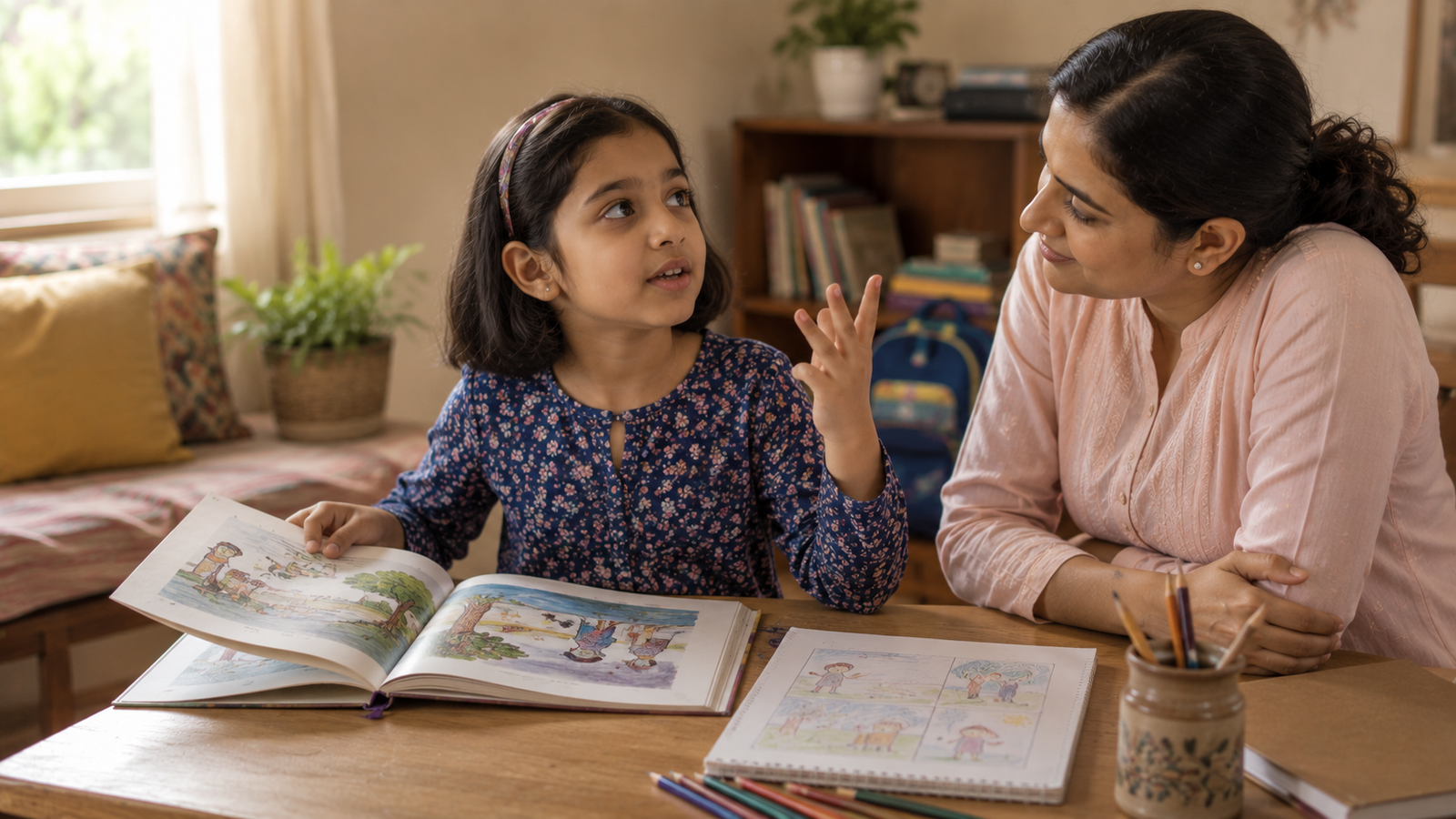
Familiar objects make inviting conversation starters because they give the child something concrete to notice and the adult something real to explain. A discussion can move naturally from “What is it?” to “Who uses it?”, “What is it made from?”, or “Did you have one when you were young?”
Responsive back-and-forth exchanges support early language development, especially when adults notice what interests a child and add words without taking over. Harvard’s Center on the Developing Child calls this “serve and return.” India’s National Curriculum Framework also recognises the role of grandparents, home languages, local stories, food, festivals, and everyday experiences in children’s learning.
The Diya: A Word Lit by Celebration
Suppose a child finds a clay diya while festival decorations are being unpacked.
Instead of simply saying, “This is a diya,” an adult might ask:
“Where have you seen one before?”
“Is this made from the same material as the brass lamp?”
“Did your Thatha’s family light diyas when he was young?”
A grandparent may remember buying unpainted lamps from a market. A parent may describe arranging them safely. The child may notice the wick, oil, flame, and shape.
The word now connects to related vocabulary: clay, brass, cotton, glow, prayer, decorate, extinguish.
Different families may connect the diya with different occasions and practices. That variation is valuable. It shows the child that culture is lived in many ways rather than copied from one universal script.
A gentle prompt can keep the child at the centre:
What do you notice about this diya that you did not notice before?
The memorable part may not be the definition. It may be a grandparent saying, “When I was your age, we carried every lamp to the terrace before sunset.”
The Tiffin: A Word Packed With Everyday Care
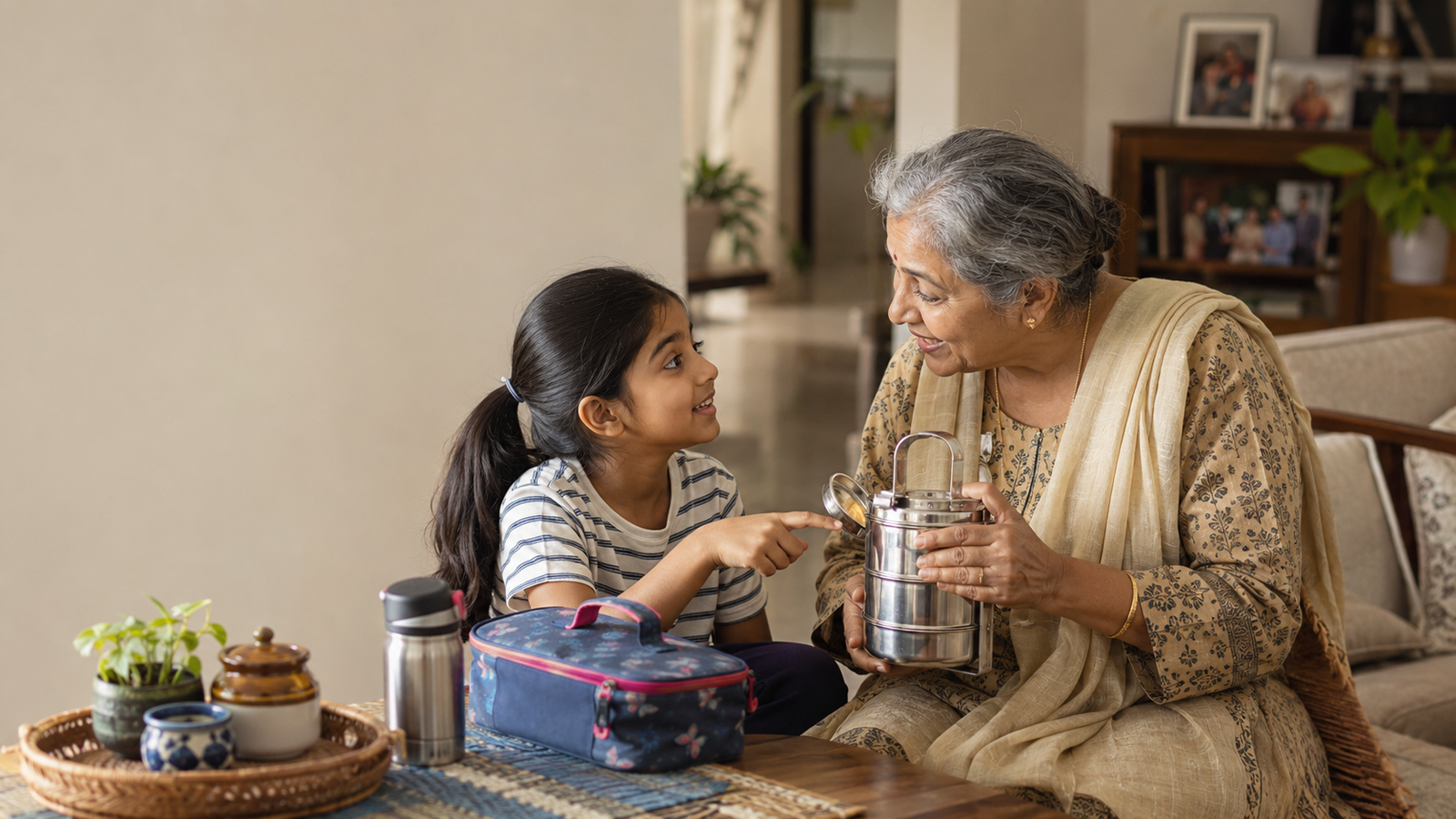
The tiffin box rarely looks like a “cultural object.” Yet it can prompt a history of ordinary family life.
“What do you carry in your school tiffin?”
“What did Nani take when she was at school?”
“Why do some boxes have several compartments?”
A child may compare a modern lunch box with a parent’s steel dabba or a grandparent’s stacked carrier. The conversation can move towards food names, textures, school routines, and small acts of care.
A grandmother may remember exchanging lemon rice for a friend’s paratha; a father may recall sambar leaking into his school bag. Words such as compartment, lid, leak, and share become part of the story.
Families may also use the word tiffin differently. Instead of deciding immediately which usage is correct, ask:
“What does tiffin mean in our home? Does your friend’s family use it differently?”
The child begins to see that words may shift according to family, region, language, and context.
The Matka: A Word Shaped by Summer
A matka invites the hands as much as the eyes. Its surface may feel grainy or cool, and it may smell faintly of wet earth.
Begin with description:
“What is it made from?”
“Who might make it?”
“Why would a family keep water in it?”
A grandparent may recall summer afternoons before a refrigerator became part of the home, while the child may know a matka only from a picture.
The basic science is simple: unglazed clay contains tiny pores. A little water reaches the outside and evaporates, carrying away heat and helping cool the water inside. Airflow and humidity affect how well this works.
But the richer conversation may be:
“What has changed since your childhood?”
“Where might people still use a matka?”
“Who shaped and fired the pot?”
“Would the water taste or feel different from refrigerated water?”
One object now connects vocabulary with season, craft, texture, science, and change.
The Dhol: A Word That Arrives With Sound
Some objects are best remembered through action. A dhol suggests rhythm, movement, volume, anticipation, and community.
A child may have heard one at a wedding or festival; a grandparent may remember another instrument from a different region.
Try asking:
“What does the rhythm make you feel?”
“How do you think the musician changes the sound?”
“Can you copy the beat on the table?”
The child can tap, listen, describe, and compare. Related words arise naturally: beat, rhythm, musician, procession, loud, soft, fast, slow, celebrate.
This is also a chance to avoid presenting Indian culture as one identical set of customs. Families from different regions may use different drums, names, and traditions.
Ask:
“What instruments have you seen where our family comes from?”
That question can lead to a conversation about a village celebration, a wedding procession, a school performance, or music heard during a family journey.
Grandparents Bring More Than Definitions
Grandparents often remember the life around an object: who used it, how it sounded, what went wrong, or what everyone laughed about. They may add a regional word, an older routine, or a comparison with newer versions.
A steel container is no longer only a container when a grandfather remembers carrying it on a long train journey. A hand fan becomes more interesting when a grandmother describes using one during a power cut. A weighing scale at a vegetable market may prompt a story about shopping before packaged produce became familiar.
The National Curriculum Framework recognises extended family and locally rooted language, stories, festivals, music, and everyday life as part of children’s learning environment.
Not every child sees a grandparent regularly. Some live far away, speak another language, or are not available. The same activity can happen through:
a video call;
a short voice note;
a recorded family story;
an older relative;
a trusted family friend;
a parent retelling a memory heard during childhood.
A two-minute prompt may be enough:
“Show Nani the matka picture and ask what she remembers.”
The purpose is connection, not a perfect family arrangement.
Try This: One Object, Three Generations
Choose one familiar object. It may be physically present, shown in a photograph, or represented on a picture card.
Let the child look closely and guess what it is or how it is used. Then invite a parent, grandparent, or older relative to share one memory connected with it.
Compare past and present without declaring one better:
What stayed the same?
What changed?
Does the family use another word for it?
Would the child use it in the same way today?
Ask only a few prompts:
What do you notice first?
Who might use this?
What does it remind you of?
Is there another word for it in our family?
What has changed since you were a child?
Can you tell the story back in your own way?
The child can retell the memory, draw the object, or add an imaginary detail. The activity should feel like a conversation, not a test.
A child does not need to remember every new word immediately. Hearing the word again in another story or situation gives it another meaningful connection.
When the Actual Object Is Not Nearby
Families will not always have a dhol, matka, or older household object within reach. A clear picture can still provide the visual starting point.
That is where Everyday Bharat Objects can fit naturally. A card can sit between child, parent, and grandparent so everyone can observe the same image, notice different details, and contribute a word or memory.
Move beyond “What is this?”:
Where might we find it?
What is it made from?
Who uses it?
What sound, smell, or memory belongs with it?
Does our family use another name?
How was it used earlier?
Can we create a story involving it?
Everyday Bharat Objects | Flashcards, Level 1 can serve as an entry point for families beginning these object-led conversations. The current listing describes 40 double-sided cards and six ways to use the set.
Everyday Bharat Objects | Flashcards, Level 2 is a separate set of 40 double-sided cards with six gameplay variations, extending the range of objects and discussions available.
The Everyday Bharat Objects | Levels 1 & 2 Combo combines both levels into an 80-card collection. It may suit families who want a wider pool for repeated conversations, sorting, comparison, recall, and storytelling, although every family does not need to begin with both.
The additional related link supplied for this article could not be reliably identified as part of the Everyday Bharat Objects family, so it has been omitted.
Treat the cards as invitations rather than tests. Children can notice, describe, ask, compare, remember, and imagine.
One Object, Many Languages
In a multilingual home, one object may collect several names.
A container may be called a tiffin box, dabba, or another family term. A clay water vessel may have a name used by one grandparent but not another. The child may know the English name from school and a different one from home.
This is not confusion to eliminate. It is material for conversation.
The National Curriculum Framework encourages children to express themselves through home and familiar languages, while the American Speech-Language-Hearing Association notes that using multiple languages does not itself cause speech or language delay.
Ask:
“Which word do we use at home?”
“What does Paati call it?”
“Have you heard another name?”
“Does it look or work differently in another region?”
The objective is not to memorise translations. It is to notice that language carries place, relationships, and experience.
A child may answer in one language, borrow a word from another, and retell the story in a third. The conversation can remain meaningful even when every family member does not use exactly the same vocabulary.
Frequently Asked Questions
How do everyday objects help children learn new words?
Objects give vocabulary a visible form and practical context. A child can connect the name with its material, use, location, sound, texture, and family memory. Talking about pictures, familiar objects, and family stories is commonly recommended as a way to support oral language and vocabulary.
What questions can grandparents ask during vocabulary activities?
Begin with concrete prompts: “What do you notice?”, “Where have you seen this?”, “What might it be used for?”, and “Does our family have another word for it?” A grandparent can then share one short memory and invite the child to ask a follow-up question or retell the story.
Can this activity work in multilingual families?
Yes. Family members can discuss the object in the languages they use most comfortably. The child can compare terms without memorising every translation. Home-language conversations can provide a strong foundation for communication and additional language learning.
How can picture flashcards be used for storytelling rather than memorisation?
Ask where the object came from, who might use it, what happened before the pictured moment, or what problem it could solve. Add a family memory, combine several cards into a story, or let the child narrate from the object’s point of view.
The Story Inside the Word
Vocabulary is more than a collection of labels.
A word can carry the roughness of clay, the click of a tiffin lid, the pulse of a drum, or the glow of a lamp remembered by someone who was once a child too.
Cultural connection does not always require a formal lesson. It can begin when an adult pauses over an ordinary object and says, “We had one of these when I was young.”
The child may forget a neat definition. The story about a leaking tiffin, a summer matka, or a row of diyas on an old terrace may remain – and the word may remain with it.
Choose one object today and see where the conversation goes. Everyday Bharat Objects is one way to create more of these moments, but the first prompt may already be sitting somewhere in your home.
References
National Council of Educational Research and Training.NCERT Foundational Stage FrameworkNational Curriculum Framework for the Foundational Stage 2022. The framework discusses family participation, grandparents, home languages, local cultural contexts, storytelling, and vocabulary development.
Center on the Developing Child at Harvard University.Serve and Return: Back-and-Forth Exchanges.
American Speech-Language-Hearing Association.Learning More Than One Language.
Reading Rockets.25 Activities for Reading and Writing Fun. The resource recommends family memories, grandparent stories, photographs, and conversations about special occasions.
Reading Rockets.Oral Language Comprehension: Activities for Pre-K Children.
Wired.This Ancient Technology Is Helping Millions Stay Cool. The article explains the evaporative-cooling principle used by porous clay matkas.