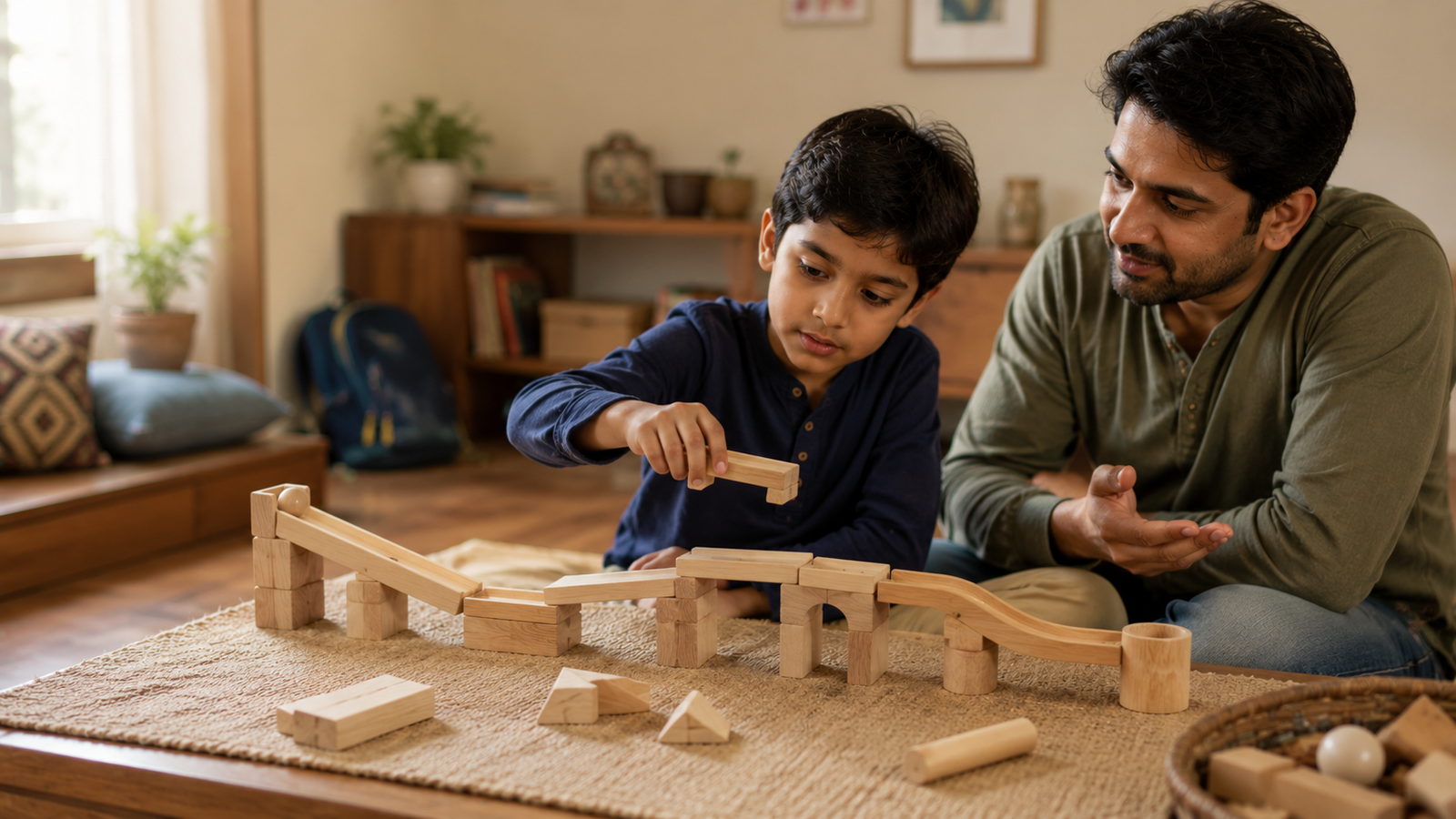
Parents want to understand why their child forgets steps, completes tasks in a random order, or struggles to explain why something happened. They are also looking for practical ways to strengthen sequencing, reasoning, and cause-and-effect thinking.
Quick Summary
Sequencing is the ability to place actions, events, or ideas in a meaningful order.
Cause-and-effect thinking helps children understand why something happened and what may happen next.
These skills support routines, instructions, reading, writing, maths, reasoning, and decision-making.
Parents can build them through everyday conversations, practical routines, stories, and picture-based activities.
A child who brushes before putting toothpaste on the brush, explains that a plant grew “just like that,” or begins a maths problem without identifying the steps may need more practice with sequencing. Sequencing means understanding what comes first, next, and last. Cause-and-effect thinking means recognising why something happened and what followed. Together, these skills help children organise information, follow instructions, reason through problems, and explain decisions. This article shows how parents can recognise common difficulties and use simple sequencing activities for kids aged 4-10 at home.
Sequencing Is More Than a Story Skill
Parents often notice sequencing difficulties in ordinary moments:
“Why did you wear your shoes before your socks?”
“I asked you to pack your book, bottle, and lunch box. Why is only the bottle in the bag?”
“What happened after the water spilled?”
A child may know each individual action but struggle to hold the full sequence in mind. They may start with the most interesting step, forget the middle, or act before thinking through what must happen.
This is not necessarily carelessness. Following a sequence requires attention, working memory, language, and planning. These abilities are still developing throughout childhood.
The Harvard Center on the Developing Child describes executive-function skills as helping people plan, focus attention, switch gears, manage information, make decisions, and plan ahead. Children develop these abilities through supportive interactions and repeated, age-appropriate practice. (Harvard Center on Child Development)
Story sequencing does not train every aspect of executive function. However, asking a child to observe events, remember them, arrange them, and explain the logic provides useful practice in organising information before responding.
What Do Sequencing and Cause and Effect Mean?
Sequencing: Putting Information in Order
Sequencing is the ability to arrange actions, events, instructions, or ideas according to time or logic.
Some sequences have a fixed order:
Put toothpaste on the brush.
Brush the teeth.
Rinse the mouth.
Other sequences describe change over time: a seed is planted, watered, sprouts, and grows leaves.
Sequencing also appears in recipes, classroom instructions, writing, science observations, and mathematical procedures.Reading Rockets notes that placing events or steps in logical order is useful across the curriculum, including when children solve maths problems. (Reading Rockets)
Cause and Effect: Connecting Reasons and Results
A cause explains why something happens. An effect is what happens as a result.
Water was spilled on the floor, so someone slipped.
Understanding this relationship helps a child move beyond “What happened?” towards “Why did it happen?” and “What might prevent it next time?”
A result may also have more than one possible cause. A plant may droop because it needs water, receives too little sunlight, or has damaged roots. Considering different possibilities supports observation and flexible reasoning. Everyday experiments and conversations can make these relationships easier for children to understand. (Reading Rockets)
Why These Skills Matter
Routines and Instructions
Getting ready for school involves connected steps: bathing, dressing, eating breakfast, packing the bag, wearing shoes, and leaving on time.
A child who understands sequence can anticipate the next action and complete more of the routine independently. Multi-step instructions also become easier when the child learns to pause, repeat the steps, and follow them in order.
Reading, Storytelling, and Writing
Stories make sense because events connect. Something happens, a character responds, and that response creates a new situation.
Identifying a beginning, middle, and end can support comprehension and retelling. In writing, sequencing helps children organise sentences without jumping randomly between ideas. Recalling events in order also helps children understand story structure and communicate more clearly. (Reading Rockets)
Maths and Problem Solving
Many maths tasks require an orderly process: understand the question, identify the information, choose an operation, solve it, and check the answer.
India’s National Curriculum Framework for the Foundational Stage describes problem solving as understanding the problem, devising a strategy, taking the correct steps, and checking the solution. It also includes observation, logical thinking, and understanding cause-and-effect relationships within children’s cognitive development.
The framework also recommends flexible, play-based and activity-based learning that includes logical thinking and problem solving, rather than relying only on rote recall.
Reasoning and Decision-Making
Sequencing helps children imagine consequences before acting:
“If I leave my project until morning, I may not have enough time.”
“If I push ahead in the queue, someone may fall.”
Young children will not always make the sensible choice, but these conversations give them a structure for discussing actions, outcomes, and alternatives.
Signs Your Child May Benefit From Practice
Your child may need additional support if they frequently:
forget the middle step of a familiar routine;
begin before hearing the full instruction;
complete steps in a random order;
struggle to explain how something happened;
confuse the cause with the result;
find multi-step word problems overwhelming.
These behaviours can also arise from tiredness, distraction, unfamiliar vocabulary, or instructions that are too long. Begin by reducing the number of steps and checking that your child understands them.
Five Simple Sequencing Activities for Kids
1. Narrate a Familiar Routine
Choose brushing teeth, packing the school bag, making nimbu pani, or preparing for bed.
Ask your child to explain the steps using “first,” “next,” “then,” and “last.” Place one step incorrectly and let the child spot the mistake.
Familiar home routines are useful starting points because the child already understands the activity and can focus on organising it. (Reading Rockets)
2. Build Multi-Step Instructions Gradually
Begin with two steps:
“Put the book on the shelf and bring your water bottle.”
Ask the child to repeat the instruction before acting. Add a third step only when two are manageable.
Keep the wording clear. A long sentence may test vocabulary and memory as much as sequencing.
3. Explore Cause and Effect at Home
Use safe, visible examples:
an ice cube left outside the freezer;
a plant that is not watered;
a wet cloth placed in sunlight;
toys left across a walking path.
Ask, “What do you think will happen?” and later, “What caused that result?”
Real examples make cause and effect easier to understand than definitions alone. Similar observation-based activities can also support early scientific thinking. (Reading Rockets)
4. Arrange Picture Sequences
Use three to five pictures showing planting a seed, cleaning a room, helping a grandparent, or preparing festival decorations.
Ask:
What comes first?
Why must this happen before that?
What changed?
Could any steps be swapped?
The final question teaches children that some sequences are fixed while others allow more than one sensible order.
5. Solve Problems Aloud
For a puzzle or maths word problem, encourage your child to ask:
What do I know?
What do I need to find?
What should I do first?
How can I check my answer?
Offer a small prompt instead of giving the complete method immediately. This helps the child practise organising their own approach.
Age-Wise Guidance
Ages 4-5
Focus on two- or three-step routines and clear picture sequences.
Children can begin using words such as “first,” “then,” and “last” and identifying simple causes:
“The glass fell because it was pushed.”
Use familiar situations and accept short explanations.
Ages 6-7
Introduce four- or five-step sequences, simple written instructions, and stories with a clear problem and outcome.
Ask why the order matters and what may happen if a step is skipped. Children can also begin checking their work against the original sequence.
Ages 8-10
Use sequencing for writing, maths, science, and decision-making.
Children can compare solution methods, explain multiple causes, identify short- and long-term effects, and justify why a particular order works.
A Visual, Screen-Free Way to Practise
Picture-based flashcards can make sequencing easier because children can observe, arrange, reconsider, and explain ideas visually.
LernZeit Creations’ Storytelling & Sequencing Flashcards use five-card story sets to help children practise what comes first, next, and last. Parents can extend each sequence by asking:
Why did this happen?
What changed?
What might happen next?
Could the story end differently?
The activity combines screen-free learning with parent-child conversation. A younger child can arrange and name the pictures, while an older child can discuss motives, consequences, alternative orders, and possible solutions.
The cards are one practical support, not a substitute for routines, shared reading, outdoor observation, or classroom learning. They provide a concrete structure for practising logical explanation through play.
Frequently Asked Questions
Is Forgetting Instructions Always a Sequencing Problem?
No. A child may not have heard the instruction, understood the vocabulary, or remembered too many steps.
Gain the child’s attention, shorten the instruction, and ask them to repeat it before deciding that sequencing is the main difficulty.
Should Every Activity Have One Correct Order?
No. Some routines have a necessary order, while other tasks allow several sensible approaches.
Ask your child to explain why their chosen order works. When several solutions are possible, the reasoning matters more than matching the adult’s answer.
How Often Should We Practise?
A few minutes within daily routines is enough to begin.
Repeated conversations while dressing, cooking, reading, travelling, or tidying are often more useful than one long formal lesson.
Key Takeaways
Sequencing helps children organise actions, information, and ideas.
Cause-and-effect thinking connects decisions with outcomes.
Routines, instructions, maths, writing, and problem solving all rely on ordered thinking.
Begin with short, familiar sequences and increase the complexity gradually.
Picture-based and real-life activities can make logical thinking visible and playful.
References
Center on the Developing Child at Harvard University.A Guide to Executive Function. (Harvard Center on Child Development)
Center on the Developing Child at Harvard University.Activities Guide: Enhancing and Practising Executive Function Skills. (Harvard Center on Child Development)
Reading Rockets.Story Sequence. (Reading Rockets)
Reading Rockets.Cause and Effect. (Reading Rockets)
Reading Rockets.Teaching Sequence. (Reading Rockets)
National Council of Educational Research and Training.National Curriculum Framework for the Foundational Stage 2022.