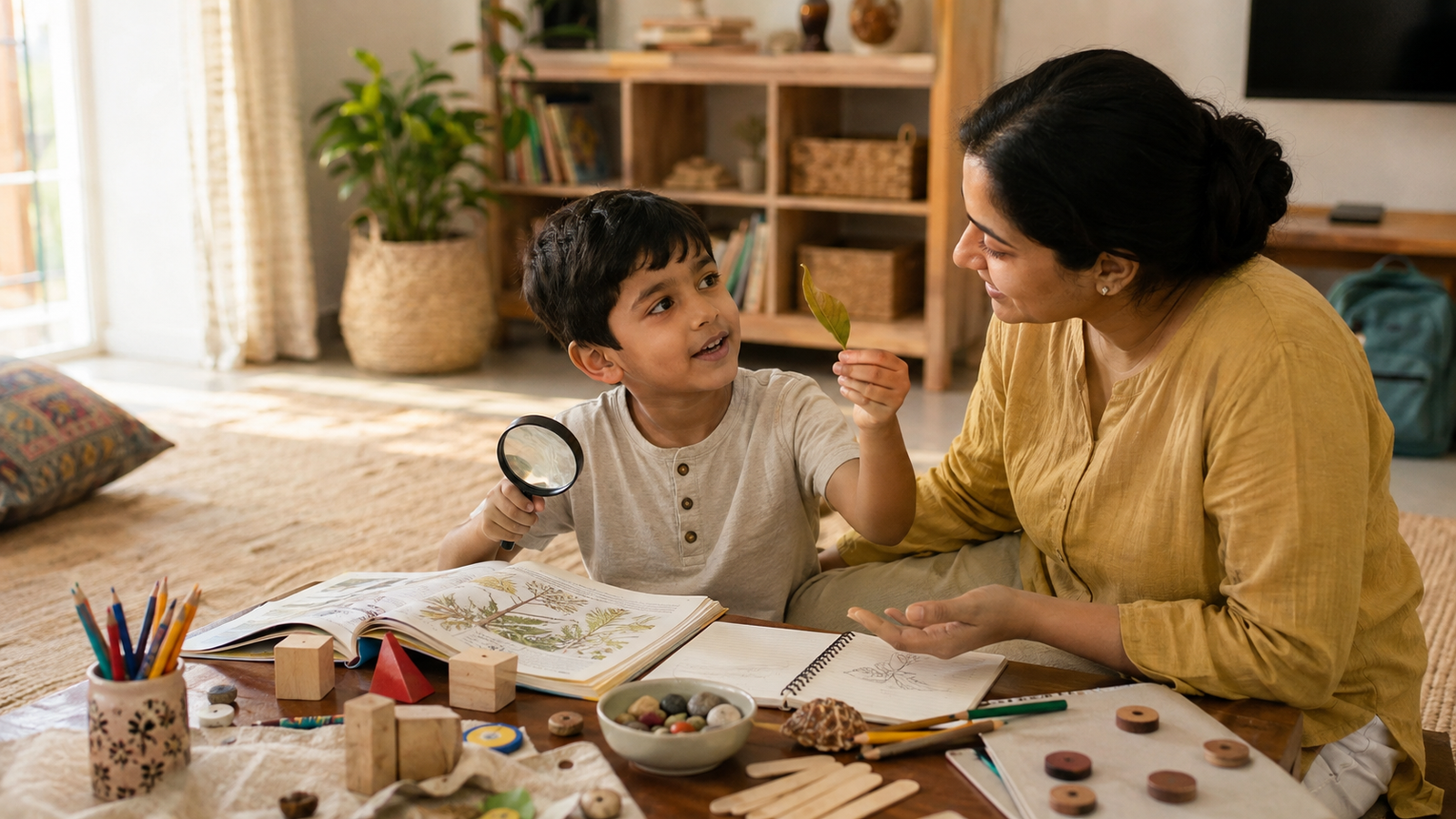
One child reaches home after a long school-bus journey. Another returns from tuition shortly before dinner. A parent is finishing a work call. A grandparent has the evening news on. One sibling is doing homework while another wants company. A pressure cooker whistles in the kitchen, the tiffin boxes are still packed, and the television remote is already within reach.
There is no single “typical” Indian evening. Advice such as “replace screens with quality family time” can ignore commutes, work, homework, dinner and the energy everyone has left.
The Evening Thali offers a more flexible way to think about this. Just as families assemble meals according to appetite, time, season and preference, they can assemble an evening from a few small components rather than follow one ideal schedule.
The aim is not to create a perfectly screen-free evening. It is to make screens only one possible part of the evening—not the automatic centre of it.
How can Indian parents create calmer screen-free evenings? Families can combine a predictable household anchor, a little decompression, one genuine conversation, a simple shared game, a light learning moment and enough unstructured time. Not every component has to appear every day.
Before Building the Thali, Notice What the Screen Is Doing
Evening screen use often serves a practical purpose.
For a child, it may provide predictable entertainment, relief after school, privacy from questions or an easy activity when outdoor play is not possible. For a parent, it may create time to cook, finish work, manage siblings or pause after a demanding day.
Neither side needs to be blamed.
A replacement works better when it addresses the need that the screen was meeting.
A tired child may need quiet rather than a language game. A parent who needs time to cook may need something the child can continue independently. Restless siblings may need a shared challenge; a child who needs movement may not be ready to sit at all.
Ask: What is difficult about this part of our evening? The answer helps determine which portions to include.
The Evening Thali
The Base: Predictable Anchors
The base is not an educational activity. It is one or two events that happen in a familiar order.
In one home, this may mean putting away shoes and the school bag, washing hands and having water. In another, it may mean changing clothes before unpacking the tiffin.
The parent does not need a minute-by-minute timetable. The useful question for the child is:
“What normally happens when I come home?”
A familiar anchor reduces the number of decisions and negotiations at the most tired part of the evening.
A realistic parent line might be:
“First, let us settle in. After your snack, you can choose what kind of evening you need.”
Routine will not remove every protest, but it gives the evening a recognisable start.
The Cooling Space: Let the Child Arrive Emotionally
Reaching home physically does not mean the child has fully left the school day behind.
The Cooling Space may involve eating quietly, changing clothes, drawing, listening to music, brief movement or doing nothing structured for a while.
Parents often ask several questions at once:
“How was school? Did you finish your lunch? What homework do you have? Why are you so quiet?”
A gentler entry is:
“You can settle first. Tell me something when you are ready.”
Decompression can make later conversation and play feel more voluntary. Its length will vary.
The Conversation Portion: Move Beyond “How Was School?”
Many children answer “How was school?” with “Fine”, “Nothing” or “I don’t know”. The question is broad, and the child may not know where to begin.
A smaller shared prompt can create an easier doorway.
One Situation, Many Voices
Place one picture-based situation where everyone can see it. Each person contributes only one thing: an observation, question, possible explanation, feeling, prediction or suggestion.
Imagine a picture of a child helping an older person carry something.
Child: “The bag looks heavy.”
Parent: “Why might the older person need help?”
Sibling: “What could happen if the child pulls too quickly?”
Grandparent: “How else could they carry it safely?”
Learn to Ask Questions Flashcards can support this exchange with a relatable situation to inspect. The child can observe, wonder, disagree or add another perspective without producing a school report.
The goal is not to complete every who, what, where, when, why and how prompt. One genuine question is enough.
The Play Portion: Give the Evening a Small Game
An evening game does not need a large board, a winner or lengthy adult attention. It needs a clear challenge and permission to be playful.
The Story Shuffle
Place a small visual sequence on the floor or table. The family might arrange the pictures, deliberately mix them up, hide one card or invent an unusual ending.
One person can defend a surprising order; another can narrate from a different viewpoint. Siblings can build the story together.
Storytelling & Sequencing Flashcards suit evenings when the child wants to touch, move, arrange and narrate instead of completing another formal language exercise.
The parent might join briefly and then step away. Once familiar, the child may set it up independently.
Stop while it still feels like play. The family does not have to complete every sequence.
The Shared-Learning Portion: Keep Learning Light
Shared learning can be meaningful without recreating school. It may be as small as naming one word, describing an object, sorting pictures, hearing a memory or building one sentence.
One Object Around the Family
Choose a picture of a familiar Indian object. Each person contributes something different.
The child may name or describe it. A parent may explain where it is used. A grandparent may share another word for it or a personal memory. A sibling may place it into a category. The child may add it to a sentence or tiny story.
Everyday Bharat Objects can provide a visual starting point for vocabulary, comparison, multilingual discussion and family memories. The value is not in delivering a cultural lecture. It is in allowing the picture to open a natural exchange.
Follow the child’s curiosity. Comparing an older object with a modern one or simply recalling where it was seen can both be enough.
The Open Space: Do Not Programme the Whole Evening
A balanced evening also needs time without measurable learning: free play, movement, drawing, books, sibling talk, a walk or doing nothing for a while.
Small household tasks—placing spoons, watering plants or matching lunch-box lids—can create participation and conversation. Children should not carry adult responsibilities; ordinary family life can simply hold connection.
Not every meaningful part of childhood needs to be packaged as a learning activity.
Three Sample Evening Thalis
These are illustrations, not schedules.
Thali One: The Tired Weekday
After a long day, the Base might be a snack and change of clothes. The Cooling Space may take most of the time. The shared portion could be one Everyday Bharat Objects card and a three-minute conversation:
“What does this remind you of?”
The child then moves into independent play or rest. Three to five minutes of genuine interaction may be enough.
Thali Two: The Multigenerational Evening
With an older relative present or on a call, the family chooses one object picture, collects one home-language word, hears a memory and invites one child-generated question.
Everyday Bharat Objects and Learn to Ask Questions can support the exchange, but the real value comes from the different voices around the picture.
Grandparents may contribute humour, work, travel, current technology or changing household habits—not only tradition.
Thali Three: The Sibling Game Evening
Children of different ages begin with a Story Shuffle. One arranges, another asks questions, and both contribute to the ending before extending it through drawing or acting.
Storytelling & Sequencing and Learn to Ask Questions can overlap naturally here. The parent may simplify roles so that one child chooses while the other narrates.
The aim is collaboration, not equal performance.
Multilingual Indian Homes: Let Ideas Come Before Perfect English
Evening conversation may move naturally between languages.
A child may learn in English at school, speak another language with grandparents and mix languages with siblings. They may know an object’s name in one language but not another.
Allow the child to explain an idea in the language that comes most easily. The family can then compare names, ask for a regional word or model the English term afterward.
A child might tell most of a story in a home language and use a few new English words. That is still meaningful participation.
The immediate goal is communication. A fuller English sentence can be modelled after the idea is expressed. Multilingualism is part of how many families communicate and learn.
Family Screen Realities
Adults may need phones for work, school messages or video calls. A television may be used for news or entertainment. Older children may have online homework.
A calmer evening does not require every device to disappear.
Families can distinguish purposeful from automatic use, create one device-light window and say clearly when viewing will happen. Occasional exceptions do not erase the pattern.
Children notice family patterns more than family slogans.
Necessary phone use need not be hidden. Honest language is more useful:
“I need ten minutes to finish this work call. You can choose your cards or play nearby, and then I will join you.”
Do Not Overload the Thali
A parent may accidentally pack homework, English, reading, vocabulary, chores and bedtime preparation into one “screen-free” session. The alternative then feels more demanding than the screen.
Choose one or two components:
- one story and free play;
- one question during snack;
- one object conversation while dinner is prepared;
- one sibling game;
- one household task with music;
- no structured activity after a difficult day.
Balance does not mean including everything. It means including enough.
When the Evening Does Not Work
When the Child Refuses Every Activity
Do not create a longer list. Hold the screen boundary calmly and allow rest, drawing, helping nearby or free play.
When the Parent Has No Energy
Use the smallest version: one card, one observation, one question and three minutes together. It is also acceptable to skip the structured portion.
When Homework Takes Over
Do not force another learning activity. Use a brief conversation during snack, dinner preparation or the journey home.
When Adults Disagree About Screens
Parents and grandparents can agree privately on one or two expectations rather than correcting each other in front of the child.
When the Television Is Already On
The evening is not ruined. Choose a clear stopping point and return to the next household anchor.
When the Routine Is Inconsistent
Return to one reliable component rather than rebuilding everything.
A family rhythm becomes familiar through repeated returns, not through perfect daily execution.
Three Visual Prompts for Three Different Evening Needs
When the Family Needs a Better Conversation
Learn to Ask Questions Flashcards can provide situation-based prompts for observation, curiosity, reasoning and shared discussion.
When the Child Wants a Hands-On Story Game
Storytelling & Sequencing Flashcards can provide movable visual stories for arranging, predicting, narrating and changing endings.
When the Evening Needs Something Familiar and Gentle
Everyday Bharat Objects | Levels 1 & 2 Combo can support vocabulary, sorting, multilingual conversation, family memories and cultural context.
Families do not need all three. One set can be rotated with books, photographs, household objects and conversation. Cards do not create calm by themselves; their value comes from how they fit into a realistic rhythm.
Frequently Asked Questions
Do screen-free evenings need to be completely free of television and phones?
No. Families can create one device-light portion while allowing purposeful or planned screen use elsewhere in the evening.
What can parents do when children are too tired for an activity?
Prioritise food, rest and decompression. One card, one question or no structured activity may be the right choice.
How can working parents create a screen-free family window?
Keep it short and attach it to an existing anchor such as snack, dinner preparation or bedtime. The window need not involve constant adult entertainment.
What are simple screen-free activities for siblings of different ages?
Try collaborative sequencing, drawing from one shared prompt, sorting familiar objects or giving each child a different role in the same story.
Can grandparents participate in these evening activities?
Yes, in person or through a call. They can ask questions, add words, share current or past experiences and listen to the child’s story.
How can multilingual families use picture cards without forcing English practice?
Let the child express the idea in a comfortable language first. Compare words or model an English sentence afterward without treating the home language as incorrect.
Build an Evening Your Family Can Recognise
A calmer evening does not require zero screens, a long educational session or cheerful cooperation from everyone. It may contain one familiar anchor, space to recover, one real conversation, a simple game and unstructured time.
The best structure is the one the family recognises and can return to. Choose a base, add one small shared portion and leave enough open space for everyone to breathe. LernZeit Creations’ picture-led prompts can support conversation, storytelling, vocabulary and shared play within this flexible structure.