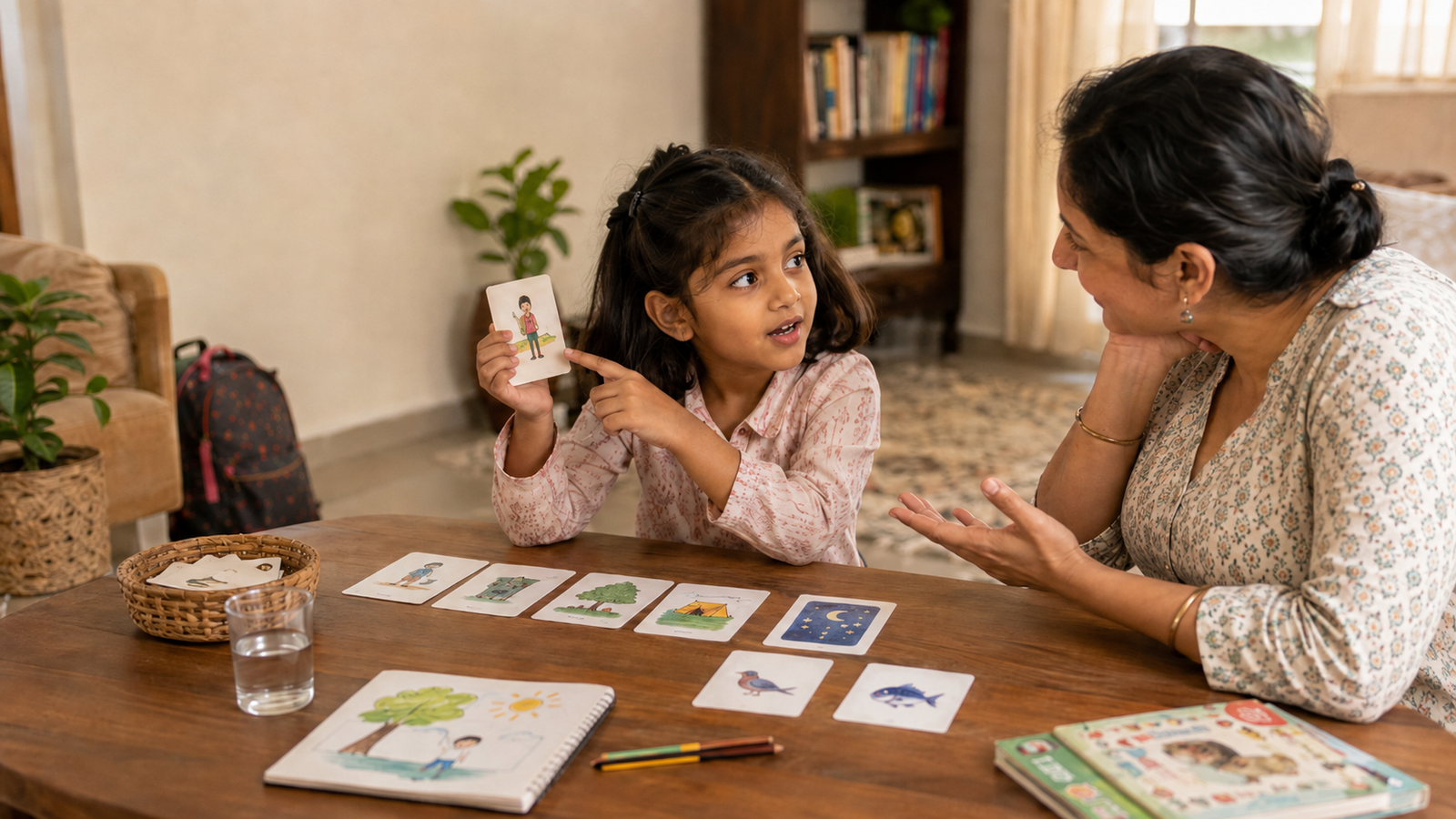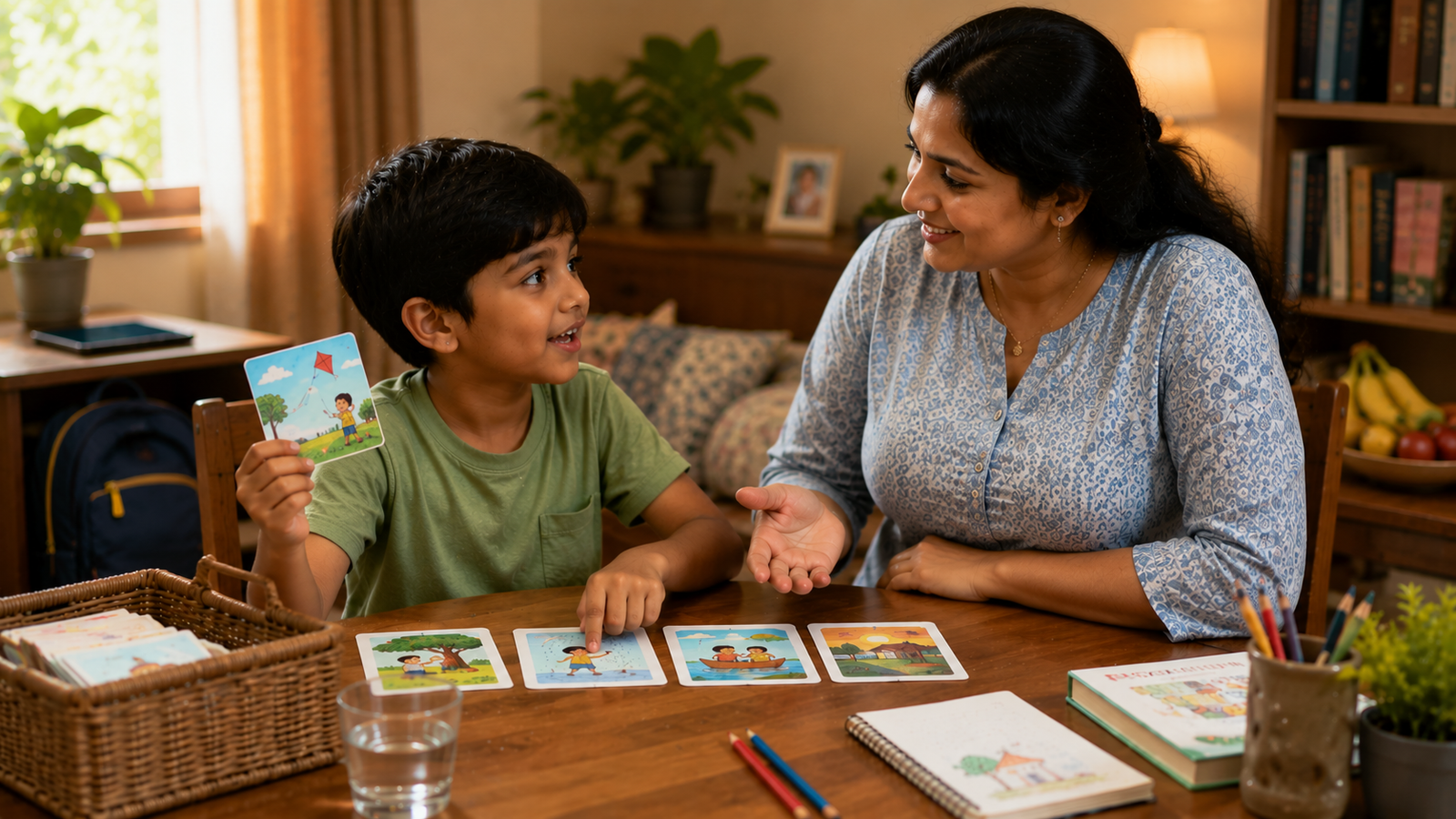
A child sits with one picture card.
Nothing flashes. No character speaks. There is no music, countdown or reward sound. For several seconds, the child simply looks.
The pause may resemble uncertainty or boredom. But the child may instead be searching for a clue, retrieving a word, comparing pictures or deciding how to begin.
Screen-free play can look quieter because more of the activity is happening inside the child’s attention than on the surface of the resource.
Why are flashcards effective screen-free learning tools? Physical picture cards invite children to inspect, remember, move, arrange, question, describe and discuss information at their own pace. The child is not only receiving what appears; they must do something with it.
Not every pause signals deep thinking, and not all digital learning is passive. Simple materials create useful participation when the picture, prompt and child’s freedom to respond work together.
Stimulation and Participation Are Not the Same
Movement, sound and instant feedback can make an experience visibly lively, and many digital resources use them thoughtfully. Yet excitement is not the only sign of engagement.
A physical card leaves many decisions with the child: where to look, where to place it, which detail to revisit and when to answer.
A quiet activity may still be mentally active.
Parents need not fill every silence. Waiting can give the child’s own observation time to appear.
Lens One: The Pause
What the Parent Sees
The child looks at a card without answering immediately. The parent repeats the question, offers a clue or prepares to move on.
What May Be Happening Underneath
The child may be scanning the picture, identifying the action, searching for a word or noticing an expression. They may be deciding whether the important detail is the spilled water, worried face or person approaching to help.
Attention sometimes looks like stillness. A child may also be tired or uninterested, so observe before assuming.
One Prompt That Changes the Play
Instead of immediately asking, “What is this?”, try:
“Take your time. What did you notice first?”
Or:
“Show me one detail before you explain the whole picture.”
Learn to Ask Questions Flashcards offer real-life visual situations with several possible points of interest. The pause becomes useful when the child may inspect before answering.
Lens Two: The Search
What the Parent Sees
The child’s eyes move across several cards. One card is picked up, replaced and picked up again. The child compares two pictures without speaking.
It can look indecisive.
What May Be Happening Underneath
The child may be searching for repeated people, changed objects or evidence of what happened first. A wet floor in one picture may explain a towel in the next.
Visual search involves comparing details across images and deciding which ones matter.
One Prompt That Changes the Play
Ask:
“What changed between these two pictures?”
Then follow with:
“Which detail helped you decide?”
Storytelling & Sequencing Flashcards invite this search across connected scenes. The aim is not only the expected order, but the evidence supporting it.
Lens Three: The Hold
What the Parent Sees
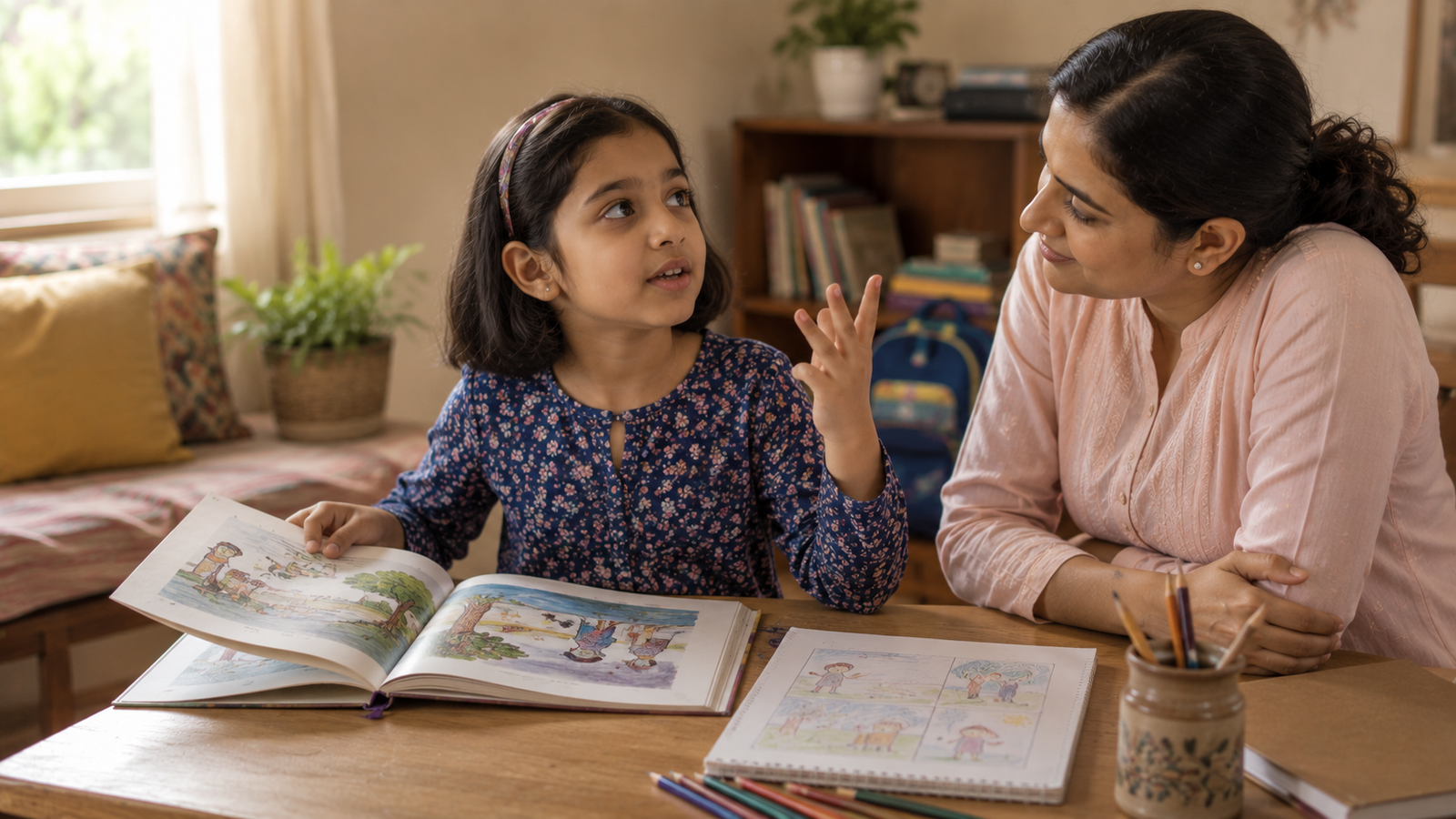
The child turns one card face-down and tries to retell the sequence. A detail is forgotten. The child pauses, checks the card and begins again.
What May Be Happening Underneath
The child may be holding an event order, action, object location, sentence beginning or question in mind.
Memory in play is not always rapid recall. It can involve remembering, checking, correcting and rebuilding. Looking again is part of comparing memory with the picture.
One Prompt That Changes the Play
Try:
“Tell the story without looking, then check what you missed.”
Or:
“Which part was easiest to remember? What made it stand out?”
Storytelling & Sequencing supports remembering connected events; Learn to Ask Questions supports remembering details, problems and unanswered questions. Both lead towards:
Notice → Remember → Question → Connect → Explain
Lens Four: The Choice
What the Parent Sees
The child chooses which card comes first, which question matters most or which ending seems likely.
What May Be Happening Underneath
The child may be comparing possibilities, weighing evidence and considering what a character knows or intends. Even deciding whether a scene belongs at the beginning or middle can require a reason.
Active thinking begins when the child has a choice to make and a reason to explain it.
One Prompt That Changes the Play
Ask:
“Which card would you place first, and what convinced you?”
Or:
“Which question would help us understand the situation best?”
The two card environments overlap naturally. A sequence may prompt, “Who noticed the problem first?” A situation card may become a story once the child imagines what happened before and after.
The emphasis remains on choice and explanation, not correctness alone.
Lens Five: The Tell
What the Parent Sees
The child speaks about the card, but the response is short:
“He fell.”
“Girl helping.”
“They went home.”
“Why is she sad?”
What May Be Happening Underneath
The child is turning visual understanding into language by retrieving vocabulary, choosing an action word, organising events and selecting useful details.
The first response need not contain everything. Spoken language grows through use and conversation, not only correction.
One Prompt That Changes the Play
Child: “The girl is helping.”
Parent: “Yes, the girl is helping the older woman pick up the bag. Why do you think the bag fell?”
The parent models a fuller sentence and opens another line of thought without declaring the first response wrong.
Storytelling & Sequencing can support connected narration. Learn to Ask Questions can support conversational turn-taking and explanations that move beyond the first answer.
One Minute of Card Play, Seen Two Ways
What the Parent Sees
The child studies four cards, moves two of them, pauses, asks why a character is carrying a towel, changes the order and tells the story.
What May Be Happening Underneath
The child is comparing scenes, remembering information, identifying a missing cause, testing a sequence, forming a question, revising a decision and explaining an outcome.
The visible action is small; the thinking may be layered.
Why Physical Cards Change the Interaction
Cards can be picked up, turned, hidden, reordered, grouped and handed over. A child can isolate one image, place two possibilities side by side or physically represent an event order.
Physical cards are not universally superior to digital tools. They offer a different interaction—tactile, flexible and conversational. A discussion about a towel in a picture can shift towards safety, helping another person or a similar incident at home.
Because there is no fixed programme directing the exchange, the adult can respond to the detail that interests the child. The cards provide a starting point, but the conversation remains open.
Conversation Without Performance Pressure
Some educational experiences use points, levels or instant feedback, which can be motivating. Card conversations can provide another kind of space.
A child may say:
“I am not sure.”
“Maybe this happened first.”
“I have another idea.”
“Can I change the ending?”
“This reminds me of our balcony.”
These responses reveal uncertainty, revision, connection and initiative.
Protect this low-pressure quality by resisting the urge to turn every interaction into a speed test or correction exercise. Complete sentences are useful but need not be demanded after every card.
The child may begin with a gesture, one word or an unfinished thought. The adult can model richer language while allowing the original idea to continue.
Won’t the Cards Become Repetitive?
Repetition and sameness are different.
A familiar sequence can be retold from memory, narrated from another viewpoint or given a new ending. A situation card can be revisited to notice another detail, discuss a consequence or imagine what the child would do.
Familiarity can reduce the effort of recognising the picture and create more space for explaining, questioning and imagining.
On the first use, a child may focus on identifying the main action. Later, the child may notice a background detail, question a character’s motive or connect the situation with something that happened at school.
Reuse works best when the prompt changes and the parent stops before the exchange becomes mechanical.
Two Ways to Invite Active Attention
Attention Across Events
Storytelling & Sequencing Flashcards invite children to compare connected pictures, hold earlier events in mind, decide on an order, notice causes and consequences, narrate a sequence and predict or change an ending.
Attention Within a Situation
Learn to Ask Questions Flashcards invite children to study one situation closely, notice people, actions, objects and problems, identify missing information, ask different kinds of questions and consider motives, consequences and perspectives.
The approaches can meet: a sequence can generate questions, and a situation card can become a story with an imagined before and after.
A parent might pause a visual story and ask the child to collect questions before revealing the next event. Alternatively, the child might study one real-life situation and construct a beginning, middle and ending around it.
Families do not need both products. A book illustration or family photograph can also support the same process.
Five Interaction Principles for Parents
Wait a Little Longer
Give the child time to inspect and formulate an idea.
Ask for Evidence
Try “What made you think that?” before marking an answer right or wrong.
Follow the Child’s Detail
When the child notices something unexpected, use it as the next conversational step.
Model, Then Continue
Expand incomplete language naturally and keep the idea moving.
Stop While It Still Feels Enjoyable
There is no need to complete every card in one sitting.
Frequently Asked Questions
Are flashcards too simple for children who are used to screens?
Not necessarily. Simplicity can leave more of the observing, choosing and explaining to the child. The quality of the picture, prompt and conversation matters more than visual complexity alone.
How can flashcards support attention without animation or sound?
A still image can be inspected for details, compared with other pictures and revisited at the child’s pace. Parents can support this by allowing pauses and asking focused, open questions.
Do flashcards help with skills other than memory?
They can provide practice in vocabulary, spoken language, sequencing, prediction, questioning, reasoning and conversation when children are asked to connect and explain ideas.
How can parents keep flashcard play from feeling repetitive?
Reuse familiar pictures with a new viewpoint, question, missing card, alternative ending or personal connection. Stop when the activity begins to feel mechanical.
How long should a screen-free flashcard session last?
There is no fixed duration. A brief, engaged conversation may be more useful than completing every card. Follow the child’s interest and energy.
Simple Does Not Mean Empty
Return to the child looking at the still picture.
The card has not moved, spoken or rewarded the child. Yet the child may have studied it, remembered another image, asked a question, revised an order, built a sentence and heard another perspective.
Simple play still works because the activity is not contained entirely inside the card. It is completed by the child’s attention, language, choices and conversation with another person.
Begin with one picture and one open question. LernZeit Creations’ picture-led resources can help families create more of this active, shared play without making the material more complicated than it needs to be.