Author: lernzeitcreations

  • Why Kids Get Bored of Learning Toys And How to Make One Activity Last Longer

    Why Kids Get Bored of Learning Toys And How to Make One Activity Last Longer

    Parents want to understand why their child quickly abandons educational products and how to make existing learning activities more engaging, reusable, and developmentally useful.

    Why Kids Get Bored of Learning Toys – And How to Make One Activity Last Longer

    Quick Summary

    Children may lose interest when a learning toy offers only one obvious task or fixed answer.

    Repetition supports practice, but it feels fresher when the question, challenge, role, or story changes.

    Choice and social interaction can give familiar materials new value.

    Flexible activities can grow with a child’s language, memory, reasoning, and independence.

    Story cards can support sequencing, speaking, prediction, memory, emotions, and creative storytelling.

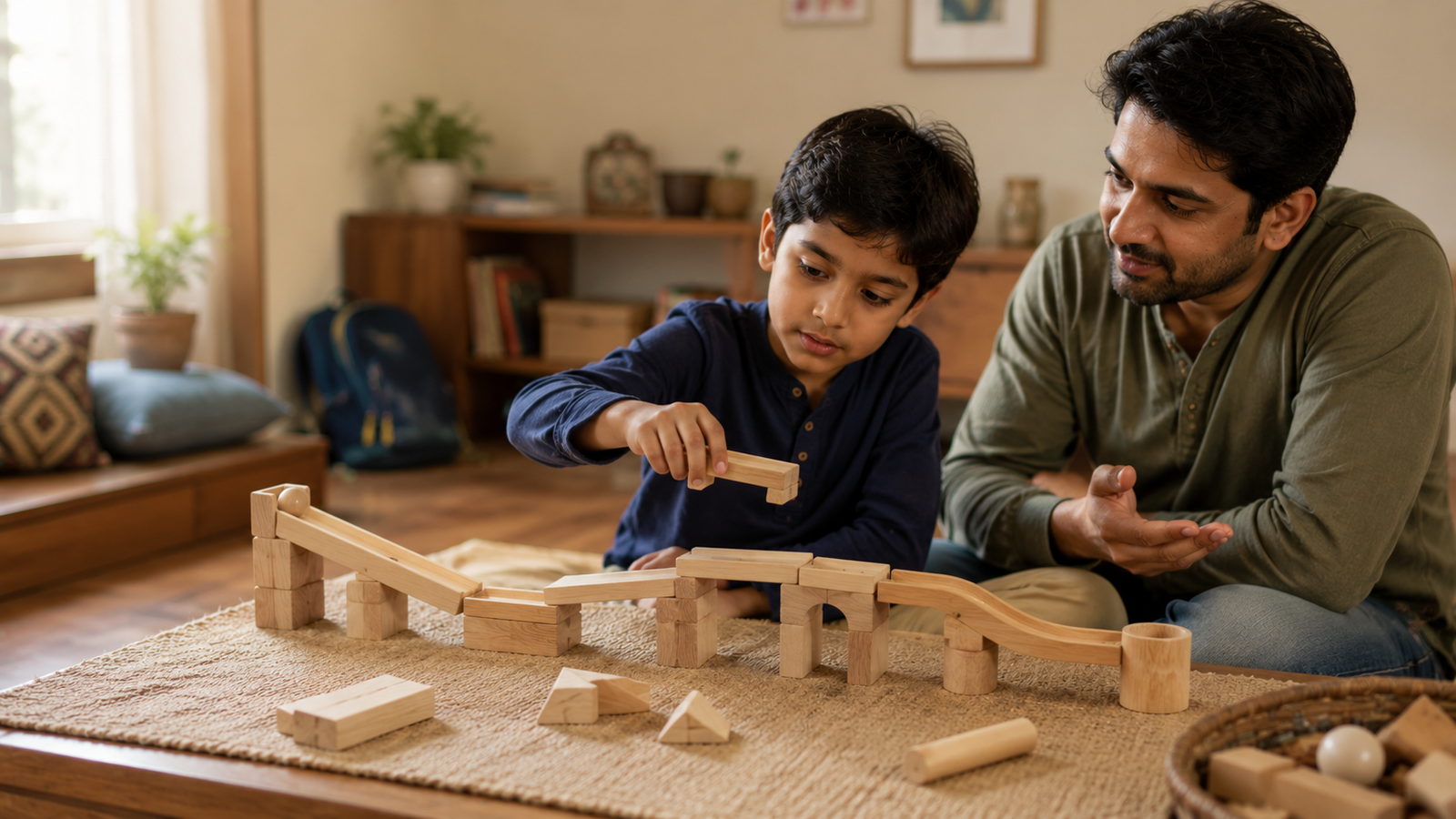
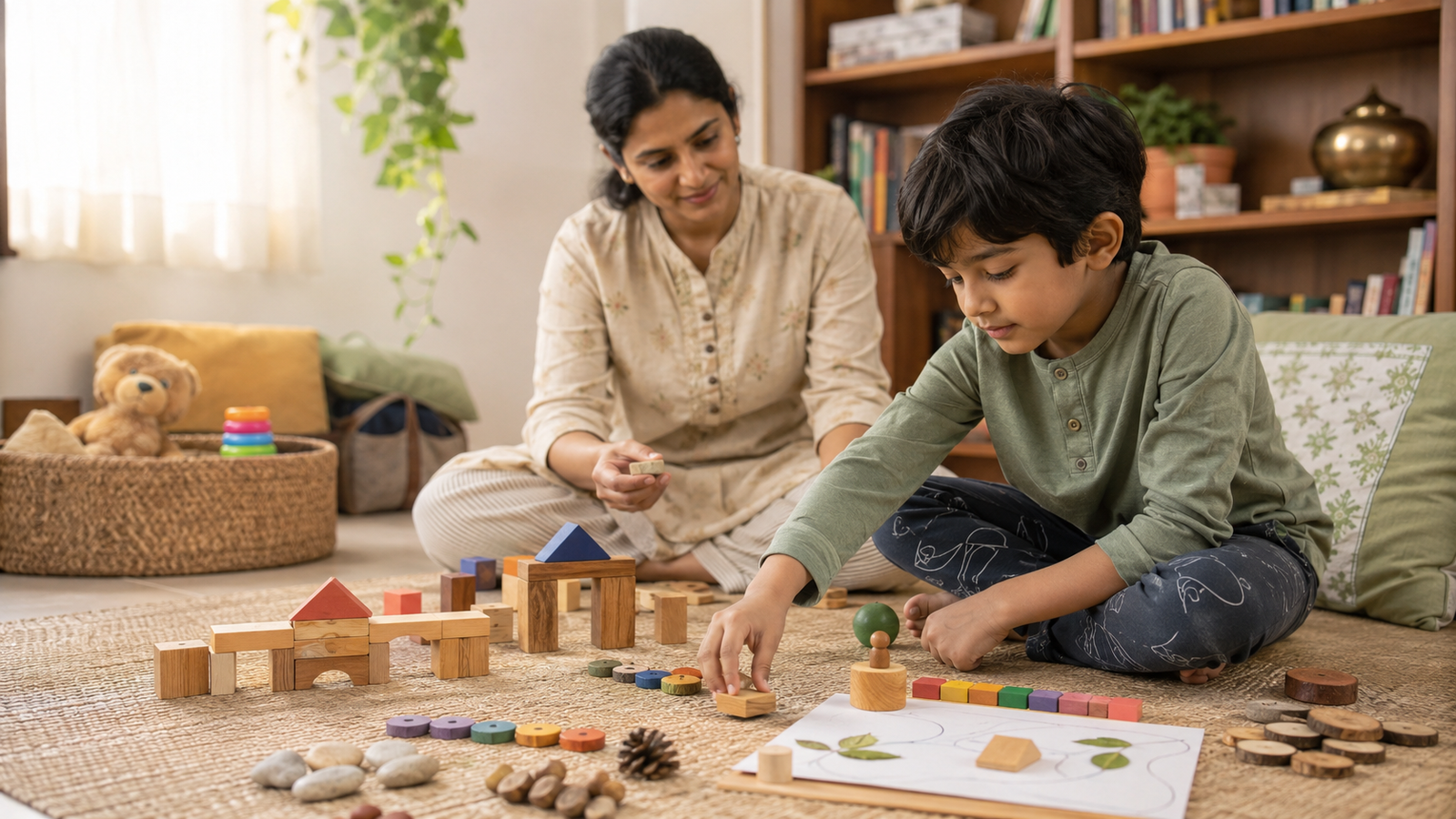
    You buy a learning game with excitement. Your child plays once. Then it sits on the shelf.

    This does not necessarily mean your child dislikes learning – or that you chose badly. Interest often fades when a child quickly discovers the only task or outcome. Children need repetition to practise skills, but repeated play works better when it includes fresh choices, changing challenges, imagination, and conversation. This article explains why boredom happens and how parents can turn one product into several reusable learning activities for kids aged 4-10.

    Why Some Learning Toys Feel “Finished”

    Some educational products have one instruction: match the pieces, name the objects, complete the puzzle, or arrange the cards once. After the child understands the task, there may be little left to explore.

    The problem is not familiarity itself. Familiar materials can be reassuring and useful. The problem is that the activity no longer asks the child to notice something new, make a choice, solve a different problem, or interact with another person.

    Harvard’s Center on the Developing Child recommends offering challenges that are achievable but not too easy, and giving children some agency in how a task is completed. Children are more likely to remain engaged when they have meaningful choices and the level of challenge changes with their capabilities. (Harvard Center on Developing Child)

    So instead of asking, “How do I make my child use this again?”, try:

    “How can the same material invite a different kind of thinking today?”

    Repetition Matters – But It Should Feel Fresh

    Children build many abilities through repetition. They hear words repeatedly before using them confidently, revisit routines before completing them independently, and retell stories before their explanations become clearer.

    Useful repetition, however, does not have to mean doing exactly the same thing. It can involve familiar material with a new goal.

    A UNICEF and LEGO Foundation brief on learning through play describes playful learning as joyful, meaningful, actively engaging, iterative, and socially interactive. Iterative play allows children to practise, try possibilities, revise ideas, and discover new challenges.

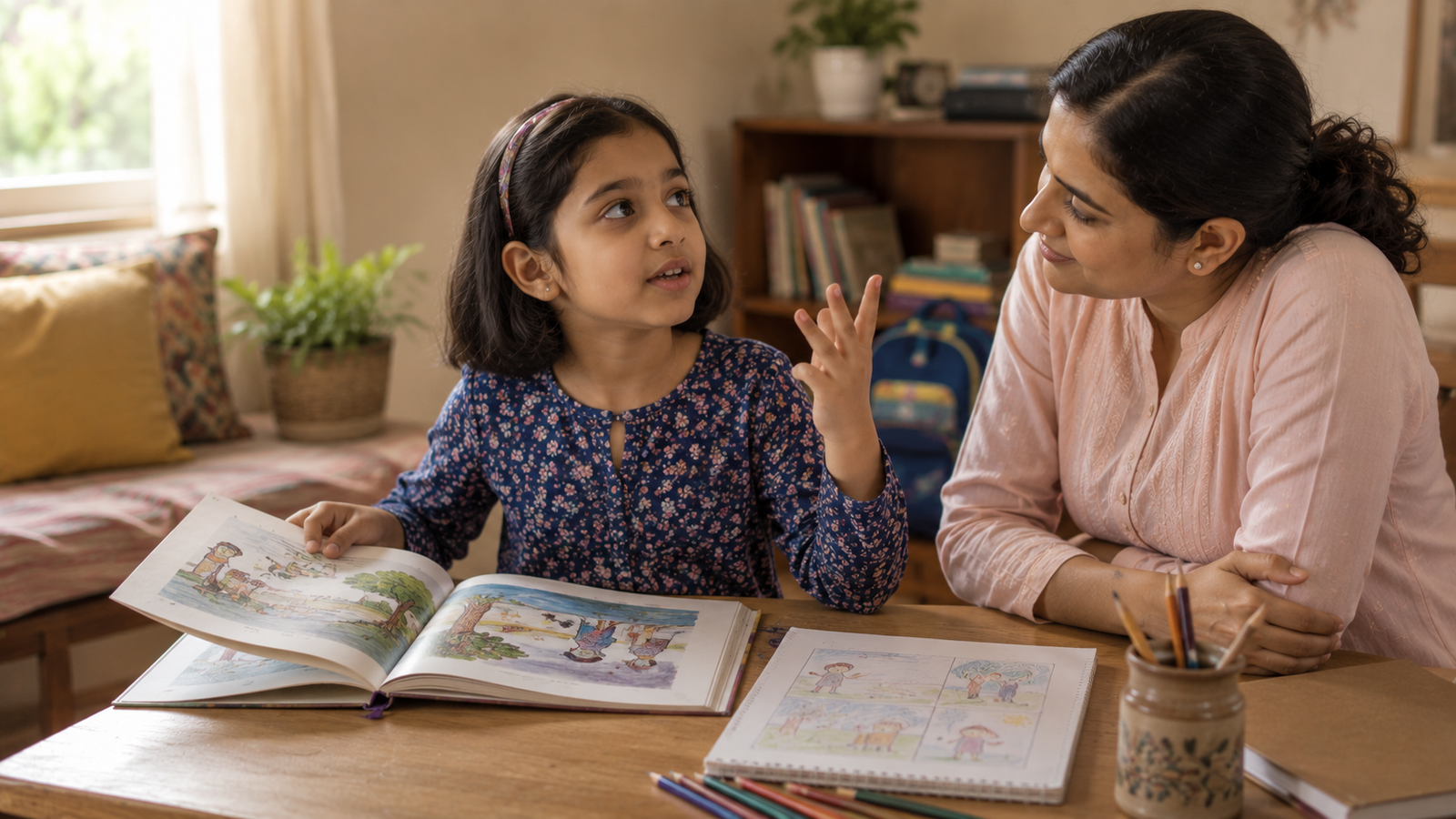
    One day, a child may arrange story cards. Another day, they may predict the ending, remember a missing card, explain a character’s feelings, or invent a new story. The material remains familiar, but the thinking changes.

    Five Ways to Make One Activity Last Longer

    1. Change the Question

    Keep the same material but rotate the thinking skill:

    “What happens first?”

    “Why did this happen?”

    “How is the character feeling?”

    “What could happen next?”

    “Can you create a different ending?”

    The child is not simply repeating an answer. They are observing, reasoning, predicting, or imagining.

    2. Adjust the Challenge

    An activity should become slightly harder as the child develops.

    A four-year-old may arrange three pictures. A six-year-old may explain why the order makes sense. An eight-year-old may compare two possible endings or defend an unusual sequence.

    Harvard’s guidance notes that motivation can fall when a task is either too easy or impossibly difficult. The aim is a challenge the child can reach with some effort and support. (Harvard Center on Developing Child)

    3. Offer a Small Choice

    Let the child choose the story, the role, or the way to play:

    “Would you like to arrange the story or tell it while I arrange it?”

    “Should we play the memory game or invent a funny ending?”

    Choice does not mean handing over every decision. Two acceptable options are often enough to encourage participation and independence.Guidance from the National Association for the Education of Young Children similarly recommends offering choices within reasonable limits. (NAEYC)

    4. Make It Social

    Take turns narrating, ask a sibling to predict the next event, or make a deliberately silly mistake for the child to correct.

    The adult can say:

    “I think the child wore shoes before socks. Does that make sense?”

    Playful learning often becomes richer through social interaction because children communicate ideas, consider another viewpoint, and build shared understanding.

    5. Connect It to Real Life

    Link the activity to experiences your child understands: packing a school bag, helping Ajji water plants, sharing food, cleaning spilled water, or preparing festival decorations.

    Ask:

    “Has something like this happened to you?”

    “What did our family do first?”

    A familiar context gives the child memories, words, and feelings to bring into the activity. It also makes the same material useful for storytelling, emotional discussion, and problem solving.

    Six Ways to Reuse Story Cards

    The same picture sequence can support six different modes of play:

    Sequencing: Arrange what happened first, next, and last.

    Speaking: Narrate each picture and connect the sentences.

    Prediction: Hide the final card and imagine what happens next.

    Memory: Remove or turn over a card and identify what is missing.

    Emotion discussion: Explain how a character may feel and why.

    Creative storytelling: Change the order, viewpoint, or ending to build a new story.

    Parents do not need to use all six at once. Selecting one variation keeps a session simple and preserves other possibilities for another day.

    Age-Wise Guidance

    Ages 4-5

    Use two- or three-step sequences. Focus on matching, naming, arranging, and describing what is visible.

    Repeat favourite stories freely. Change only one feature at a time, such as hiding a card or asking how a character feels.

    Ages 6-7

    Use four- or five-step stories and introduce “why,” “because,” and “what next” questions.

    Children can remember missing cards, explain cause and effect, take turns narrating, or retell a story with a beginning, middle, and end.

    Ages 8-10

    Increase the reasoning rather than simply adding more pieces.

    Ask children to compare endings, narrate from another character’s perspective, identify a better decision, justify an alternative order, or turn the sequence into a paragraph or comic strip.

    A Story Game Designed for Repeat Play

    Picture cards are naturally flexible because children can observe, move, hide, arrange, describe, and reinterpret them.

    LernZeit Creations’ Storytelling & Sequencing Flashcards are designed with six gameplay variations rather than one fixed activity. The same five-card story sets can be used for sequencing, speaking, prediction, memory, emotion discussion, and creative storytelling.

    A younger child may begin by placing events in order and naming what is happening. As the child develops, the parent can ask for a complete narration, reasons and consequences, alternative endings, emotional viewpoints, or solutions to the problem shown.

    This allows the cards to work not only as a story-sequencing game, but also as a screen-free communication, memory, and logical-thinking activity. Parents do not need worksheets, printing, or a new lesson plan; they can choose one story set and change only the rule or question.

    No learning product can guarantee that a child will never lose interest. Children’s preferences, moods, and developmental stages change. Flexible materials can, however, offer stronger repeat value because the activity grows with the child instead of ending after one correct arrangement.

    Frequently Asked Questions

    Should I Put a Learning Toy Away When Interest Drops?

    Often, yes. A short break can restore freshness.

    Bring it back later with a different way to play rather than repeating the same instruction. Avoid insisting that the child finish simply because the product was purchased.

    Is Repeating the Same Story Useful?

    Yes, when the child remains involved and the conversation develops.

    A familiar plot allows the child to focus on new vocabulary, clearer narration, motives, feelings, or alternative outcomes.

    How Long Should a Play Session Last?

    Stop while the child is still reasonably interested.

    A focused 5-15-minute activity may be easier for many families than extending play after the child has disengaged. Follow the child’s cues rather than treating one duration as a rule.

    Key Takeaways

    Children may abandon a learning toy when it offers one fixed task with no new decision or challenge.

    Repetition supports learning, but the question, role, rule, or difficulty can change.

    Choice, achievable challenge, social interaction, and familiar contexts can improve engagement.

    Flexible materials offer better repeat value because they support different skills and ages.

    One set of story cards can become several screen-free activities when parents vary how it is used.

    References

    Center on the Developing Child at Harvard University.How to Motivate Children: Science-Based Approaches for Parents, Caregivers, and Teachers. The resource discusses novelty, achievable challenge, agency, social interaction, and motivation. (Harvard Center on Developing Child)

    UNICEF and the LEGO Foundation.Learning Through Play: Strengthening Learning Through Play in Early Childhood Education Programmes. The brief describes playful learning as joyful, meaningful, actively engaging, iterative, and socially interactive.

    National Association for the Education of Young Children.Three Powerful Practices for Guiding Children’s Behaviour. The article explains how limited choices can encourage children’s participation and independence. (NAEYC)

    Center on the Developing Child at Harvard University.Brain-Building Through Play. The resource provides age-based play activities connected with attention, working memory, and self-control. (Harvard Center on Developing Child)

  • How to Build Your Child’s Thinking Skills at Home in Just 10 Minutes a Day

    How to Build Your Child’s Thinking Skills at Home in Just 10 Minutes a Day

    Parents want a realistic, low-preparation way to support their child’s learning despite limited time and energy. They need a clear activity they can begin using at home immediately.

    How to Build Your Child’s Thinking Skills at Home in Just 10 Minutes a Day

    Quick Summary

    Home learning does not need worksheets, screens, or a long lesson plan.

    Ten focused minutes can practise observation, sequencing, reasoning, vocabulary, and communication.

    Use a simple routine: observe for two minutes, arrange for two, discuss for three, and retell for three.

    Familiar stories, routines, photographs, or picture cards keep preparation minimal.

    Most parents want to support their child’s learning, but after school, work, homework, meals, and bedtime, very little time remains. Home learning does not have to become another class. A short, repeatable ten-minute conversation can help children practise observation, sequencing, logical thinking, cause and effect, vocabulary, and expression. This article gives parents of children aged 4-10 a practical routine requiring little preparation. Ten minutes is not a magic number; it is simply a manageable place to begin.

    Why Helping at Home Can Feel Difficult

    Many parents are not short of interest. They are short of time, energy, and clear ideas.

    A 2025 UK survey by the National Literacy Trust found that lack of time due to work was the most frequently reported barrier to shared learning activities, mentioned by 44.8% of surveyed parents and carers of children aged five and under. Cost and limited availability of local activities were also common barriers. The survey is not an Indian study, but the practical challenge may feel familiar to many working families.

    Children also learn through responsive conversation. Harvard’s Center on the Developing Child describes “serve and return” interaction as a back-and-forth exchange in which a child communicates and a caring adult notices and responds. These exchanges support early language and social development. (Harvard Center on Child Development)

    The reassuring message is that you do not need to recreate school at home. You need a small activity, a few thoughtful prompts, and space for your child to think aloud.

    What Thinking Skills Can Ten Minutes Practise?

    A short picture or storytelling activity can bring several skills together:

    Observation: noticing people, objects, actions, expressions, and changes.

    Sequencing: deciding what happened first, next, and last.

    Cause and effect: explaining why something happened and what resulted.

    Communication: finding words, forming sentences, and connecting ideas.

    Problem solving: predicting what may happen next or suggesting another response.

    Children use these skills while getting ready for school, understanding why a wet floor is unsafe, explaining a disagreement, or following steps in a maths problem.

    Reading Rockets describes story sequencing as identifying the beginning, middle, and end so events can be retold in logical order. It also connects sequencing with more advanced understanding of relationships such as cause and effect. (Reading Rockets)

    The Simple 10-Minute Thinking Routine

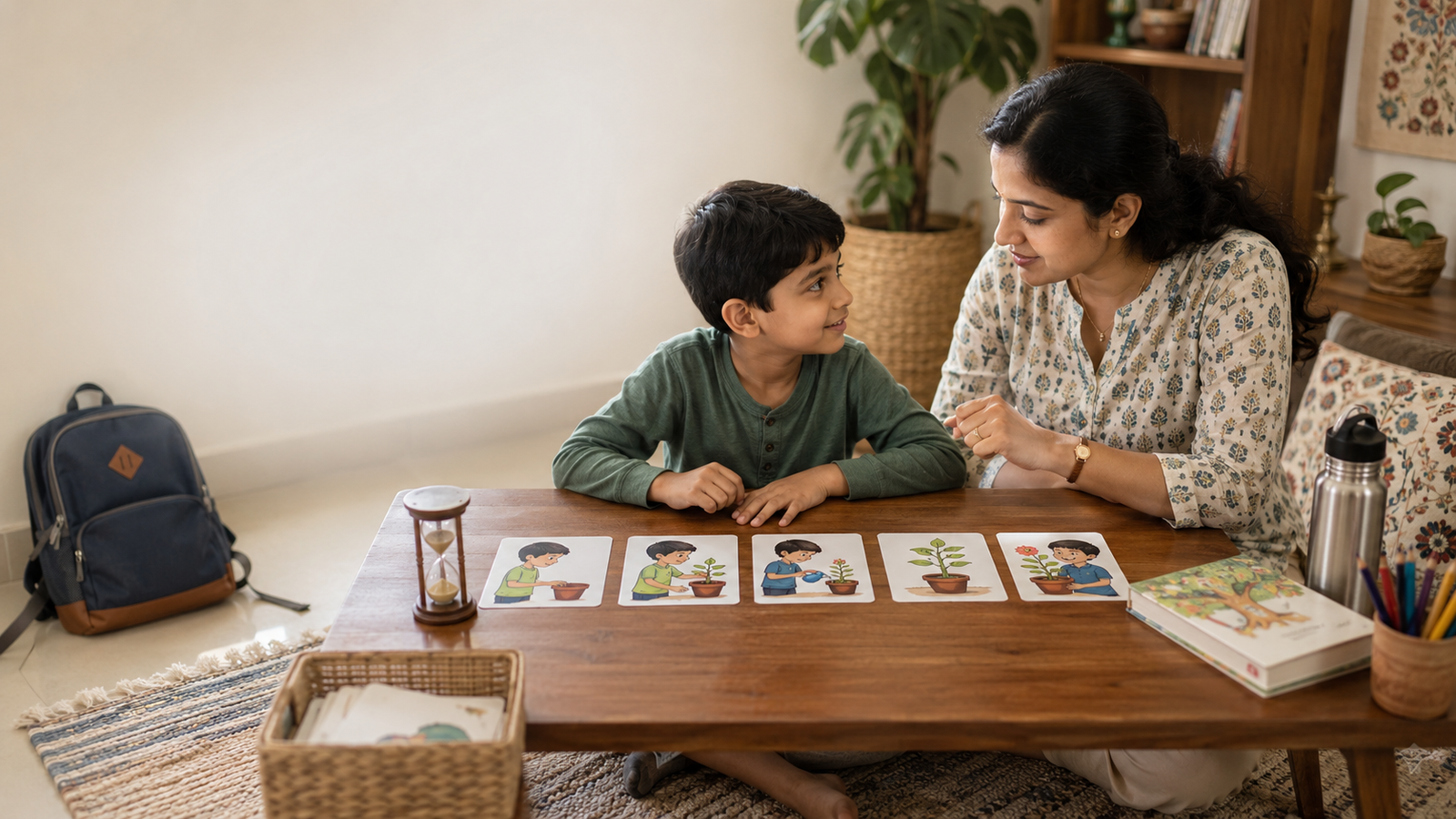
    Use a short picture story, three to five sequencing cards, a wordless book, or a family photograph. A timer is optional; the routine should not feel like a race.

    Minutes 1-2: Observe

    Place the picture or cards where your child can see them. Ask one or two prompts:

    “What do you notice?”

    “Who can you see?”

    “What looks important?”

    “How might this person be feeling?”

    Give the child time to look. When the answer is one word, accept and expand it naturally.

    Child: “Water.”

    Parent: “Yes, there is water on the floor. I wonder how it got there.”

    The child now has something concrete to observe and discuss instead of having to invent a topic from nothing.

    Minutes 3-4: Arrange

    Mix the pictures and ask the child to place them in a sensible order.

    Ask:

    “What must happen first?”

    “Which picture comes next?”

    “How do you know this is last?”

    “Could these two be swapped?”

    Do not correct immediately. Ask the child to explain the choice. Some sequences have one necessary order, while others allow more than one reasonable interpretation.

    Minutes 5-7: Ask “Why?” and “What Next?”

    Choose only two or three questions:

    “Why did this happen?”

    “What changed?”

    “What might happen next?”

    “What could the character do differently?”

    “What would you do?”

    This stage lets children practise cause and effect, prediction, emotional understanding, and problem solving.

    Ask, “What makes you think that?” when the reasoning matters more than one expected answer.

    Minutes 8-10: Retell

    Invite your child to tell the sequence in their own words.

    Useful sentence starters include:

    “First…”

    “After that…”

    “Because…”

    “Finally…”

    Let the child finish before correcting grammar. When the retelling is brief, model a slightly fuller version and invite one extra detail.

    Interactive story conversations that include questions, predictions, and child participation encourage children to engage with a story rather than listen passively. The goal is not a polished performance; it is organising and communicating an idea. (Reading Rockets)

    Four Low-Prep Variations for Busy Homes

    1. Use a Daily Routine

    Ask your child to explain the steps involved in brushing teeth, packing the school bag, making nimbu pani, tidying toys, or preparing for bed.

    Deliberately place one step in the wrong position and ask:

    “What would happen if we did this first?”

    This turns a familiar routine into a sequencing and reasoning activity without creating additional work for the parent.

    2. Use a Family or Festival Photograph

    Choose a photograph of visiting grandparents, making rangoli, decorating for a festival, or sharing a family meal.

    Ask:

    “What happened before this photograph?”

    “What may have happened afterwards?”

    “How might each person have felt?”

    The child can draw on a familiar experience while practising memory, vocabulary, sequencing, and emotional understanding.

    3. Turn a Small Problem Into a Story

    Use an everyday situation: crayons were left on the floor, a water bottle leaked inside a school bag, or two children wanted the same toy.

    Ask the child to describe:

    What the problem is.

    What may have caused it.

    Two possible solutions.

    What could happen after each solution.

    The purpose is not to find the adult’s preferred answer immediately. It is to help the child connect choices with possible outcomes.

    4. Let the Child Lead

    Once the routine becomes familiar, exchange roles. Let your child arrange the pictures and ask you the questions.

    You can deliberately give an unusual answer and allow the child to question your reasoning. Becoming the storyteller keeps the activity playful and reduces the feeling of being assessed.

    Age-Wise Guidance

    Ages 4-5

    Use two- or three-step sequences based on familiar routines.

    Focus on naming actions, identifying simple feelings, and using “first,” “then,” and “last.” Accept pointing, single words, and short sentences. Expand the child’s answer without demanding that they repeat your sentence perfectly.

    Ages 6-7

    Use four- or five-step stories.

    Ask why the order matters, connect a cause with its result, and encourage a retelling with a clear beginning and ending. Children can also predict one sensible next event or identify what might happen if a step is skipped.

    Ages 8-10

    Ask for alternative explanations, different viewpoints, and more than one solution.

    Children can justify an order, identify short- and long-term consequences, compare possible decisions, or turn the oral story into a short paragraph or comic strip when time permits.

    When the Routine Does Not Go Smoothly

    Some days your child may be tired, restless, or unwilling to talk. Stop after the observation stage or let the child choose the pictures. A two-minute exchange still provides meaningful interaction.

    Avoid asking too many questions, correcting every sentence, or insisting on the adult’s interpretation. A useful rhythm is:

    Ask. Pause. Listen. Respond.

    In multilingual Indian homes, allow the child to explain first in the language that feels most comfortable. The American Speech-Language-Hearing Association encourages parents to speak with children in the languages they use most comfortably and to value communication practice over perfection. (ASHA)

    The child can then learn a few relevant words or sentences in the language used at school.

    A Low-Prep, Screen-Free Tool for the Routine

    Picture-based flashcards suit this ten-minute structure because parents do not need to print worksheets, search for an activity, or plan a lesson.

    LernZeit Creations’ Storytelling & Sequencing Flashcards use five-card story sets that children can observe, arrange, narrate, and discuss. A parent can choose one set and follow the same four stages:

    Notice the details.

    Decide the order.

    Explore “why” and “what next.”

    Retell the complete story.

    The cards can help children practise sequencing, cause and effect, vocabulary, communication, and problem solving through relaxed parent-child interaction.

    A younger child may describe one picture at a time. An older child can defend an order, predict consequences, discuss how a character feels, or propose another ending.

    The flashcards are one practical, screen-free option alongside family photographs, wordless books, household routines, and stories drawn from daily life. The learning comes from the conversation around the pictures – not from finishing the activity quickly or finding one perfect answer.

    Frequently Asked Questions

    Do We Have to Practise Every Day?

    No. “Ten minutes a day” is a simple routine, not a strict rule.

    Begin with three or four short sessions a week when that is more realistic. A routine that fits comfortably into family life is more useful than an ambitious plan that quickly becomes stressful.

    What If My Child Gives the Wrong Order?

    Ask, “Can you explain your thinking?” before changing it.

    The child may have noticed a detail you missed or created another logical version of the story. Correct gently when the sequence depends on a factual or safety-related order.

    Is This a Replacement for Reading Together?

    No. Shared reading offers opportunities for vocabulary, knowledge, imagination, and connection.

    Use the ten-minute routine after reading, on a particularly busy day, or as a separate thinking activity. The two practices can complement each other.

    Key Takeaways

    Supporting learning at home does not require a long lesson or elaborate preparation.

    A ten-minute observe-arrange-question-retell routine can practise several skills together.

    Familiar routines, photographs, stories, and picture cards keep the activity relevant and low-cost.

    Gentle questions and patient listening are more useful than constant correction.

    The best routine is one that fits your family well enough to repeat.

    References

    National Literacy Trust.Parents’ Support for Young Children’s Literacy at Home in 2025, published 2026.

    National Literacy Trust.Latest Research Reveals a Decline in Parents Engaging in Daily Activities to Support Early Literacy, 2026. (National Literacy Trust)

    Center on the Developing Child at Harvard University.Serve and Return: Back-and-Forth Exchanges. (Harvard Center on Child Development)

    Reading Rockets.Story Sequence. (Reading Rockets)

    Reading Rockets.Learning to Read and Write: What Research Reveals. (Reading Rockets)

    American Speech-Language-Hearing Association.Learning More Than One Language. (ASHA)

  • Marks Don’t Show This: 5 Thinking Skills Every Child Needs Beyond the Report Card

    Marks Don’t Show This: 5 Thinking Skills Every Child Needs Beyond the Report Card

    Parents want to understand which important abilities may not appear clearly in marks or conventional report cards. They also want practical ways to recognise and support these skills at home.

    Marks Don’t Show This: 5 Thinking Skills Every Child Needs Beyond the Report Card

    Quick Summary

    Marks show performance in assessed subjects, but not every ability a child uses in life.

    Five important life skills are sequencing, cause-and-effect reasoning, communication, emotional understanding, and problem solving.

    Parents can observe these skills through stories, routines, conversations, and small responsibilities.

    Progress may appear as clearer explanations, thoughtful choices, or greater independence – not only higher scores.

    A report card may tell you what your child scored, but not whether your child can explain an idea, organise events, understand why something happened, consider another person’s feelings, or solve an everyday problem. Marks are useful, but they offer only one view of learning. Children also need thinking, communication, and life skills that help them use knowledge beyond a worksheet. This article explains five such skills, what they look like in children aged 4-10, and how parents can strengthen them through ordinary conversations, stories, routines, and play.

    Marks Matter – but They Are Not the Full Picture

    A test may show whether a child remembered a fact, understood a lesson, or followed a familiar procedure. It may not reveal how the child approaches an unfamiliar situation. Can they explain their reasoning, recover when the first idea fails, understand another viewpoint, or complete a routine independently?

    This is not an argument against marks or schools. Academic feedback helps parents and teachers identify strengths and learning gaps. The concern begins only when a number becomes the entire definition of the child.

    India’s National Curriculum Framework for the Foundational Stage calls for holistic development across academic and non-academic capacities. It includes communication, cooperation, resilience, conceptual understanding, problem solving, creativity, and critical thinking – not only learning for examinations.

    A 2021 US survey of 2,000 parents by the Thomas B. Fordham Institute found that parents responded most positively to the term “Life Skills,” while “Social-Emotional Learning” received much weaker support. The survey does not represent Indian parents, but it offers a useful communication lesson: practical descriptions often connect better with families than abstract educational labels. (Fordham Institute)

    What Do Life Skills Look Like in a Child?

    For a child aged 4-10, life skills may appear when they:

    remember the steps for getting ready for school;

    explain why someone slipped after water was spilled;

    tell a grandparent what happened during the day;

    try another method when a block structure falls;

    predict what may happen if a plant is not watered.

    These ordinary moments show how children observe, connect, communicate, and act.

    Five Thinking Skills Beyond the Report Card

    1. Sequencing: Organising Ideas and Actions

    Sequencing is the ability to understand what comes first, next, and last. It supports storytelling, brushing teeth, packing a school bag, writing a paragraph, and solving a maths problem step by step.

    A child developing this skill may say:

    “First we mixed the batter, then Amma heated the pan, and finally we made the dosa.”

    Notice whether the child can identify a beginning, connect the middle steps, and recognise the result.

    2. Cause-and-Effect Reasoning: Understanding Why

    Cause-and-effect reasoning connects an action or event with its result:

    “The toy broke because someone stepped on it.”

    “The plant grew because it received water and sunlight.”

    This skill supports safety, comprehension, science learning, and decision-making. Ask, “What makes you think that?” or “Could there be another reason?” The goal is thoughtful reasoning, not always one expected answer.

    3. Communication and Storytelling: Making Thinking Visible

    A child may know more than they can show in a written response. When children describe a picture or retell an event, they practise vocabulary, sentence formation, sequencing, memory, and clarity.

    The National Curriculum Framework identifies effective communication for day-to-day interactions as a foundational goal and gives importance to oral-language development.

    Instead of asking only, “Did you understand?”, try:

    “Tell me what happened in your own words.”

    “Which part was important?”

    “How would you explain this to Ajji?”

    The explanation helps you see how the child organises knowledge.

    4. Emotional Understanding: Seeing Another Perspective

    Children need opportunities to recognise what people may feel, want, or misunderstand. A child practising emotional understanding might notice that a sibling is disappointed after losing a turn or that two story characters may see the same event differently.

    Stories create a safe distance for questions such as:

    “How might this character feel?”

    “Why might the other child disagree?”

    “What could they say instead?”

    The National Curriculum Framework describes stories as a way to explore social relationships, ethical choices, emotions, language, and life skills.

    5. Problem Solving: Choosing What to Do Next

    Problem solving appears when a child works out how to share limited crayons, rebuilds a fallen tower, finds a missing item, or cleans a spill safely.

    It does not mean finding an answer immediately. It involves understanding the problem, considering options, trying a strategy, and checking the result. The National Curriculum Framework describes a similar process and encourages children to consider more than one strategy.

    Parents can ask:

    “What is the problem?”

    “What could you try first?”

    “Did that work?”

    “What else could you do?”

    Five Ways to Build These Skills at Home

    1. Ask for the Thinking Behind an Answer

    After homework, ask, “How did you work it out?” A child’s explanation may reveal good reasoning even when there is a calculation or spelling mistake.

    2. Give Small, Real Responsibilities

    Let children pack part of the school bag, arrange items for puja, set the table, sort laundry, or prepare ingredients for a snack. Discuss the order and how they will check the task.

    3. Discuss Everyday Cause and Effect

    Ask what happens if wet clothes remain folded, toys block a doorway, ice is left outside, or diyas are placed carelessly. Keep the tone curious rather than corrective.

    4. Use Stories Without Turning Them Into Tests

    After a story, ask one thoughtful question:

    “Why did the character choose that?”

    “What would you have done?”

    “Could the story end differently?”

    Several answers may be reasonable.

    5. Name the Progress You Notice

    Instead of only saying, “Good job,” try:

    “You explained every step clearly.”

    “You thought of two solutions.”

    “You noticed how the other child might feel.”

    Specific feedback shows the child what successful thinking looks like.

    Age-Wise Guidance

    Ages 4-5

    Look for simple three-step sequences, basic feeling words, short explanations, and attempts to solve familiar problems. Use pictures, pretend play, and household routines. Accept brief answers and model slightly fuller ones.

    Ages 6-7

    Children can begin explaining causes, retelling a story with a clear order, following longer instructions, and comparing two choices. Ask them to explain their reasoning before correcting the result.

    Ages 8-10

    Children can consider multiple causes, support an opinion with evidence, plan a task, reflect on mistakes, and recognise different perspectives. Encourage them to compare strategies and predict consequences.

    A Screen-Free Way to See Thinking in Action

    Picture-based activities make a child’s thinking visible. Children can observe details, arrange events, explain choices, predict outcomes, and discuss feelings without facing a formal test.

    LernZeit Creations’ Storytelling & Sequencing Flashcards use five-card story sets for this kind of parent-child interaction. A child can place events in order, narrate the story, explain why something happened, describe how a character may feel, and suggest what could happen next.

    This makes the cards more than a storytelling activity. They can help parents observe sequencing, communication, cause-and-effect reasoning, emotional understanding, and problem solving together.

    There is no need for one perfect narration. The value lies in the conversation and in noticing how the child’s explanations develop. The cards are one playful, screen-free tool alongside shared reading, household responsibilities, outdoor observation, and family storytelling.

    Frequently Asked Questions

    Does a High-Scoring Child Still Need Life-Skills Practice?

    Yes. Academic performance and everyday thinking overlap, but they are not identical. A child may perform well in familiar tests and still need practice explaining choices, managing routines, considering feelings, or approaching unfamiliar problems.

    Should Parents Formally Assess These Skills?

    Usually, no score sheet is needed. Observe the child across different situations and notice gradual changes in clarity, independence, flexibility, and reasoning. Avoid comparing siblings.

    What If My Child Gives an Unexpected Answer?

    Ask for the reasoning before correcting it. The answer may be imaginative or logically possible from a different interpretation. Correct factual or safety misunderstandings gently while preserving the child’s willingness to think aloud.

    Key Takeaways

    Marks provide useful information, but they do not represent every part of development.

    Sequencing, reasoning, communication, emotional understanding, and problem solving are practical life skills.

    Parents can observe these abilities during routines, stories, responsibilities, and conversations.

    Questions such as “Why?”, “What happened next?”, and “What else could you try?” make thinking visible.

    Progress can appear as clearer explanations, stronger reasoning, and growing independence.

    References

    National Council of Educational Research and Training.National Curriculum Framework for the Foundational Stage 2022. The framework discusses holistic development, communication, critical thinking, life skills, storytelling, reasoning, and problem solving.

    Tyner, Adam.How to Sell SEL: Parents and the Politics of Social-Emotional Learning. Thomas B. Fordham Institute, 2021.

    Northern, Amber M., and Michael J. Petrilli.The Vast Majority of Parents Want Schools to Teach Children Social and Emotional Skills. Thomas B. Fordham Institute, 2021. (The Thomas B. Fordham Institute)

  • My child lacks confidence while speaking. What do I do?

    My child lacks confidence while speaking. What do I do?

    Parents want to understand why their child knows an answer but hesitates to speak, gives one-word responses, or lacks confidence expressing ideas. They are seeking gentle, practical ways to support communication without forcing the child to perform.

    How Storytelling Builds Speaking Confidence in Children Without Pressure

    Does your child know the answer but hesitate to say it? Some children need extra time to organise their thoughts, find the right words, or feel safe enough to speak. Speaking confidence is not built only through recitations, stage performances, or public-speaking classes. It can grow through small, repeated, low-pressure conversations with a trusted adult. Storytelling gives children a helpful structure: they can observe a picture, arrange events, and gradually connect ideas into sentences. This article explains why children may hesitate and how parents can use simple storytelling activities to support clearer, more confident expression.

    Quick Summary

    Quiet or hesitant speech does not automatically mean a child lacks knowledge.

    Pictures and sequences give children something concrete to discuss.

    Retelling can support sentence formation, vocabulary, sequencing, and clarity.

    Patient pauses and gentle prompts reduce the feeling of being tested.

    Speaking confidence grows through regular conversation, not pressure to perform.

    Why Some Children Know the Answer but Do Not Say It

    A child may answer freely at home but become silent in class, use single words despite understanding the idea, or abandon a sentence halfway through.

    The child may be cautious, need more processing time, worry about mistakes, or find it difficult to retrieve vocabulary quickly. Speaking in a less familiar language can add effort. Quietness is not a flaw to “fix”; the aim is to create safe opportunities to practise sharing ideas.

    Responsive, back-and-forth exchanges with caring adults support early communication and social development. Harvard’s Center on the Developing Child describes these exchanges as “serve and return”: the child communicates, and the adult responds meaningfully.

    Why Storytelling Makes Speaking Easier

    Pictures Reduce Pressure

    “Tell me something” requires the child to choose a topic, organise details, and find the words at once. A picture narrows the task. The child can begin with something visible:

    “I see a girl holding an umbrella.”

    The parent can then ask:

    “Where is she going?”

    “How do you know it is raining?”

    Wordless pictures create opportunities to notice details, listen, speak, and form stories without depending on one memorised answer.

    Sequences Give Thoughts a Structure

    A story sequence answers an important question:

    “What should I talk about next?”

    The child can move through the pictures using simple connectors such as:

    First…

    Next…

    Because…

    After that…

    Finally…

    Instead of inventing everything from nothing, the child observes, orders, and explains.

    A child who initially says, “Boy fell,” may gradually learn to say:

    “First, the boy was running. Then he slipped because the floor was wet.”

    The sequence provides a visible path for the explanation.

    Retelling Builds Language

    When children retell stories, they practise choosing words, linking events, describing characters, and forming connected sentences.

    A review of 11 studies involving toddlers and preschoolers found that story-retelling practices were associated with gains in story comprehension, expressive vocabulary, receptive language, and early literacy. These findings make retelling one useful language activity, not a guarantee of a particular outcome.

    By ages 4-5, many children are developing longer sentences and beginning to include characters, settings, and connected events in stories. Development varies, so milestones are guides rather than deadlines.

    Conversation Works Better Than Constant Correction

    Parents naturally want to help when a child says:

    “Boy fall water.”

    Correcting every word may make a hesitant child focus on mistakes rather than meaning.

    Try expanding the sentence instead:

    Child: “Boy fall water.”

    Parent: “Yes, the boy slipped because there was water on the floor.”

    The child hears a fuller model without being told the attempt was wrong.

    It also helps to pause rather than repeat the question or supply the answer. ASHA recommends attentive listening, allowing response time, and adding to what a child says.

    This approach is sometimes called language expansion. The parent accepts the child’s idea and gently models a clearer or more complete version.

    The goal is not to ignore grammar indefinitely. It is to protect the child’s willingness to communicate while showing how ideas can be expressed more clearly.

    Five Low-Pressure Storytelling Activities at Home

    1. Begin With “Tell Me What You See”

    Choose a picture from a book, family album, magazine, or picture card.

    Ask:

    Who is in the picture?

    What are they doing?

    What did you notice first?

    Accept pointing or one-word answers initially and expand them naturally. Family photographs can prompt conversations about making rangoli, visiting grandparents, or preparing for a festival.

    For example:

    Child: “Dadi. Diyas.”

    Parent: “Yes, Dadi is arranging the diyas for Deepavali.”

    2. Imagine What Happened Before and After

    Show one picture and ask:

    What happened before this?

    What might happen next?

    What clue helped you decide?

    Several answers may be sensible, which can help a child who fears being wrong.

    Take turns answering. When a parent offers an imaginative response first, the activity feels more like shared play and less like a test.

    3. Arrange and Narrate One Card at a Time

    Give the child three to five pictures from a clear sequence. Ask them to arrange the cards and describe only the first one.

    Move through the cards gradually, then help the child join the sentences into one retelling.

    This observe-arrange-narrate process divides a large speaking task into manageable steps. A hesitant child does not need to remember and explain the entire story immediately.

    4. Talk About Feelings and Motives

    Try asking:

    How is the child feeling?

    What makes you think that?

    Why did the character do that?

    What could someone say to help?

    ASHA suggests using pictures, familiar stories, pretend play, and family photographs to discuss characters, actions, and feelings.

    These questions also help children practise emotional vocabulary such as disappointed, nervous, relieved, worried, proud, and excited.

    5. Build One Full Sentence Together

    When the child gives a short answer, help build one complete sentence.

    Child: “Grandma cooking.”

    Parent: “Grandma is cooking what?”

    Child: “Payasam.”

    Together: “Grandma is cooking payasam for the festival.”

    Say, “Let us put your ideas together,” rather than “Say it properly,” so the adult feels like a partner rather than an evaluator.

    Helpful Prompts That Do Not Feel Like a Test

    Use one prompt at a time:

    “Tell me what you see.”

    “What happened first?”

    “How is the child feeling?”

    “What makes you think that?”

    “Can we put that into one full sentence?”

    “What would you do next?”

    Avoid asking several questions rapidly. Respond with interest before moving to the next prompt.

    You can also replace questions with comments. Instead of always asking, “What is happening?” say:

    “I noticed that the child is hiding something behind her back.”

    A child may respond more naturally to an interesting observation than to a direct question.

    In multilingual Indian homes, allow the child to tell the story in the language that comes most naturally. You can then model a sentence in English or another school language. ASHA advises families to talk, play, read, and listen together in all the languages they use at home.

    Age-Wise Guidance

    Ages 4-5

    Begin with naming, describing, and two- or three-picture sequences. Help the child form simple sentences about who, what, and where.

    Use playful voices, puppets, or familiar routines such as brushing teeth, packing a bag, or helping serve food.

    Accept short responses. Model a slightly longer sentence without expecting the child to repeat it perfectly.

    Ages 6-7

    Encourage a beginning, middle, and end. Help children connect ideas using “then,” “because,” and “so.”

    They can retell a classroom event, explain how a festival decoration was made, or describe what a character wanted.

    Ask one follow-up question that encourages detail:

    “What happened because of that?”

    Ages 8-10

    Move towards opinions, perspective, and explanation:

    Which character made the better decision?

    What supports your idea?

    How could the problem be solved differently?

    How might another character describe the same event?

    Children can also turn an oral story into a diary entry, comic strip, paragraph, or alternative ending.

    A Screen-Free Tool for Speaking Practice

    Picture-based flashcards can make expression easier because the child does not have to begin with an empty topic. They can first observe, then arrange, narrate, and discuss.

    LernZeit Creations’ Storytelling & Sequencing Flashcards use five-card story sets that give children a visible path through a story. A child may begin by naming objects, then describe each card, connect the events, explain why something happened, and imagine what could happen next.

    Used as a relaxed parent-child activity, the cards can support communication, vocabulary, sequencing, and speaking confidence without turning the conversation into a formal lesson.

    The parent does not need to search for the “correct” narration. The same cards can support several conversations:

    What do you notice?

    What happened first?

    Why did that happen?

    How is the person feeling?

    What might happen next?

    Could the story end differently?

    The flashcards are one screen-free practice tool alongside family stories, shared reading, pretend play, and everyday conversation.

    When Extra Support May Be Helpful

    Some children are simply quiet and communicate well when comfortable. Seek professional guidance if you are concerned about speech clarity, understanding language, forming sentences, communicating in familiar settings, or a loss of previously used skills.

    Developmental checklists cannot diagnose a child at home. ASHA notes that children develop at different rates and recommends professional assessment when a child is not meeting many milestones in the relevant age range.

    Parents can begin by discussing their observations with the child’s teacher or paediatrician. A qualified speech-language professional can assess whether the child needs additional support.

    Frequently Asked Questions

    Should I make my shy child speak in front of relatives?

    Inviting is better than forcing. Offer a small role, such as showing one picture or saying one sentence, and allow the child to decline.

    Confidence is more likely to grow when participation feels safe and achievable.

    Should I correct incomplete sentences?

    Listen to the meaning first, then model a fuller version. Correct when clarification is needed, but avoid interrupting every attempt.

    A conversation should not feel like a grammar examination.

    Can storytelling help a child who speaks confidently only at home?

    It may provide a useful bridge. Begin with a trusted adult, then include a sibling or friend, and later try a small familiar group.

    Keep the same story or pictures so that only the audience changes, not the entire task.

    Key Takeaways

    Speaking confidence develops through small, responsive conversations.

    Pictures and sequences reduce the need to invent everything at once.

    Retelling helps children practise vocabulary, sentence formation, clarity, and structure.

    Listening, pausing, and expanding words are often more helpful than constant correction.

    The goal is meaningful expression, not a perfect performance.

    References

    Center on the Developing Child at Harvard University.Serve and Return: Back-and-Forth Exchanges.

    Dunst, C., Simkus, A., and Hamby, D.Children’s Story Retelling as a Literacy and Language Enhancement Strategy. CELLreviews, 2012.

    American Speech-Language-Hearing Association.Communication Milestones: 4 to 5 Years.

    Communication Health Support Association, powered by ASHA expertise.Tips for Your Child’s Speech and Language Development.

    American Speech-Language-Hearing Association.Eight Speech and Language Skills to Practise With Your Preschooler at Home.

    Reading Rockets.Sharing Wordless Picture Books.

  • Before, After, Then: How Sequencing Builds Problem-Solving Skills in Children

    Before, After, Then: How Sequencing Builds Problem-Solving Skills in Children

    Parents want to understand why their child forgets steps, completes tasks in a random order, or struggles to explain why something happened. They are also looking for practical ways to strengthen sequencing, reasoning, and cause-and-effect thinking.

    Quick Summary

    Sequencing is the ability to place actions, events, or ideas in a meaningful order.

    Cause-and-effect thinking helps children understand why something happened and what may happen next.

    These skills support routines, instructions, reading, writing, maths, reasoning, and decision-making.

    Parents can build them through everyday conversations, practical routines, stories, and picture-based activities.

    A child who brushes before putting toothpaste on the brush, explains that a plant grew “just like that,” or begins a maths problem without identifying the steps may need more practice with sequencing. Sequencing means understanding what comes first, next, and last. Cause-and-effect thinking means recognising why something happened and what followed. Together, these skills help children organise information, follow instructions, reason through problems, and explain decisions. This article shows how parents can recognise common difficulties and use simple sequencing activities for kids aged 4-10 at home.

    Sequencing Is More Than a Story Skill

    Parents often notice sequencing difficulties in ordinary moments:

    “Why did you wear your shoes before your socks?”

    “I asked you to pack your book, bottle, and lunch box. Why is only the bottle in the bag?”

    “What happened after the water spilled?”

    A child may know each individual action but struggle to hold the full sequence in mind. They may start with the most interesting step, forget the middle, or act before thinking through what must happen.

    This is not necessarily carelessness. Following a sequence requires attention, working memory, language, and planning. These abilities are still developing throughout childhood.

    The Harvard Center on the Developing Child describes executive-function skills as helping people plan, focus attention, switch gears, manage information, make decisions, and plan ahead. Children develop these abilities through supportive interactions and repeated, age-appropriate practice. (Harvard Center on Child Development)

    Story sequencing does not train every aspect of executive function. However, asking a child to observe events, remember them, arrange them, and explain the logic provides useful practice in organising information before responding.

    What Do Sequencing and Cause and Effect Mean?

    Sequencing: Putting Information in Order

    Sequencing is the ability to arrange actions, events, instructions, or ideas according to time or logic.

    Some sequences have a fixed order:

    Put toothpaste on the brush.

    Brush the teeth.

    Rinse the mouth.

    Other sequences describe change over time: a seed is planted, watered, sprouts, and grows leaves.

    Sequencing also appears in recipes, classroom instructions, writing, science observations, and mathematical procedures.Reading Rockets notes that placing events or steps in logical order is useful across the curriculum, including when children solve maths problems. (Reading Rockets)

    Cause and Effect: Connecting Reasons and Results

    A cause explains why something happens. An effect is what happens as a result.

    Water was spilled on the floor, so someone slipped.

    Understanding this relationship helps a child move beyond “What happened?” towards “Why did it happen?” and “What might prevent it next time?”

    A result may also have more than one possible cause. A plant may droop because it needs water, receives too little sunlight, or has damaged roots. Considering different possibilities supports observation and flexible reasoning. Everyday experiments and conversations can make these relationships easier for children to understand. (Reading Rockets)

    Why These Skills Matter

    Routines and Instructions

    Getting ready for school involves connected steps: bathing, dressing, eating breakfast, packing the bag, wearing shoes, and leaving on time.

    A child who understands sequence can anticipate the next action and complete more of the routine independently. Multi-step instructions also become easier when the child learns to pause, repeat the steps, and follow them in order.

    Reading, Storytelling, and Writing

    Stories make sense because events connect. Something happens, a character responds, and that response creates a new situation.

    Identifying a beginning, middle, and end can support comprehension and retelling. In writing, sequencing helps children organise sentences without jumping randomly between ideas. Recalling events in order also helps children understand story structure and communicate more clearly. (Reading Rockets)

    Maths and Problem Solving

    Many maths tasks require an orderly process: understand the question, identify the information, choose an operation, solve it, and check the answer.

    India’s National Curriculum Framework for the Foundational Stage describes problem solving as understanding the problem, devising a strategy, taking the correct steps, and checking the solution. It also includes observation, logical thinking, and understanding cause-and-effect relationships within children’s cognitive development.

    The framework also recommends flexible, play-based and activity-based learning that includes logical thinking and problem solving, rather than relying only on rote recall.

    Reasoning and Decision-Making

    Sequencing helps children imagine consequences before acting:

    “If I leave my project until morning, I may not have enough time.”

    “If I push ahead in the queue, someone may fall.”

    Young children will not always make the sensible choice, but these conversations give them a structure for discussing actions, outcomes, and alternatives.

    Signs Your Child May Benefit From Practice

    Your child may need additional support if they frequently:

    forget the middle step of a familiar routine;

    begin before hearing the full instruction;

    complete steps in a random order;

    struggle to explain how something happened;

    confuse the cause with the result;

    find multi-step word problems overwhelming.

    These behaviours can also arise from tiredness, distraction, unfamiliar vocabulary, or instructions that are too long. Begin by reducing the number of steps and checking that your child understands them.

    Five Simple Sequencing Activities for Kids

    1. Narrate a Familiar Routine

    Choose brushing teeth, packing the school bag, making nimbu pani, or preparing for bed.

    Ask your child to explain the steps using “first,” “next,” “then,” and “last.” Place one step incorrectly and let the child spot the mistake.

    Familiar home routines are useful starting points because the child already understands the activity and can focus on organising it. (Reading Rockets)

    2. Build Multi-Step Instructions Gradually

    Begin with two steps:

    “Put the book on the shelf and bring your water bottle.”

    Ask the child to repeat the instruction before acting. Add a third step only when two are manageable.

    Keep the wording clear. A long sentence may test vocabulary and memory as much as sequencing.

    3. Explore Cause and Effect at Home

    Use safe, visible examples:

    an ice cube left outside the freezer;

    a plant that is not watered;

    a wet cloth placed in sunlight;

    toys left across a walking path.

    Ask, “What do you think will happen?” and later, “What caused that result?”

    Real examples make cause and effect easier to understand than definitions alone. Similar observation-based activities can also support early scientific thinking. (Reading Rockets)

    4. Arrange Picture Sequences

    Use three to five pictures showing planting a seed, cleaning a room, helping a grandparent, or preparing festival decorations.

    Ask:

    What comes first?

    Why must this happen before that?

    What changed?

    Could any steps be swapped?

    The final question teaches children that some sequences are fixed while others allow more than one sensible order.

    5. Solve Problems Aloud

    For a puzzle or maths word problem, encourage your child to ask:

    What do I know?

    What do I need to find?

    What should I do first?

    How can I check my answer?

    Offer a small prompt instead of giving the complete method immediately. This helps the child practise organising their own approach.

    Age-Wise Guidance

    Ages 4-5

    Focus on two- or three-step routines and clear picture sequences.

    Children can begin using words such as “first,” “then,” and “last” and identifying simple causes:

    “The glass fell because it was pushed.”

    Use familiar situations and accept short explanations.

    Ages 6-7

    Introduce four- or five-step sequences, simple written instructions, and stories with a clear problem and outcome.

    Ask why the order matters and what may happen if a step is skipped. Children can also begin checking their work against the original sequence.

    Ages 8-10

    Use sequencing for writing, maths, science, and decision-making.

    Children can compare solution methods, explain multiple causes, identify short- and long-term effects, and justify why a particular order works.

    A Visual, Screen-Free Way to Practise

    Picture-based flashcards can make sequencing easier because children can observe, arrange, reconsider, and explain ideas visually.

    LernZeit Creations’ Storytelling & Sequencing Flashcards use five-card story sets to help children practise what comes first, next, and last. Parents can extend each sequence by asking:

    Why did this happen?

    What changed?

    What might happen next?

    Could the story end differently?

    The activity combines screen-free learning with parent-child conversation. A younger child can arrange and name the pictures, while an older child can discuss motives, consequences, alternative orders, and possible solutions.

    The cards are one practical support, not a substitute for routines, shared reading, outdoor observation, or classroom learning. They provide a concrete structure for practising logical explanation through play.

    Frequently Asked Questions

    Is Forgetting Instructions Always a Sequencing Problem?

    No. A child may not have heard the instruction, understood the vocabulary, or remembered too many steps.

    Gain the child’s attention, shorten the instruction, and ask them to repeat it before deciding that sequencing is the main difficulty.

    Should Every Activity Have One Correct Order?

    No. Some routines have a necessary order, while other tasks allow several sensible approaches.

    Ask your child to explain why their chosen order works. When several solutions are possible, the reasoning matters more than matching the adult’s answer.

    How Often Should We Practise?

    A few minutes within daily routines is enough to begin.

    Repeated conversations while dressing, cooking, reading, travelling, or tidying are often more useful than one long formal lesson.

    Key Takeaways

    Sequencing helps children organise actions, information, and ideas.

    Cause-and-effect thinking connects decisions with outcomes.

    Routines, instructions, maths, writing, and problem solving all rely on ordered thinking.

    Begin with short, familiar sequences and increase the complexity gradually.

    Picture-based and real-life activities can make logical thinking visible and playful.

    References

    Center on the Developing Child at Harvard University.A Guide to Executive Function. (Harvard Center on Child Development)

    Center on the Developing Child at Harvard University.Activities Guide: Enhancing and Practising Executive Function Skills. (Harvard Center on Child Development)

    Reading Rockets.Story Sequence. (Reading Rockets)

    Reading Rockets.Cause and Effect. (Reading Rockets)

    Reading Rockets.Teaching Sequence. (Reading Rockets)

    National Council of Educational Research and Training.National Curriculum Framework for the Foundational Stage 2022.

  • Why Your Child Can Read a Story but Struggles to Retell It Clearly

    Why Your Child Can Read a Story but Struggles to Retell It Clearly

    Quick Summary

    • Reading words and understanding a story are related but different skills.
    • Retelling requires memory, sequencing, vocabulary, cause-and-effect thinking, and expression.
    • Small prompts such as “What happened first?” work better than “Tell me the whole story.”
    • Everyday routines and picture sequences offer useful, low-pressure practice.

    Your child reads a page aloud without much difficulty. Then you ask, “What happened in the story?” and hear, “I don’t know,” or receive a one-word reply.

    This is a common concern. Reading words and understanding, organising, and explaining a story are separate tasks. Retelling asks a child to remember events, decide what matters, put ideas in order, and express them clearly.

    These skills can be practised gently through shared reading, conversation, familiar routines, and visual storytelling activities at home.

    Reading Words Is Not the Same as Understanding a Story

    When children recognise or sound out printed words, they are using decoding skills. Comprehension requires them to build meaning from those words.

    A child may read each sentence accurately but still struggle to answer:

    • Who was the story about?
    • What happened first?
    • What was the problem?
    • Why did it happen?
    • How did it end?

    Reading research commonly describes skilled reading as a combination of word recognition and language comprehension. Reading Rockets explains how decoding, fluency, vocabulary, and comprehension work together.

    Retelling adds another challenge: the child must reorganise what they understood into an explanation that someone else can follow.

    Why Retelling Is Harder Than It Looks

    It depends on memory

    Children must hold several events in mind while deciding which details are important. A younger child may remember the funniest picture or the ending but forget the events that connected them.

    It requires sequencing

    A story usually has an order: something begins, a change or problem occurs, characters respond, and the story reaches an ending.

    Children may need help connecting events with words such as “first,” “next,” “because,” and “finally.” Story-sequencing activities make this structure easier to see and practise.

    It requires cause-and-effect thinking

    Retelling is more than listing events. Children also need to explain how one event led to another.

    For example:

    “Aarav forgot his umbrella, so he got wet.”

    Questions such as “Why did that happen?” and “What happened because of it?” help children practise these connections.

    It requires expressive language

    A child may understand the story but struggle to find the right words quickly or form a connected explanation.

    This can be noticeable in multilingual homes. A child may explain an idea more confidently in Tamil, Hindi, Bengali, Kannada, Marathi, or another home language than in the language used at school.

    Letting the child retell first in a familiar language can show you what they understood. India’s National Curriculum Framework for the Foundational Stage also supports using children’s home languages as a bridge to learning other languages.

    Signs Your Child May Need More Storytelling Practice

    Brief answers are not always concerning. Children may respond with few words when they are tired, distracted, shy, or uninterested in a book.

    More practice may help when your child frequently:

    • names characters but cannot explain what they did;
    • mixes up the order of events;
    • jumps from the beginning to the ending;
    • describes pictures separately without connecting them;
    • answers “what” questions but struggles with “why” or “how.”

    These are not diagnostic signs. They are clues that the child may benefit from smaller prompts, visual support, and more time to answer.

    Why Storytelling Skills Matter

    Retelling helps children practise:

    • remembering information;
    • organising ideas logically;
    • using vocabulary in context;
    • forming connected sentences;
    • understanding cause and effect;
    • explaining actions, motives, and feelings.

    These abilities are useful beyond books. Children use them when explaining what happened at school, describing a disagreement, giving instructions for a game, recounting a family outing, and later organising ideas in writing.

    Longitudinal early-literacy research has found associations between children’s oral narrative skills around school entry and later reading comprehension.

    This does not mean storytelling alone determines academic success. It means that understanding and organising spoken stories is one part of a broader literacy foundation.

    India’s National Curriculum Framework for the Foundational Stage similarly emphasises oral language, storytelling, picture conversations, shared reading, and meaning-making during the early years.

    Five Simple Activities to Try at Home

    Keep the activities short and conversational. The goal is not to test your child after every book, but to give them regular opportunities to organise and express ideas.

    1. Ask “First, Next, Then, Last”

    After a short story, ask:

    • What happened first?
    • What happened next?
    • What changed?
    • How did it end?

    Use the same questions for brushing teeth, getting ready for school, making a snack, tidying toys, or preparing diyas before a festival.

    Familiar routines allow children to focus on order rather than remembering unfamiliar details.

    2. Find the Main Change

    Ask:

    “What was different at the end?”

    Then ask:

    “What caused that change?”

    This helps children identify the central event instead of listing every small detail. For younger children, offer two possible answers and let them choose.

    3. Build a Cause-and-Effect Chain

    Choose one event and ask:

    • Why did it happen?
    • What happened because of it?
    • What could the character have done differently?

    For example:

    “Meera left her crayons on the floor. What happened next?”

    The child might say that someone stepped on them, they broke, or Meera could not find them later. More than one sensible answer may be possible.

    4. Arrange and Retell Picture Sequences

    Use three to five pictures showing an everyday event. Mix them up and ask your child to arrange them in order.

    Then invite the child to tell the story. Model connecting words naturally:

    “First the seed was planted. After that it was watered. Finally, a small plant grew.”

    Pictures reduce the need to remember everything and make the structure of a story visible.

    5. Retell One Moment From the Day

    At dinner or bedtime, ask each family member to share one small event, such as helping a grandparent, sharing lunch, missing the school bus, or preparing for a festival.

    Prompt gently:

    • Who was there?
    • What happened first?
    • How did you feel?
    • How did it end?

    Personal stories connect language practice with emotions, family conversation, and everyday Indian life.

    Age-Wise Guidance

    Ages 4–5

    Begin with two- or three-step sequences involving familiar actions. Encourage children to name who was involved, what happened, and what came next.

    Accept short answers and expand them rather than correcting them.

    When your child says, “Boy fell,” you might reply:

    “Yes, the boy fell because the floor was wet.”

    Ages 6–7

    Encourage children to include a beginning, a problem or change, important events, and an ending.

    Ask simple questions about motives and consequences:

    “Why did she do that?”

    “What happened because of her decision?”

    Ages 8–10

    Move towards inference, perspective, and writing.

    Ask:

    • How might each character have felt?
    • Was the decision fair?
    • What clues support your answer?
    • How could the ending be changed?

    Children can also turn an oral retelling into a paragraph, comic strip, diary entry, or alternative ending.

    A Gentle, Screen-Free Way to Practise

    Picture-based storytelling tools can make retelling feel more manageable because children have something concrete to observe, arrange, and discuss.

    LernZeit Creations’ Storytelling & Sequencing Flashcards use five-card story sets to help children place events in order, describe what is happening, connect causes and outcomes, and retell the sequence in their own words.

    A child can begin by naming one picture at a time. Through repeated parent-child conversation, they can gradually connect the pictures using words such as “because,” “after,” and “finally.”

    The cards are a playful, screen-free support, not a replacement for shared reading, everyday conversations, or family storytelling. They offer a clear visual structure when the open-ended question “What happened?” feels difficult.

    Frequently Asked Questions

    My child remembers the events but tells them in the wrong order. Is that a problem?

    Not necessarily. Your child may understand the events but still need help organising them.

    Ask for only three parts at first:

    1. What happened at the beginning?
    2. What was the main change or problem?
    3. How did it end?

    Add more details once that structure is clear.

    Should I correct grammar during every retelling?

    Let your child finish first. Then model a clearer sentence naturally.

    Child: “Girl go shop and lose bag.”

    Parent: “Yes, the girl went to the shop, and then she realised she had lost her bag.”

    The immediate goal is clear communication, not perfect grammar.

    Can my child retell the story in a home language?

    Yes. Retelling in a familiar language can reveal what the child understood without making second-language vocabulary an additional barrier.

    You can then help translate a few important words or sentences into the language used at school.

    Key Takeaways

    • Reading words accurately does not always mean a child can explain the story.
    • Retelling combines comprehension, memory, sequencing, vocabulary, and expression.
    • Small, specific questions are often more helpful than one broad question.
    • Familiar routines, family experiences, and pictures provide meaningful practice.
    • Warm, regular conversation matters more than a perfect retelling.

    References

    1. Reading Rockets. What Is Reading?
    2. Reading Rockets. Story Sequence
    3. Suggate, S., Schaughency, E., McAnally, H., and Reese, E. From Infancy to Adolescence: The Longitudinal Links Between Vocabulary, Early Literacy Skills, Oral Narrative, and Reading Comprehension. Cognitive Development, 2018.
    4. National Council of Educational Research and Training. National Curriculum Framework for the Foundational Stage 2022.