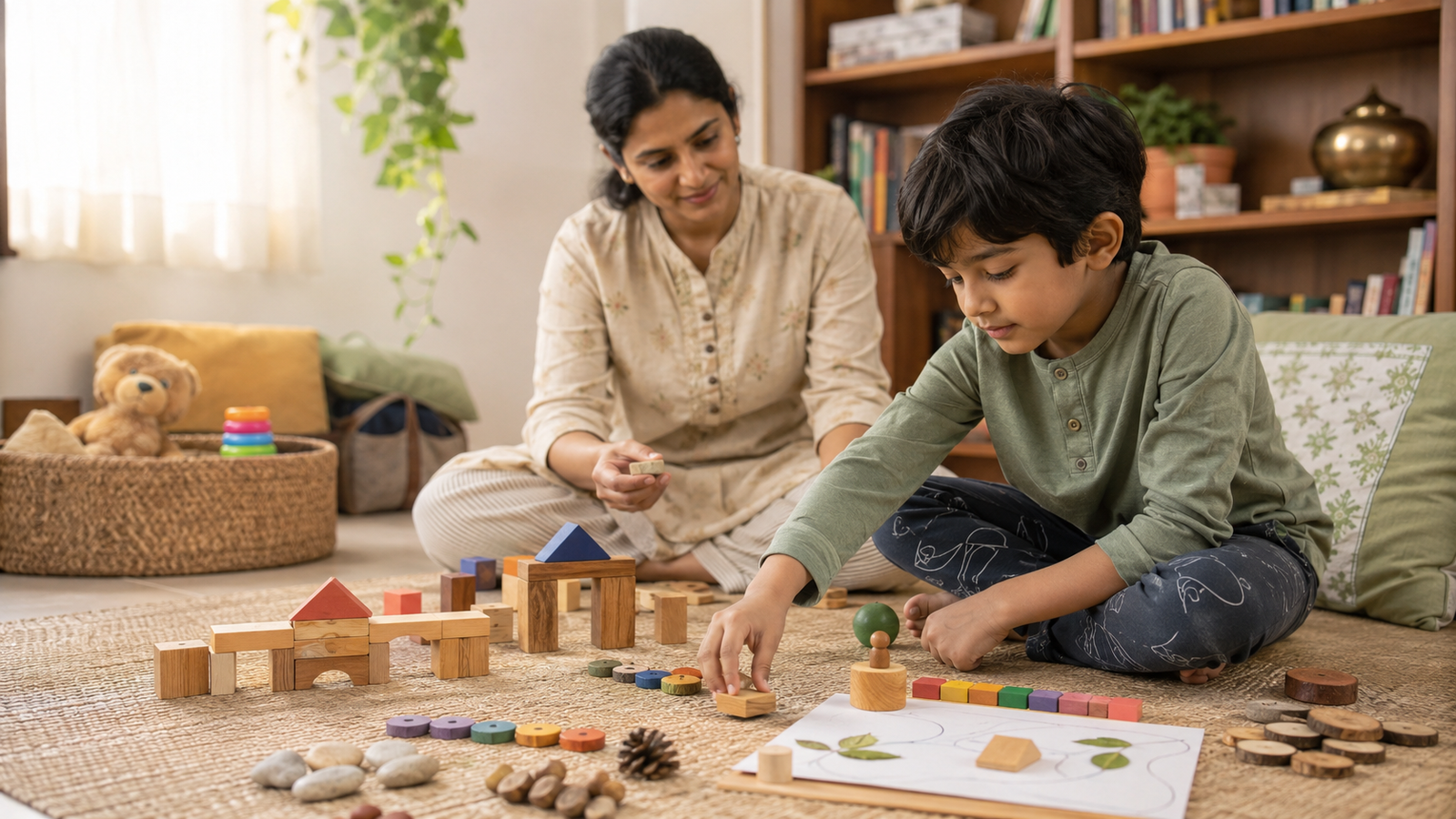
Parents want to understand why their child quickly abandons educational products and how to make existing learning activities more engaging, reusable, and developmentally useful.
Why Kids Get Bored of Learning Toys – And How to Make One Activity Last Longer
Quick Summary
Children may lose interest when a learning toy offers only one obvious task or fixed answer.
Repetition supports practice, but it feels fresher when the question, challenge, role, or story changes.
Choice and social interaction can give familiar materials new value.
Flexible activities can grow with a child’s language, memory, reasoning, and independence.
Story cards can support sequencing, speaking, prediction, memory, emotions, and creative storytelling.
You buy a learning game with excitement. Your child plays once. Then it sits on the shelf.
This does not necessarily mean your child dislikes learning – or that you chose badly. Interest often fades when a child quickly discovers the only task or outcome. Children need repetition to practise skills, but repeated play works better when it includes fresh choices, changing challenges, imagination, and conversation. This article explains why boredom happens and how parents can turn one product into several reusable learning activities for kids aged 4-10.
Why Some Learning Toys Feel “Finished”
Some educational products have one instruction: match the pieces, name the objects, complete the puzzle, or arrange the cards once. After the child understands the task, there may be little left to explore.
The problem is not familiarity itself. Familiar materials can be reassuring and useful. The problem is that the activity no longer asks the child to notice something new, make a choice, solve a different problem, or interact with another person.
Harvard’s Center on the Developing Child recommends offering challenges that are achievable but not too easy, and giving children some agency in how a task is completed. Children are more likely to remain engaged when they have meaningful choices and the level of challenge changes with their capabilities. (Harvard Center on Developing Child)
So instead of asking, “How do I make my child use this again?”, try:
“How can the same material invite a different kind of thinking today?”
Repetition Matters – But It Should Feel Fresh
Children build many abilities through repetition. They hear words repeatedly before using them confidently, revisit routines before completing them independently, and retell stories before their explanations become clearer.
Useful repetition, however, does not have to mean doing exactly the same thing. It can involve familiar material with a new goal.
A UNICEF and LEGO Foundation brief on learning through play describes playful learning as joyful, meaningful, actively engaging, iterative, and socially interactive. Iterative play allows children to practise, try possibilities, revise ideas, and discover new challenges.
One day, a child may arrange story cards. Another day, they may predict the ending, remember a missing card, explain a character’s feelings, or invent a new story. The material remains familiar, but the thinking changes.
Five Ways to Make One Activity Last Longer
1. Change the Question
Keep the same material but rotate the thinking skill:
“What happens first?”
“Why did this happen?”
“How is the character feeling?”
“What could happen next?”
“Can you create a different ending?”
The child is not simply repeating an answer. They are observing, reasoning, predicting, or imagining.
2. Adjust the Challenge
An activity should become slightly harder as the child develops.
A four-year-old may arrange three pictures. A six-year-old may explain why the order makes sense. An eight-year-old may compare two possible endings or defend an unusual sequence.
Harvard’s guidance notes that motivation can fall when a task is either too easy or impossibly difficult. The aim is a challenge the child can reach with some effort and support. (Harvard Center on Developing Child)
3. Offer a Small Choice
Let the child choose the story, the role, or the way to play:
“Would you like to arrange the story or tell it while I arrange it?”
“Should we play the memory game or invent a funny ending?”
Choice does not mean handing over every decision. Two acceptable options are often enough to encourage participation and independence.Guidance from the National Association for the Education of Young Children similarly recommends offering choices within reasonable limits. (NAEYC)
4. Make It Social
Take turns narrating, ask a sibling to predict the next event, or make a deliberately silly mistake for the child to correct.
The adult can say:
“I think the child wore shoes before socks. Does that make sense?”
Playful learning often becomes richer through social interaction because children communicate ideas, consider another viewpoint, and build shared understanding.
5. Connect It to Real Life
Link the activity to experiences your child understands: packing a school bag, helping Ajji water plants, sharing food, cleaning spilled water, or preparing festival decorations.
Ask:
“Has something like this happened to you?”
“What did our family do first?”
A familiar context gives the child memories, words, and feelings to bring into the activity. It also makes the same material useful for storytelling, emotional discussion, and problem solving.
Six Ways to Reuse Story Cards
The same picture sequence can support six different modes of play:
Sequencing: Arrange what happened first, next, and last.
Speaking: Narrate each picture and connect the sentences.
Prediction: Hide the final card and imagine what happens next.
Memory: Remove or turn over a card and identify what is missing.
Emotion discussion: Explain how a character may feel and why.
Creative storytelling: Change the order, viewpoint, or ending to build a new story.
Parents do not need to use all six at once. Selecting one variation keeps a session simple and preserves other possibilities for another day.
Age-Wise Guidance
Ages 4-5
Use two- or three-step sequences. Focus on matching, naming, arranging, and describing what is visible.
Repeat favourite stories freely. Change only one feature at a time, such as hiding a card or asking how a character feels.
Ages 6-7
Use four- or five-step stories and introduce “why,” “because,” and “what next” questions.
Children can remember missing cards, explain cause and effect, take turns narrating, or retell a story with a beginning, middle, and end.
Ages 8-10
Increase the reasoning rather than simply adding more pieces.
Ask children to compare endings, narrate from another character’s perspective, identify a better decision, justify an alternative order, or turn the sequence into a paragraph or comic strip.
A Story Game Designed for Repeat Play
Picture cards are naturally flexible because children can observe, move, hide, arrange, describe, and reinterpret them.
LernZeit Creations’ Storytelling & Sequencing Flashcards are designed with six gameplay variations rather than one fixed activity. The same five-card story sets can be used for sequencing, speaking, prediction, memory, emotion discussion, and creative storytelling.
A younger child may begin by placing events in order and naming what is happening. As the child develops, the parent can ask for a complete narration, reasons and consequences, alternative endings, emotional viewpoints, or solutions to the problem shown.
This allows the cards to work not only as a story-sequencing game, but also as a screen-free communication, memory, and logical-thinking activity. Parents do not need worksheets, printing, or a new lesson plan; they can choose one story set and change only the rule or question.
No learning product can guarantee that a child will never lose interest. Children’s preferences, moods, and developmental stages change. Flexible materials can, however, offer stronger repeat value because the activity grows with the child instead of ending after one correct arrangement.
Frequently Asked Questions
Should I Put a Learning Toy Away When Interest Drops?
Often, yes. A short break can restore freshness.
Bring it back later with a different way to play rather than repeating the same instruction. Avoid insisting that the child finish simply because the product was purchased.
Is Repeating the Same Story Useful?
Yes, when the child remains involved and the conversation develops.
A familiar plot allows the child to focus on new vocabulary, clearer narration, motives, feelings, or alternative outcomes.
How Long Should a Play Session Last?
Stop while the child is still reasonably interested.
A focused 5-15-minute activity may be easier for many families than extending play after the child has disengaged. Follow the child’s cues rather than treating one duration as a rule.
Key Takeaways
Children may abandon a learning toy when it offers one fixed task with no new decision or challenge.
Repetition supports learning, but the question, role, rule, or difficulty can change.
Choice, achievable challenge, social interaction, and familiar contexts can improve engagement.
Flexible materials offer better repeat value because they support different skills and ages.
One set of story cards can become several screen-free activities when parents vary how it is used.
References
Center on the Developing Child at Harvard University.How to Motivate Children: Science-Based Approaches for Parents, Caregivers, and Teachers. The resource discusses novelty, achievable challenge, agency, social interaction, and motivation. (Harvard Center on Developing Child)
UNICEF and the LEGO Foundation.Learning Through Play: Strengthening Learning Through Play in Early Childhood Education Programmes. The brief describes playful learning as joyful, meaningful, actively engaging, iterative, and socially interactive.
National Association for the Education of Young Children.Three Powerful Practices for Guiding Children’s Behaviour. The article explains how limited choices can encourage children’s participation and independence. (NAEYC)
Center on the Developing Child at Harvard University.Brain-Building Through Play. The resource provides age-based play activities connected with attention, working memory, and self-control. (Harvard Center on Developing Child)
Leave a Reply