Tag: story sequencing for kids

  • Flashcards as Screen-Free Learning Tools: Why Simple Play Still Works

    Flashcards as Screen-Free Learning Tools: Why Simple Play Still Works

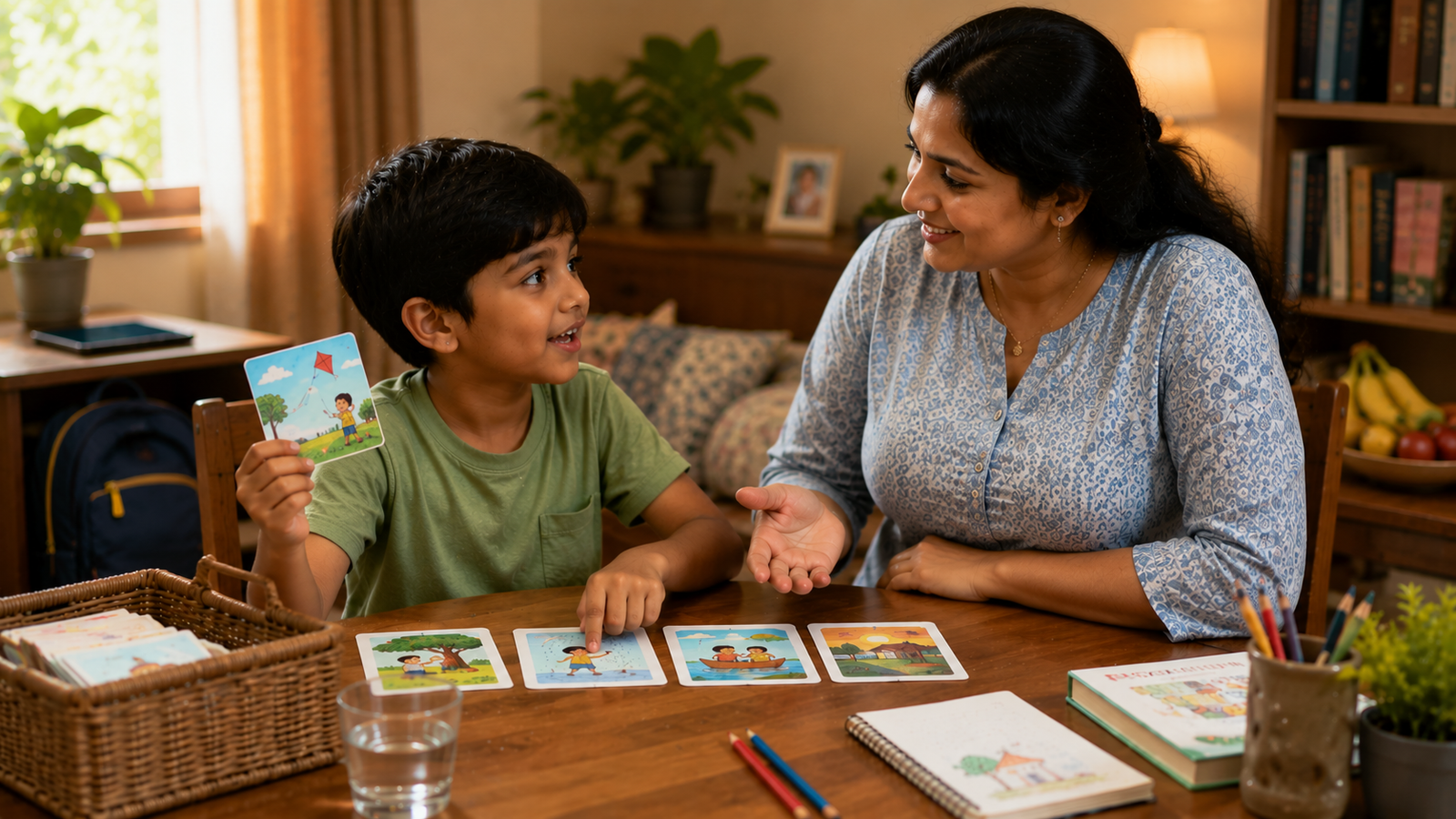
    A child sits with one picture card.

    Nothing flashes. No character speaks. There is no music, countdown or reward sound. For several seconds, the child simply looks.

    The pause may resemble uncertainty or boredom. But the child may instead be searching for a clue, retrieving a word, comparing pictures or deciding how to begin.

    Screen-free play can look quieter because more of the activity is happening inside the child’s attention than on the surface of the resource.

    Why are flashcards effective screen-free learning tools? Physical picture cards invite children to inspect, remember, move, arrange, question, describe and discuss information at their own pace. The child is not only receiving what appears; they must do something with it.

    Not every pause signals deep thinking, and not all digital learning is passive. Simple materials create useful participation when the picture, prompt and child’s freedom to respond work together.

    Stimulation and Participation Are Not the Same

    Movement, sound and instant feedback can make an experience visibly lively, and many digital resources use them thoughtfully. Yet excitement is not the only sign of engagement.

    A physical card leaves many decisions with the child: where to look, where to place it, which detail to revisit and when to answer.

    A quiet activity may still be mentally active.

    Parents need not fill every silence. Waiting can give the child’s own observation time to appear.

    Lens One: The Pause

    What the Parent Sees

    The child looks at a card without answering immediately. The parent repeats the question, offers a clue or prepares to move on.

    What May Be Happening Underneath

    The child may be scanning the picture, identifying the action, searching for a word or noticing an expression. They may be deciding whether the important detail is the spilled water, worried face or person approaching to help.

    Attention sometimes looks like stillness. A child may also be tired or uninterested, so observe before assuming.

    One Prompt That Changes the Play

    Instead of immediately asking, “What is this?”, try:

    “Take your time. What did you notice first?”

    Or:

    “Show me one detail before you explain the whole picture.”

    Learn to Ask Questions Flashcards offer real-life visual situations with several possible points of interest. The pause becomes useful when the child may inspect before answering.

    Lens Two: The Search

    What the Parent Sees

    The child’s eyes move across several cards. One card is picked up, replaced and picked up again. The child compares two pictures without speaking.

    It can look indecisive.

    What May Be Happening Underneath

    The child may be searching for repeated people, changed objects or evidence of what happened first. A wet floor in one picture may explain a towel in the next.

    Visual search involves comparing details across images and deciding which ones matter.

    One Prompt That Changes the Play

    Ask:

    “What changed between these two pictures?”

    Then follow with:

    “Which detail helped you decide?”

    Storytelling & Sequencing Flashcards invite this search across connected scenes. The aim is not only the expected order, but the evidence supporting it.

    Lens Three: The Hold

    What the Parent Sees

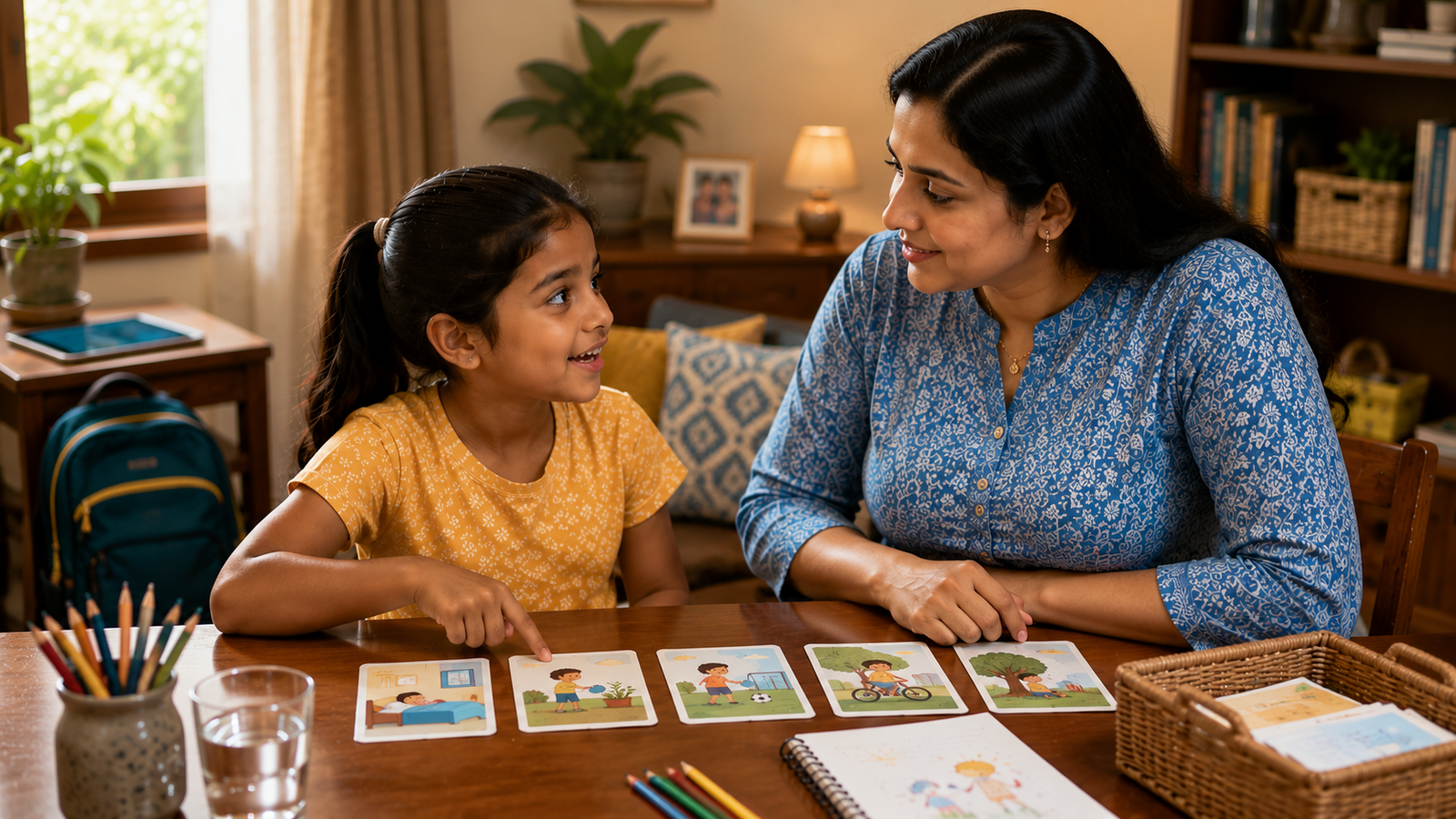
    The child turns one card face-down and tries to retell the sequence. A detail is forgotten. The child pauses, checks the card and begins again.

    What May Be Happening Underneath

    The child may be holding an event order, action, object location, sentence beginning or question in mind.

    Memory in play is not always rapid recall. It can involve remembering, checking, correcting and rebuilding. Looking again is part of comparing memory with the picture.

    One Prompt That Changes the Play

    Try:

    “Tell the story without looking, then check what you missed.”

    Or:

    “Which part was easiest to remember? What made it stand out?”

    Storytelling & Sequencing supports remembering connected events; Learn to Ask Questions supports remembering details, problems and unanswered questions. Both lead towards:

    Notice → Remember → Question → Connect → Explain

    Lens Four: The Choice

    What the Parent Sees

    The child chooses which card comes first, which question matters most or which ending seems likely.

    What May Be Happening Underneath

    The child may be comparing possibilities, weighing evidence and considering what a character knows or intends. Even deciding whether a scene belongs at the beginning or middle can require a reason.

    Active thinking begins when the child has a choice to make and a reason to explain it.

    One Prompt That Changes the Play

    Ask:

    “Which card would you place first, and what convinced you?”

    Or:

    “Which question would help us understand the situation best?”

    The two card environments overlap naturally. A sequence may prompt, “Who noticed the problem first?” A situation card may become a story once the child imagines what happened before and after.

    The emphasis remains on choice and explanation, not correctness alone.

    Lens Five: The Tell

    What the Parent Sees

    The child speaks about the card, but the response is short:

    “He fell.”

    “Girl helping.”

    “They went home.”

    “Why is she sad?”

    What May Be Happening Underneath

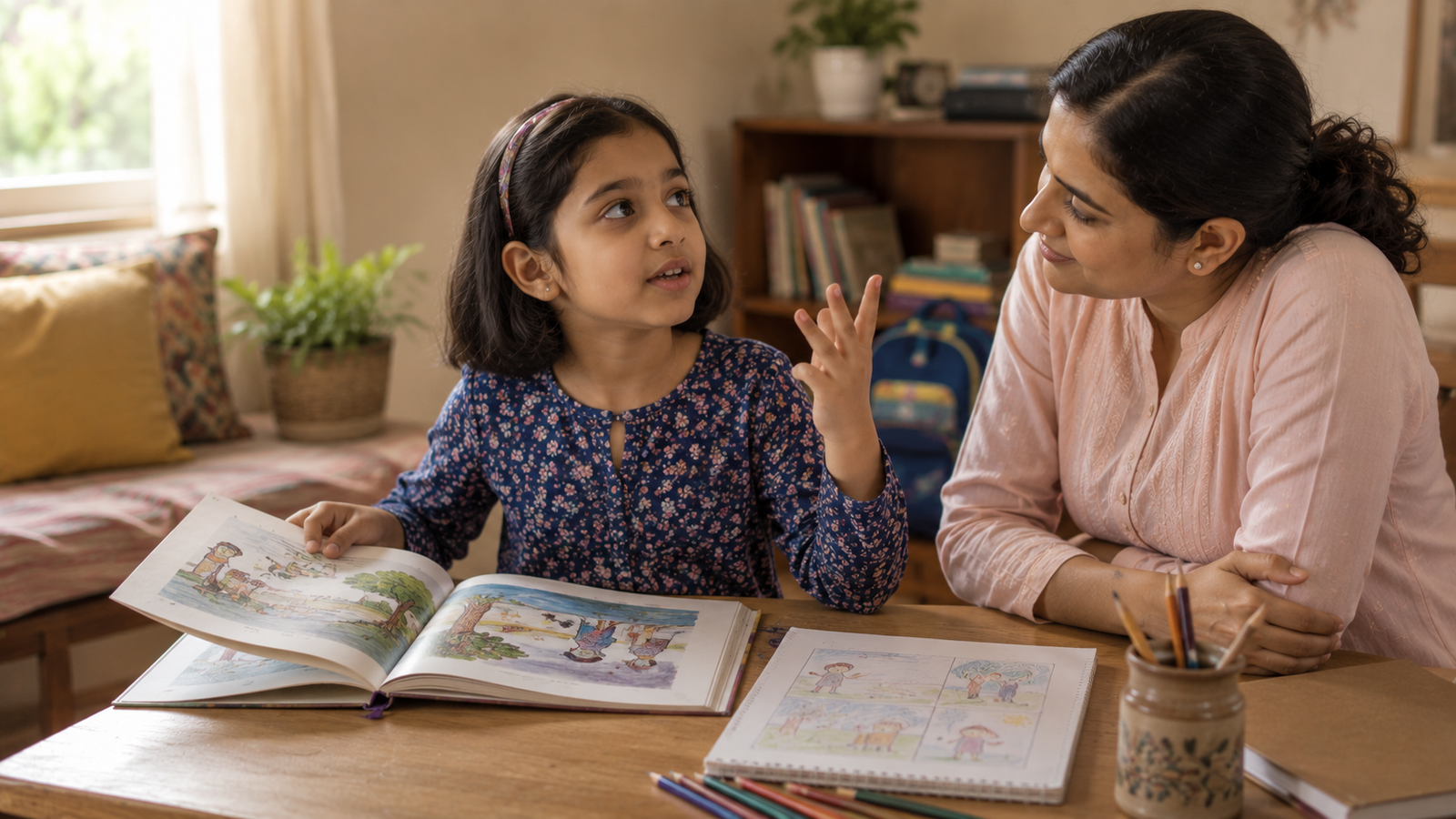
    The child is turning visual understanding into language by retrieving vocabulary, choosing an action word, organising events and selecting useful details.

    The first response need not contain everything. Spoken language grows through use and conversation, not only correction.

    One Prompt That Changes the Play

    Child: “The girl is helping.”

    Parent: “Yes, the girl is helping the older woman pick up the bag. Why do you think the bag fell?”

    The parent models a fuller sentence and opens another line of thought without declaring the first response wrong.

    Storytelling & Sequencing can support connected narration. Learn to Ask Questions can support conversational turn-taking and explanations that move beyond the first answer.

    One Minute of Card Play, Seen Two Ways

    What the Parent Sees

    The child studies four cards, moves two of them, pauses, asks why a character is carrying a towel, changes the order and tells the story.

    What May Be Happening Underneath

    The child is comparing scenes, remembering information, identifying a missing cause, testing a sequence, forming a question, revising a decision and explaining an outcome.

    The visible action is small; the thinking may be layered.

    Why Physical Cards Change the Interaction

    Cards can be picked up, turned, hidden, reordered, grouped and handed over. A child can isolate one image, place two possibilities side by side or physically represent an event order.

    Physical cards are not universally superior to digital tools. They offer a different interaction—tactile, flexible and conversational. A discussion about a towel in a picture can shift towards safety, helping another person or a similar incident at home.

    Because there is no fixed programme directing the exchange, the adult can respond to the detail that interests the child. The cards provide a starting point, but the conversation remains open.

    Conversation Without Performance Pressure

    Some educational experiences use points, levels or instant feedback, which can be motivating. Card conversations can provide another kind of space.

    A child may say:

    “I am not sure.”

    “Maybe this happened first.”

    “I have another idea.”

    “Can I change the ending?”

    “This reminds me of our balcony.”

    These responses reveal uncertainty, revision, connection and initiative.

    Protect this low-pressure quality by resisting the urge to turn every interaction into a speed test or correction exercise. Complete sentences are useful but need not be demanded after every card.

    The child may begin with a gesture, one word or an unfinished thought. The adult can model richer language while allowing the original idea to continue.

    Won’t the Cards Become Repetitive?

    Repetition and sameness are different.

    A familiar sequence can be retold from memory, narrated from another viewpoint or given a new ending. A situation card can be revisited to notice another detail, discuss a consequence or imagine what the child would do.

    Familiarity can reduce the effort of recognising the picture and create more space for explaining, questioning and imagining.

    On the first use, a child may focus on identifying the main action. Later, the child may notice a background detail, question a character’s motive or connect the situation with something that happened at school.

    Reuse works best when the prompt changes and the parent stops before the exchange becomes mechanical.

    Two Ways to Invite Active Attention

    Attention Across Events

    Storytelling & Sequencing Flashcards invite children to compare connected pictures, hold earlier events in mind, decide on an order, notice causes and consequences, narrate a sequence and predict or change an ending.

    Attention Within a Situation

    Learn to Ask Questions Flashcards invite children to study one situation closely, notice people, actions, objects and problems, identify missing information, ask different kinds of questions and consider motives, consequences and perspectives.

    The approaches can meet: a sequence can generate questions, and a situation card can become a story with an imagined before and after.

    A parent might pause a visual story and ask the child to collect questions before revealing the next event. Alternatively, the child might study one real-life situation and construct a beginning, middle and ending around it.

    Families do not need both products. A book illustration or family photograph can also support the same process.

    Five Interaction Principles for Parents

    Wait a Little Longer

    Give the child time to inspect and formulate an idea.

    Ask for Evidence

    Try “What made you think that?” before marking an answer right or wrong.

    Follow the Child’s Detail

    When the child notices something unexpected, use it as the next conversational step.

    Model, Then Continue

    Expand incomplete language naturally and keep the idea moving.

    Stop While It Still Feels Enjoyable

    There is no need to complete every card in one sitting.

    Frequently Asked Questions

    Are flashcards too simple for children who are used to screens?

    Not necessarily. Simplicity can leave more of the observing, choosing and explaining to the child. The quality of the picture, prompt and conversation matters more than visual complexity alone.

    How can flashcards support attention without animation or sound?

    A still image can be inspected for details, compared with other pictures and revisited at the child’s pace. Parents can support this by allowing pauses and asking focused, open questions.

    Do flashcards help with skills other than memory?

    They can provide practice in vocabulary, spoken language, sequencing, prediction, questioning, reasoning and conversation when children are asked to connect and explain ideas.

    How can parents keep flashcard play from feeling repetitive?

    Reuse familiar pictures with a new viewpoint, question, missing card, alternative ending or personal connection. Stop when the activity begins to feel mechanical.

    How long should a screen-free flashcard session last?

    There is no fixed duration. A brief, engaged conversation may be more useful than completing every card. Follow the child’s interest and energy.

    Simple Does Not Mean Empty

    Return to the child looking at the still picture.

    The card has not moved, spoken or rewarded the child. Yet the child may have studied it, remembered another image, asked a question, revised an order, built a sentence and heard another perspective.

    Simple play still works because the activity is not contained entirely inside the card. It is completed by the child’s attention, language, choices and conversation with another person.

    Begin with one picture and one open question. LernZeit Creations’ picture-led resources can help families create more of this active, shared play without making the material more complicated than it needs to be.
  • How to Build a 15-Minute Learning Ritual at Home

    How to Build a 15-Minute Learning Ritual at Home

    15 minutes
    1 picture or short sequence
    1 story
    1 child-generated question
    1 complete sentence
    1 closing reflection

    A useful home-learning ritual does not need a large setup. It needs a familiar beginning, a small challenge, genuine conversation and a clear ending.

    How can parents create a 15-minute learning routine at home? Choose one picture or short card sequence, tell one story, encourage one meaningful question, build one complete sentence and close with one reflection.

    Why a Ritual Is Different from an Activity Plan

    An activity plan asks the parent to keep deciding what to teach, collect and explain. In a ritual, the structure stays familiar while the picture, question and conversation change.

    The routine stays the same. The thinking inside it changes.

    The minute markers below are flexible. One beat may take longer, and the family can still stop after fifteen minutes.

    0:00–4:00 — The Story Beat

    Begin with a short picture sequence, situation card, object card, book illustration or family photograph.

    Invite the child to arrange or narrate what they see. They might identify the beginning, explain the problem, create a title or invent a missing event.

    Parent: Which picture should come first?
    Child: The one where the boy sees the fallen plant.
    Parent: What happens next?
    Child: He picks it up and adds more soil.

    4:00–7:00 — The Question Beat

    Ask the child to generate one question about the story or picture. When needed, prompt gently:

    • What are you curious about?
    • What information is missing?
    • Why might this have happened?
    • What could happen next?

    From the observation, “The girl is carrying a bag,” a child might ask, “Where is she going?”, “Why is the bag so full?” or “Who packed it?”

    This is not a quiz with one answer. The child is learning to notice what is unknown and participate actively in conversation.

    7:00–11:00 — The Sentence Beat

    Choose one idea, action or object and help the child express it as a complete sentence.

    Use a simple Sentence Stretch:

    “Matka.”

    • It is a matka.
    • The matka is made of clay.
    • The family keeps drinking water in the clay matka during summer.

    Or stretch “Helping” into:

    “The child is helping his grandmother carry the basket.”

    A useful framework is:

    Who or what + action or description + object or place + one useful detail

    Aim for one thoughtful sentence, not ten repetitive ones.

    11:00–15:00 — The Reflection Beat

    Close with one predictable prompt:

    • What was most interesting today?
    • Did anything remind you of our family?
    • Which word would you like to remember?
    • What should tomorrow’s story be about?

    The child may answer aloud, draw, choose a favourite card, act out one moment or place a card in a “tomorrow” basket.

    Reflection gives the child ownership and a calm ending. An object picture may prompt:

    • Have you seen this at your grandparents’ home?
    • Does our family use another word for it?
    • What modern object serves a similar purpose?

    The conversation can include culture without turning into a formal cultural lesson.

    One Picture, Fifteen Minutes: A Complete Example

    A child sees pictures of an overturned plant pot and a boy helping his grandmother restore the plant.

    Story

    “The pot fell. The boy saw it. He helped his grandmother put the plant back.”

    Question

    “Why did the pot fall?”

    The parent welcomes different possibilities and asks which one seems most likely.

    Sentence

    “Boy helping” becomes:

    “The boy is helping his grandmother put the plant back into the pot.”

    Reflection

    The child remembers watering a balcony plant and chooses a garden for tomorrow’s story.

    This is a flow to adapt, not a script to follow word for word.

    Keep the Rhythm. Change One Element.

    Keep the pattern familiar while changing one part:

    • use a new picture;
    • ask a different question;
    • retell the scene from another viewpoint;
    • choose a new object word;
    • let the child lead.

    A grandparent can join the reflection, or the child can draw instead of speaking.

    No reward chart or perfect streak is required. Missing a day is not failure. Return when the next calm fifteen-minute window appears.

    Adapt the Ritual to the Child

    For a Child Who Prefers Short Responses

    Accept pointing, choosing, acting or one-word answers before modelling a fuller sentence.

    For a Child Who Talks at Length

    Ask for a four-sentence story, one important question and one sentence to improve.

    For Siblings

    Let one child arrange, another ask, and both share a reflection.

    For Older Children

    Explore motives, alternative explanations, stronger vocabulary and changes in perspective.

    Build a LernZeit Ritual Basket

    Choose Storytelling & Sequencing for narration, order, prediction and cause-and-effect thinking.

    Choose Learn to Ask Questions for closer observation and child-generated curiosity.

    Choose Everyday Bharat Objects for vocabulary, description and family connections.

    Two sets can be combined, or different sets can be rotated across the week. All three are not required. The ritual also works with one card, photograph or book illustration.

    Frequently Asked Questions

    Is fifteen minutes enough for a meaningful learning activity?

    It can be. The value comes from genuine observation, thinking and conversation, not the number of tasks completed.

    Does the ritual need to happen at the same time every day?

    No. A familiar sequence matters more than a fixed time. Use it whenever the family has a calm fifteen-minute window.

    What should I do when my child does not want to speak?

    Allow pointing, arranging, drawing or acting. Model a sentence without pressure and let the child participate quietly.

    Can the same picture cards be reused regularly?

    Yes. Change the question, viewpoint, ending, sentence detail or reflection. Familiar pictures can still lead to new thinking.

    The Closing Line

    One story.
    One question.
    One sentence.
    One reflection.

    The goal is not to complete a large amount of work. It is to create a small space in which the child can notice, organise, wonder, speak and connect.

    Choose one picture and try the ritual once without planning an entire week. LernZeit Creations’ visual prompts can help families find new stories, questions, sentences and reflections while keeping the rhythm familiar.

  • How Festivals Can Make English Practice Feel Like Play

    How Festivals Can Make English Practice Feel Like Play

    A child studies a picture of a family preparing for a celebration. Someone is hanging flowers. Another person is carrying a tray. A grandparent is stirring something in the kitchen.

    The parent does not ask, “Which tense is this?”

    Instead, she asks, “What is happening now?”

    “The girl is hanging flowers.”

    “What happened before this?”

    “They cleaned the doorway.”

    “What will they do next?”

    “They will light the lamps.”

    The child has moved through past, present, and future without opening a grammar workbook. Festivals offer familiar actions, memories, routines, and plans that can be described naturally. The language has a purpose: the child is discussing something recognisable.

    Welcome to the Festival Language Studio

    Imagine placing one festival picture in the middle of three playful language zones.

    In Yesterday, the child recalls what already happened.

    In Today, the child describes what is happening now – or what the family usually does.

    In Tomorrow, the child talks about plans, preparations, and possibilities.

    Parents do not need to begin with terms such as simple past or present continuous. Begin with time and action: What happened? What is happening? What usually happens? What will happen next?

    The child gradually notices that the sentence changes when the time changes. This treats grammar as communication rather than a hunt for the correct label; language instruction is most useful when children can communicate meaning, not only pursue grammatical perfection.

    Festival contexts also give sentence-building a cultural and emotional setting instead of leaving actions inside isolated exercises.

    Zone One: Yesterday – Replay a Festival Memory

    Yesterday is the zone of completed actions.

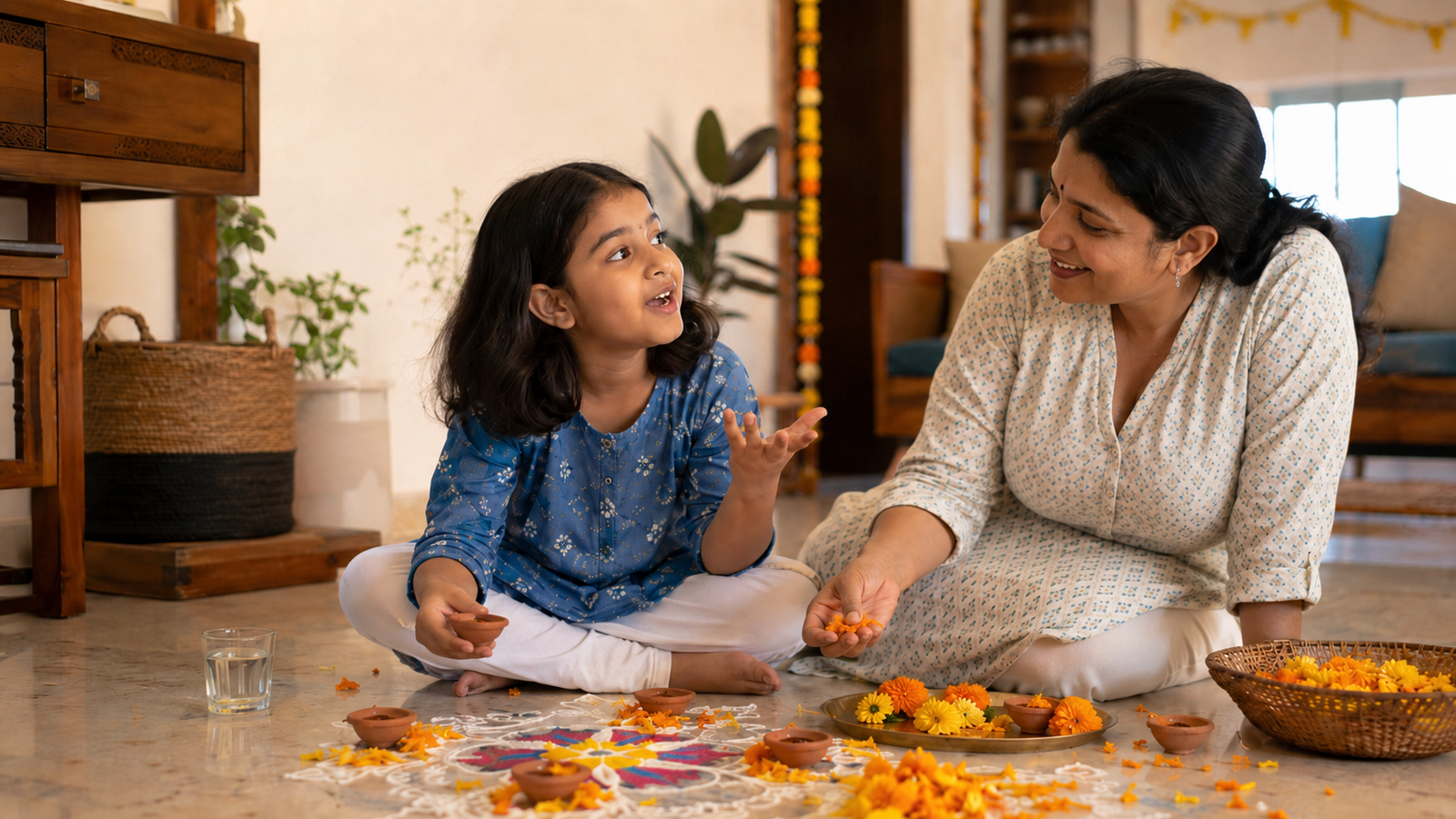
    Choose a memory from a celebration familiar to your family: visiting relatives, preparing food, making a kolam, exchanging greetings, attending a community event, carrying flowers, listening to music, or decorating a room.

    Ask, “What did we do first?”

    A conversation may unfold like this:

    Parent: What did we do in the morning?Child: We made sweets.Parent: Who helped you?Child: Grandma helped me.Parent: What happened after that?Child: I decorated the box.

    Festival Memory Replay

    Invite your child to choose one moment and describe where they were, who was present, what happened first, what they did, and how they felt.

    When the child says, “We decorated,” add a little language without treating the answer as a mistake:

    “Yes, we decorated the doorway with flowers.”

    Expansion lets children hear a fuller sentence while keeping their idea intact. Communication guidance similarly recommends adding to what a child says and talking about pictures and everyday experiences.

    You can then invite one more detail:

    “When did we decorate it?”

    “We decorated it in the evening.”

    Zone Two: Today – Catch the Festival in Motion

    Today is the busiest part of the studio.

    Look closely at a festival scene and describe the actions in progress:

    Mother is arranging the flowers.

    The children are carrying the lamps.

    Grandpa is telling a story.

    My cousin is playing the dhol.

    The family is preparing food.

    We are decorating the room.

    Then ask what the family usually does:

    We visit our relatives.

    Our family prepares this sweet every year.

    We exchange greetings with our neighbours.

    A picture can support two conversations: what is happening now and what commonly happens in the family’s tradition. Choose examples relevant to your own celebrations; no ritual, food, or dress is universal.

    Action Detective

    Ask the child to find five actions in a picture and turn each one into a complete sentence.

    Begin simply:

    “The girl is holding a plate.”

    Then add playful missions:

    Find an action involving sound.

    Find an action involving food.

    Find something one person is doing.

    Find something several people are doing.

    Find an action that requires careful movement.

    The game develops observation alongside sentence formation. Picture talk connects words with actions and ideas, while oral-language practice supports communication.

    For a humorous round, the adult can make an obviously incorrect observation:

    “The musician is cooking the flowers.”

    The child must identify what is wrong and repair the sentence:

    “No, the musician is playing the dhol. The woman is arranging the flowers.”

    The correction belongs to the game, not to criticism.

    Zone Three: Tomorrow – Talk About Plans

    Future language appears naturally when children are looking forward to something.

    Ask:

    What will we do tomorrow?

    Who will visit us?

    What will you wear?

    What are we going to prepare?

    What will happen after sunset?

    A short dialogue might sound like this:

    Parent: What will we do tomorrow morning?Child: We will decorate the house.Parent: What will you decorate?Child: I will decorate the doorway.Parent: What will you use?Child: I will use flowers.

    Festival Planner

    Invite the child to make three spoken plans:

    one thing I will wear;

    one thing I will help with;

    one person I will meet;

    one food I will eat;

    one activity I am excited about.

    The child can draw the plans or arrange them in order after speaking. The aim is to practise intention and expectation, not predict the celebration perfectly.

    Festival-based grammar feels refreshingly different because plans already matter to the child; the language is attached to anticipation rather than an abstract rule.

    The Festival Time-Travel Game

    Now connect all three zones.

    Choose one action: decorate, cook, visit, dance, light, carry, play, share, wear, or make.

    Move it through time:

    Yesterday, we decorated the room.

    Try another:

    Yesterday, Grandma made laddus.

    The child is learning more than a changed verb. Each sentence communicates who is acting, what is happening, when and where it happens, and which details make the meaning clearer.

    For extra play, say, “Yesterday, Grandpa danced with a giant laddu.” Ask what sounds unusual. The child may repair it:

    “Grandpa danced while holding a plate of laddus.”

    This is a thoughtfully specific bridge between grammar, visual storytelling, and children’s lived cultural experiences. The language stays structured, but the conversation remains imaginative.

    From One Word to a Complete Sentence

    Some children understand the scene but answer with one word.

    Parent: What is she doing?Child: Decorating.Parent: Who is decorating?Child: The girl.Parent: Can we join those ideas?Child: The girl is decorating.Parent: What is she decorating?Child: The girl is decorating the doorway.Parent: What is she using?Child: The girl is decorating the doorway with flowers.

    A reusable pattern is:

    Who + action + object or place + extra detail

    For example:

    The boy is carrying a lamp carefully.

    Grandma made sweets in the kitchen.

    We will visit our relatives in the evening.

    A short, clear sentence is useful progress. Sentence frames can support speaking by providing structure without supplying the answer.

    Seven Days in the Studio

    Keep each session to about five or ten minutes.

    Day 1 – Spot the Actions

    Choose one festival photograph or picture. Name the actions you can see.

    Day 2 – Remember Yesterday

    Share three sentences about a past celebration.

    Day 3 – Describe the Scene in Motion

    Say what different people are doing now.

    Day 4 – Plan Tomorrow

    Talk about an upcoming family activity or celebration.

    Day 5 – Change the Time

    Move one action through yesterday, today, and tomorrow.

    Day 6 – Add One More Detail

    Expand a sentence using who, where, when, what, or how.

    Day 7 – Tell the Whole Festival Story

    Combine several sentences into a short spoken narrative.

    The studio can fit into a car journey, a family visit, or a few minutes with old photographs.

    When a Picture Makes the Conversation Easier

    Families can use photographs and real celebrations, but finding a clear scene with several actions is not always easy.

    That is where Tenses Through Festivals can serve as a picture-led starting point. The product brings together English sentence formation, action words, past-present-future expressions, festival settings, observation, storytelling, and parent-child conversation.

    A card can prompt: What is happening? What happened before? What might happen next? What does this person usually do? Can you add a place or time, or turn the actions into a story?

    The distinctive idea is the combination: instead of unrelated sentences, language sits inside recognisable scenes involving preparation, food, decoration, music, visits, and shared traditions.

    Tenses Through Festivals Flashcards, Level 1 can be used as a starting collection for families introducing picture-led sentence-building and conversations about time. The current listing presents the product around past, present, and future language through familiar Indian traditions and celebrations.

    Tenses Through Festivals Flashcards, Level 2 offers an additional collection of visual situations and action-based conversation possibilities. It should not be assumed to be harder or intended for a particular age unless the family has separately verified that detail.

    The Tenses Through Festivals Flashcards, Levels 1 & 2 Combo may suit families who want a broader pool of scenes for rotating activities, comparing actions, sorting by time, and creating longer stories.

    Its refreshingly specific format combines grammar with Indian festival contexts, visual observation, speaking, and family interaction – a combination parents may not commonly encounter in standard worksheet-based resources.

    Frequently Asked Questions

    How can I teach tenses without making my child memorise grammar rules?

    Begin with time-based questions rather than terminology: “What happened?”, “What is happening?”, and “What will happen next?” Use a familiar photograph or picture and model one sentence at a time. Once the child is comfortable expressing time through speech, grammatical names can be introduced gradually if they are useful.

    What festival activities can help children practise English sentences?

    Children can describe preparations, recall a previous celebration, plan an upcoming visit, find actions in a picture, compare family traditions, or narrate events in order. Families should choose festivals and practices familiar to the child rather than trying to cover every celebration.

    Can children learn past, present, and future expressions through pictures?

    Pictures provide visible people, objects, actions, and settings. A parent can ask what is happening in the scene, what may have happened before it, and what could happen next. This gives the child a concrete subject for sentences instead of requiring ideas and grammar at the same time.

    What should I do when my child answers with only one word?

    Accept the idea, then help expand it. If the child says “decorating,” ask who is decorating, what they are decorating, or what they are using. Join the answers gradually. Avoid beginning with “That is not a complete sentence,” which may make a hesitant speaker less willing to continue.

    How are festival-based tense flashcards different from regular grammar worksheets?

    Worksheets often begin with written rules, isolated sentences, or blanks. Festival-based picture cards begin with a recognisable scene and invite the child to observe, speak, remember, predict, and tell a story. The grammatical practice is still present, but it is carried by meaningful action and conversation.

    Leave the Studio Open

    The next time your child sees a festival photograph, choose one action.

    Ask:

    “What happened yesterday?”

    Three questions are enough to begin.

    English practice does not have to arrive as a worksheet. It can enter through flowers being hung, food being prepared, music being played, or a family making plans – before anyone calls it a lesson.

    References

    Cambridge University Press.Pedagogical Interventions to L2 Grammar Instruction.

    Reading Rockets.Your Child’s Communication Development, Birth to Five.

    Reading Rockets.Basics: Oral Language.

    Colorín Colorado.Sentence Frames and Sentence Starters.

  • Grandparents, Stories, and Everyday Objects: A Beautiful Way to Build Vocabulary

    Grandparents, Stories, and Everyday Objects: A Beautiful Way to Build Vocabulary

    The child had seen the small brass lamp many times in her grandmother’s prayer room. That afternoon, she finally pointed to it.

    “What is this?”

    “A diya,” her grandmother said.

    The answer could have ended there. Instead, she described childhood Deepavali mornings: rolling cotton into wicks, filling clay lamps with oil, and waiting for dusk. One unfamiliar word had opened a story about light, family, and a house the child had never seen.

    An ordinary object can hold a name, a memory, and a piece of family history.

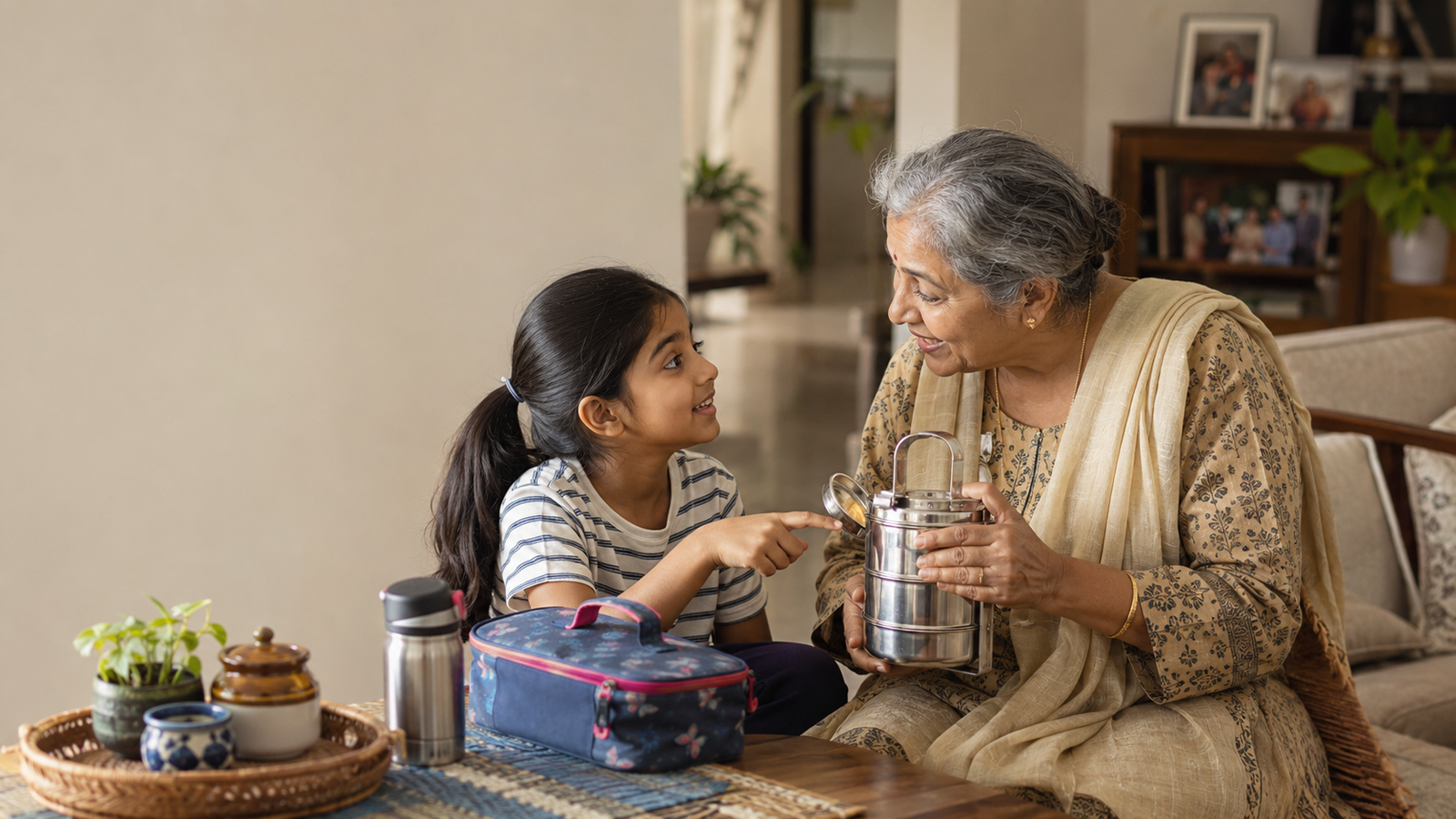
    Grandparents can help children build vocabulary by connecting object names with practical uses, regional words, sensory details, and lived memories. A word such as matka or tiffin becomes more meaningful when it belongs to a person, place, routine, or story – not only to a definition.

    A Word Becomes Richer When It Belongs Somewhere

    Naming an object is useful, but it is only the beginning. Knowing where a diya is used, what it feels like, who lights it, and why it appears in a family story gives the word a network of meaning.

    Familiar objects make inviting conversation starters because they give the child something concrete to notice and the adult something real to explain. A discussion can move naturally from “What is it?” to “Who uses it?”, “What is it made from?”, or “Did you have one when you were young?”

    Responsive back-and-forth exchanges support early language development, especially when adults notice what interests a child and add words without taking over. Harvard’s Center on the Developing Child calls this “serve and return.” India’s National Curriculum Framework also recognises the role of grandparents, home languages, local stories, food, festivals, and everyday experiences in children’s learning.

    The Diya: A Word Lit by Celebration

    Suppose a child finds a clay diya while festival decorations are being unpacked.

    Instead of simply saying, “This is a diya,” an adult might ask:

    “Where have you seen one before?”

    “Is this made from the same material as the brass lamp?”

    “Did your Thatha’s family light diyas when he was young?”

    A grandparent may remember buying unpainted lamps from a market. A parent may describe arranging them safely. The child may notice the wick, oil, flame, and shape.

    The word now connects to related vocabulary: clay, brass, cotton, glow, prayer, decorate, extinguish.

    Different families may connect the diya with different occasions and practices. That variation is valuable. It shows the child that culture is lived in many ways rather than copied from one universal script.

    A gentle prompt can keep the child at the centre:

    What do you notice about this diya that you did not notice before?

    The memorable part may not be the definition. It may be a grandparent saying, “When I was your age, we carried every lamp to the terrace before sunset.”

    The Tiffin: A Word Packed With Everyday Care

    The tiffin box rarely looks like a “cultural object.” Yet it can prompt a history of ordinary family life.

    “What do you carry in your school tiffin?”

    “What did Nani take when she was at school?”

    “Why do some boxes have several compartments?”

    A child may compare a modern lunch box with a parent’s steel dabba or a grandparent’s stacked carrier. The conversation can move towards food names, textures, school routines, and small acts of care.

    A grandmother may remember exchanging lemon rice for a friend’s paratha; a father may recall sambar leaking into his school bag. Words such as compartment, lid, leak, and share become part of the story.

    Families may also use the word tiffin differently. Instead of deciding immediately which usage is correct, ask:

    “What does tiffin mean in our home? Does your friend’s family use it differently?”

    The child begins to see that words may shift according to family, region, language, and context.

    The Matka: A Word Shaped by Summer

    A matka invites the hands as much as the eyes. Its surface may feel grainy or cool, and it may smell faintly of wet earth.

    Begin with description:

    “What is it made from?”

    “Who might make it?”

    “Why would a family keep water in it?”

    A grandparent may recall summer afternoons before a refrigerator became part of the home, while the child may know a matka only from a picture.

    The basic science is simple: unglazed clay contains tiny pores. A little water reaches the outside and evaporates, carrying away heat and helping cool the water inside. Airflow and humidity affect how well this works.

    But the richer conversation may be:

    “What has changed since your childhood?”

    “Where might people still use a matka?”

    “Who shaped and fired the pot?”

    “Would the water taste or feel different from refrigerated water?”

    One object now connects vocabulary with season, craft, texture, science, and change.

    The Dhol: A Word That Arrives With Sound

    Some objects are best remembered through action. A dhol suggests rhythm, movement, volume, anticipation, and community.

    A child may have heard one at a wedding or festival; a grandparent may remember another instrument from a different region.

    Try asking:

    “What does the rhythm make you feel?”

    “How do you think the musician changes the sound?”

    “Can you copy the beat on the table?”

    The child can tap, listen, describe, and compare. Related words arise naturally: beat, rhythm, musician, procession, loud, soft, fast, slow, celebrate.

    This is also a chance to avoid presenting Indian culture as one identical set of customs. Families from different regions may use different drums, names, and traditions.

    Ask:

    “What instruments have you seen where our family comes from?”

    That question can lead to a conversation about a village celebration, a wedding procession, a school performance, or music heard during a family journey.

    Grandparents Bring More Than Definitions

    Grandparents often remember the life around an object: who used it, how it sounded, what went wrong, or what everyone laughed about. They may add a regional word, an older routine, or a comparison with newer versions.

    A steel container is no longer only a container when a grandfather remembers carrying it on a long train journey. A hand fan becomes more interesting when a grandmother describes using one during a power cut. A weighing scale at a vegetable market may prompt a story about shopping before packaged produce became familiar.

    The National Curriculum Framework recognises extended family and locally rooted language, stories, festivals, music, and everyday life as part of children’s learning environment.

    Not every child sees a grandparent regularly. Some live far away, speak another language, or are not available. The same activity can happen through:

    a video call;

    a short voice note;

    a recorded family story;

    an older relative;

    a trusted family friend;

    a parent retelling a memory heard during childhood.

    A two-minute prompt may be enough:

    “Show Nani the matka picture and ask what she remembers.”

    The purpose is connection, not a perfect family arrangement.

    Try This: One Object, Three Generations

    Choose one familiar object. It may be physically present, shown in a photograph, or represented on a picture card.

    Let the child look closely and guess what it is or how it is used. Then invite a parent, grandparent, or older relative to share one memory connected with it.

    Compare past and present without declaring one better:

    What stayed the same?

    What changed?

    Does the family use another word for it?

    Would the child use it in the same way today?

    Ask only a few prompts:

    What do you notice first?

    Who might use this?

    What does it remind you of?

    Is there another word for it in our family?

    What has changed since you were a child?

    Can you tell the story back in your own way?

    The child can retell the memory, draw the object, or add an imaginary detail. The activity should feel like a conversation, not a test.

    A child does not need to remember every new word immediately. Hearing the word again in another story or situation gives it another meaningful connection.

    When the Actual Object Is Not Nearby

    Families will not always have a dhol, matka, or older household object within reach. A clear picture can still provide the visual starting point.

    That is where Everyday Bharat Objects can fit naturally. A card can sit between child, parent, and grandparent so everyone can observe the same image, notice different details, and contribute a word or memory.

    Move beyond “What is this?”:

    Where might we find it?

    What is it made from?

    Who uses it?

    What sound, smell, or memory belongs with it?

    Does our family use another name?

    How was it used earlier?

    Can we create a story involving it?

    Everyday Bharat Objects | Flashcards, Level 1 can serve as an entry point for families beginning these object-led conversations. The current listing describes 40 double-sided cards and six ways to use the set.

    Everyday Bharat Objects | Flashcards, Level 2 is a separate set of 40 double-sided cards with six gameplay variations, extending the range of objects and discussions available.

    The Everyday Bharat Objects | Levels 1 & 2 Combo combines both levels into an 80-card collection. It may suit families who want a wider pool for repeated conversations, sorting, comparison, recall, and storytelling, although every family does not need to begin with both.

    The additional related link supplied for this article could not be reliably identified as part of the Everyday Bharat Objects family, so it has been omitted.

    Treat the cards as invitations rather than tests. Children can notice, describe, ask, compare, remember, and imagine.

    One Object, Many Languages

    In a multilingual home, one object may collect several names.

    A container may be called a tiffin box, dabba, or another family term. A clay water vessel may have a name used by one grandparent but not another. The child may know the English name from school and a different one from home.

    This is not confusion to eliminate. It is material for conversation.

    The National Curriculum Framework encourages children to express themselves through home and familiar languages, while the American Speech-Language-Hearing Association notes that using multiple languages does not itself cause speech or language delay.

    Ask:

    “Which word do we use at home?”

    “What does Paati call it?”

    “Have you heard another name?”

    “Does it look or work differently in another region?”

    The objective is not to memorise translations. It is to notice that language carries place, relationships, and experience.

    A child may answer in one language, borrow a word from another, and retell the story in a third. The conversation can remain meaningful even when every family member does not use exactly the same vocabulary.

    Frequently Asked Questions

    How do everyday objects help children learn new words?

    Objects give vocabulary a visible form and practical context. A child can connect the name with its material, use, location, sound, texture, and family memory. Talking about pictures, familiar objects, and family stories is commonly recommended as a way to support oral language and vocabulary.

    What questions can grandparents ask during vocabulary activities?

    Begin with concrete prompts: “What do you notice?”, “Where have you seen this?”, “What might it be used for?”, and “Does our family have another word for it?” A grandparent can then share one short memory and invite the child to ask a follow-up question or retell the story.

    Can this activity work in multilingual families?

    Yes. Family members can discuss the object in the languages they use most comfortably. The child can compare terms without memorising every translation. Home-language conversations can provide a strong foundation for communication and additional language learning.

    How can picture flashcards be used for storytelling rather than memorisation?

    Ask where the object came from, who might use it, what happened before the pictured moment, or what problem it could solve. Add a family memory, combine several cards into a story, or let the child narrate from the object’s point of view.

    The Story Inside the Word

    Vocabulary is more than a collection of labels.

    A word can carry the roughness of clay, the click of a tiffin lid, the pulse of a drum, or the glow of a lamp remembered by someone who was once a child too.

    Cultural connection does not always require a formal lesson. It can begin when an adult pauses over an ordinary object and says, “We had one of these when I was young.”

    The child may forget a neat definition. The story about a leaking tiffin, a summer matka, or a row of diyas on an old terrace may remain – and the word may remain with it.

    Choose one object today and see where the conversation goes. Everyday Bharat Objects is one way to create more of these moments, but the first prompt may already be sitting somewhere in your home.

    References

    National Council of Educational Research and Training.NCERT Foundational Stage FrameworkNational Curriculum Framework for the Foundational Stage 2022. The framework discusses family participation, grandparents, home languages, local cultural contexts, storytelling, and vocabulary development.

    Center on the Developing Child at Harvard University.Serve and Return: Back-and-Forth Exchanges.

    American Speech-Language-Hearing Association.Learning More Than One Language.

    Reading Rockets.25 Activities for Reading and Writing Fun. The resource recommends family memories, grandparent stories, photographs, and conversations about special occasions.

    Reading Rockets.Oral Language Comprehension: Activities for Pre-K Children.

    Wired.This Ancient Technology Is Helping Millions Stay Cool. The article explains the evaporative-cooling principle used by porous clay matkas.

  • Why Kids Get Bored of Learning Toys And How to Make One Activity Last Longer

    Why Kids Get Bored of Learning Toys And How to Make One Activity Last Longer

    Parents want to understand why their child quickly abandons educational products and how to make existing learning activities more engaging, reusable, and developmentally useful.

    Why Kids Get Bored of Learning Toys – And How to Make One Activity Last Longer

    Quick Summary

    Children may lose interest when a learning toy offers only one obvious task or fixed answer.

    Repetition supports practice, but it feels fresher when the question, challenge, role, or story changes.

    Choice and social interaction can give familiar materials new value.

    Flexible activities can grow with a child’s language, memory, reasoning, and independence.

    Story cards can support sequencing, speaking, prediction, memory, emotions, and creative storytelling.

    You buy a learning game with excitement. Your child plays once. Then it sits on the shelf.

    This does not necessarily mean your child dislikes learning – or that you chose badly. Interest often fades when a child quickly discovers the only task or outcome. Children need repetition to practise skills, but repeated play works better when it includes fresh choices, changing challenges, imagination, and conversation. This article explains why boredom happens and how parents can turn one product into several reusable learning activities for kids aged 4-10.

    Why Some Learning Toys Feel “Finished”

    Some educational products have one instruction: match the pieces, name the objects, complete the puzzle, or arrange the cards once. After the child understands the task, there may be little left to explore.

    The problem is not familiarity itself. Familiar materials can be reassuring and useful. The problem is that the activity no longer asks the child to notice something new, make a choice, solve a different problem, or interact with another person.

    Harvard’s Center on the Developing Child recommends offering challenges that are achievable but not too easy, and giving children some agency in how a task is completed. Children are more likely to remain engaged when they have meaningful choices and the level of challenge changes with their capabilities. (Harvard Center on Developing Child)

    So instead of asking, “How do I make my child use this again?”, try:

    “How can the same material invite a different kind of thinking today?”

    Repetition Matters – But It Should Feel Fresh

    Children build many abilities through repetition. They hear words repeatedly before using them confidently, revisit routines before completing them independently, and retell stories before their explanations become clearer.

    Useful repetition, however, does not have to mean doing exactly the same thing. It can involve familiar material with a new goal.

    A UNICEF and LEGO Foundation brief on learning through play describes playful learning as joyful, meaningful, actively engaging, iterative, and socially interactive. Iterative play allows children to practise, try possibilities, revise ideas, and discover new challenges.

    One day, a child may arrange story cards. Another day, they may predict the ending, remember a missing card, explain a character’s feelings, or invent a new story. The material remains familiar, but the thinking changes.

    Five Ways to Make One Activity Last Longer

    1. Change the Question

    Keep the same material but rotate the thinking skill:

    “What happens first?”

    “Why did this happen?”

    “How is the character feeling?”

    “What could happen next?”

    “Can you create a different ending?”

    The child is not simply repeating an answer. They are observing, reasoning, predicting, or imagining.

    2. Adjust the Challenge

    An activity should become slightly harder as the child develops.

    A four-year-old may arrange three pictures. A six-year-old may explain why the order makes sense. An eight-year-old may compare two possible endings or defend an unusual sequence.

    Harvard’s guidance notes that motivation can fall when a task is either too easy or impossibly difficult. The aim is a challenge the child can reach with some effort and support. (Harvard Center on Developing Child)

    3. Offer a Small Choice

    Let the child choose the story, the role, or the way to play:

    “Would you like to arrange the story or tell it while I arrange it?”

    “Should we play the memory game or invent a funny ending?”

    Choice does not mean handing over every decision. Two acceptable options are often enough to encourage participation and independence.Guidance from the National Association for the Education of Young Children similarly recommends offering choices within reasonable limits. (NAEYC)

    4. Make It Social

    Take turns narrating, ask a sibling to predict the next event, or make a deliberately silly mistake for the child to correct.

    The adult can say:

    “I think the child wore shoes before socks. Does that make sense?”

    Playful learning often becomes richer through social interaction because children communicate ideas, consider another viewpoint, and build shared understanding.

    5. Connect It to Real Life

    Link the activity to experiences your child understands: packing a school bag, helping Ajji water plants, sharing food, cleaning spilled water, or preparing festival decorations.

    Ask:

    “Has something like this happened to you?”

    “What did our family do first?”

    A familiar context gives the child memories, words, and feelings to bring into the activity. It also makes the same material useful for storytelling, emotional discussion, and problem solving.

    Six Ways to Reuse Story Cards

    The same picture sequence can support six different modes of play:

    Sequencing: Arrange what happened first, next, and last.

    Speaking: Narrate each picture and connect the sentences.

    Prediction: Hide the final card and imagine what happens next.

    Memory: Remove or turn over a card and identify what is missing.

    Emotion discussion: Explain how a character may feel and why.

    Creative storytelling: Change the order, viewpoint, or ending to build a new story.

    Parents do not need to use all six at once. Selecting one variation keeps a session simple and preserves other possibilities for another day.

    Age-Wise Guidance

    Ages 4-5

    Use two- or three-step sequences. Focus on matching, naming, arranging, and describing what is visible.

    Repeat favourite stories freely. Change only one feature at a time, such as hiding a card or asking how a character feels.

    Ages 6-7

    Use four- or five-step stories and introduce “why,” “because,” and “what next” questions.

    Children can remember missing cards, explain cause and effect, take turns narrating, or retell a story with a beginning, middle, and end.

    Ages 8-10

    Increase the reasoning rather than simply adding more pieces.

    Ask children to compare endings, narrate from another character’s perspective, identify a better decision, justify an alternative order, or turn the sequence into a paragraph or comic strip.

    A Story Game Designed for Repeat Play

    Picture cards are naturally flexible because children can observe, move, hide, arrange, describe, and reinterpret them.

    LernZeit Creations’ Storytelling & Sequencing Flashcards are designed with six gameplay variations rather than one fixed activity. The same five-card story sets can be used for sequencing, speaking, prediction, memory, emotion discussion, and creative storytelling.

    A younger child may begin by placing events in order and naming what is happening. As the child develops, the parent can ask for a complete narration, reasons and consequences, alternative endings, emotional viewpoints, or solutions to the problem shown.

    This allows the cards to work not only as a story-sequencing game, but also as a screen-free communication, memory, and logical-thinking activity. Parents do not need worksheets, printing, or a new lesson plan; they can choose one story set and change only the rule or question.

    No learning product can guarantee that a child will never lose interest. Children’s preferences, moods, and developmental stages change. Flexible materials can, however, offer stronger repeat value because the activity grows with the child instead of ending after one correct arrangement.

    Frequently Asked Questions

    Should I Put a Learning Toy Away When Interest Drops?

    Often, yes. A short break can restore freshness.

    Bring it back later with a different way to play rather than repeating the same instruction. Avoid insisting that the child finish simply because the product was purchased.

    Is Repeating the Same Story Useful?

    Yes, when the child remains involved and the conversation develops.

    A familiar plot allows the child to focus on new vocabulary, clearer narration, motives, feelings, or alternative outcomes.

    How Long Should a Play Session Last?

    Stop while the child is still reasonably interested.

    A focused 5-15-minute activity may be easier for many families than extending play after the child has disengaged. Follow the child’s cues rather than treating one duration as a rule.

    Key Takeaways

    Children may abandon a learning toy when it offers one fixed task with no new decision or challenge.

    Repetition supports learning, but the question, role, rule, or difficulty can change.

    Choice, achievable challenge, social interaction, and familiar contexts can improve engagement.

    Flexible materials offer better repeat value because they support different skills and ages.

    One set of story cards can become several screen-free activities when parents vary how it is used.

    References

    Center on the Developing Child at Harvard University.How to Motivate Children: Science-Based Approaches for Parents, Caregivers, and Teachers. The resource discusses novelty, achievable challenge, agency, social interaction, and motivation. (Harvard Center on Developing Child)

    UNICEF and the LEGO Foundation.Learning Through Play: Strengthening Learning Through Play in Early Childhood Education Programmes. The brief describes playful learning as joyful, meaningful, actively engaging, iterative, and socially interactive.

    National Association for the Education of Young Children.Three Powerful Practices for Guiding Children’s Behaviour. The article explains how limited choices can encourage children’s participation and independence. (NAEYC)

    Center on the Developing Child at Harvard University.Brain-Building Through Play. The resource provides age-based play activities connected with attention, working memory, and self-control. (Harvard Center on Developing Child)

  • Before, After, Then: How Sequencing Builds Problem-Solving Skills in Children

    Before, After, Then: How Sequencing Builds Problem-Solving Skills in Children

    Parents want to understand why their child forgets steps, completes tasks in a random order, or struggles to explain why something happened. They are also looking for practical ways to strengthen sequencing, reasoning, and cause-and-effect thinking.

    Quick Summary

    Sequencing is the ability to place actions, events, or ideas in a meaningful order.

    Cause-and-effect thinking helps children understand why something happened and what may happen next.

    These skills support routines, instructions, reading, writing, maths, reasoning, and decision-making.

    Parents can build them through everyday conversations, practical routines, stories, and picture-based activities.

    A child who brushes before putting toothpaste on the brush, explains that a plant grew “just like that,” or begins a maths problem without identifying the steps may need more practice with sequencing. Sequencing means understanding what comes first, next, and last. Cause-and-effect thinking means recognising why something happened and what followed. Together, these skills help children organise information, follow instructions, reason through problems, and explain decisions. This article shows how parents can recognise common difficulties and use simple sequencing activities for kids aged 4-10 at home.

    Sequencing Is More Than a Story Skill

    Parents often notice sequencing difficulties in ordinary moments:

    “Why did you wear your shoes before your socks?”

    “I asked you to pack your book, bottle, and lunch box. Why is only the bottle in the bag?”

    “What happened after the water spilled?”

    A child may know each individual action but struggle to hold the full sequence in mind. They may start with the most interesting step, forget the middle, or act before thinking through what must happen.

    This is not necessarily carelessness. Following a sequence requires attention, working memory, language, and planning. These abilities are still developing throughout childhood.

    The Harvard Center on the Developing Child describes executive-function skills as helping people plan, focus attention, switch gears, manage information, make decisions, and plan ahead. Children develop these abilities through supportive interactions and repeated, age-appropriate practice. (Harvard Center on Child Development)

    Story sequencing does not train every aspect of executive function. However, asking a child to observe events, remember them, arrange them, and explain the logic provides useful practice in organising information before responding.

    What Do Sequencing and Cause and Effect Mean?

    Sequencing: Putting Information in Order

    Sequencing is the ability to arrange actions, events, instructions, or ideas according to time or logic.

    Some sequences have a fixed order:

    Put toothpaste on the brush.

    Brush the teeth.

    Rinse the mouth.

    Other sequences describe change over time: a seed is planted, watered, sprouts, and grows leaves.

    Sequencing also appears in recipes, classroom instructions, writing, science observations, and mathematical procedures.Reading Rockets notes that placing events or steps in logical order is useful across the curriculum, including when children solve maths problems. (Reading Rockets)

    Cause and Effect: Connecting Reasons and Results

    A cause explains why something happens. An effect is what happens as a result.

    Water was spilled on the floor, so someone slipped.

    Understanding this relationship helps a child move beyond “What happened?” towards “Why did it happen?” and “What might prevent it next time?”

    A result may also have more than one possible cause. A plant may droop because it needs water, receives too little sunlight, or has damaged roots. Considering different possibilities supports observation and flexible reasoning. Everyday experiments and conversations can make these relationships easier for children to understand. (Reading Rockets)

    Why These Skills Matter

    Routines and Instructions

    Getting ready for school involves connected steps: bathing, dressing, eating breakfast, packing the bag, wearing shoes, and leaving on time.

    A child who understands sequence can anticipate the next action and complete more of the routine independently. Multi-step instructions also become easier when the child learns to pause, repeat the steps, and follow them in order.

    Reading, Storytelling, and Writing

    Stories make sense because events connect. Something happens, a character responds, and that response creates a new situation.

    Identifying a beginning, middle, and end can support comprehension and retelling. In writing, sequencing helps children organise sentences without jumping randomly between ideas. Recalling events in order also helps children understand story structure and communicate more clearly. (Reading Rockets)

    Maths and Problem Solving

    Many maths tasks require an orderly process: understand the question, identify the information, choose an operation, solve it, and check the answer.

    India’s National Curriculum Framework for the Foundational Stage describes problem solving as understanding the problem, devising a strategy, taking the correct steps, and checking the solution. It also includes observation, logical thinking, and understanding cause-and-effect relationships within children’s cognitive development.

    The framework also recommends flexible, play-based and activity-based learning that includes logical thinking and problem solving, rather than relying only on rote recall.

    Reasoning and Decision-Making

    Sequencing helps children imagine consequences before acting:

    “If I leave my project until morning, I may not have enough time.”

    “If I push ahead in the queue, someone may fall.”

    Young children will not always make the sensible choice, but these conversations give them a structure for discussing actions, outcomes, and alternatives.

    Signs Your Child May Benefit From Practice

    Your child may need additional support if they frequently:

    forget the middle step of a familiar routine;

    begin before hearing the full instruction;

    complete steps in a random order;

    struggle to explain how something happened;

    confuse the cause with the result;

    find multi-step word problems overwhelming.

    These behaviours can also arise from tiredness, distraction, unfamiliar vocabulary, or instructions that are too long. Begin by reducing the number of steps and checking that your child understands them.

    Five Simple Sequencing Activities for Kids

    1. Narrate a Familiar Routine

    Choose brushing teeth, packing the school bag, making nimbu pani, or preparing for bed.

    Ask your child to explain the steps using “first,” “next,” “then,” and “last.” Place one step incorrectly and let the child spot the mistake.

    Familiar home routines are useful starting points because the child already understands the activity and can focus on organising it. (Reading Rockets)

    2. Build Multi-Step Instructions Gradually

    Begin with two steps:

    “Put the book on the shelf and bring your water bottle.”

    Ask the child to repeat the instruction before acting. Add a third step only when two are manageable.

    Keep the wording clear. A long sentence may test vocabulary and memory as much as sequencing.

    3. Explore Cause and Effect at Home

    Use safe, visible examples:

    an ice cube left outside the freezer;

    a plant that is not watered;

    a wet cloth placed in sunlight;

    toys left across a walking path.

    Ask, “What do you think will happen?” and later, “What caused that result?”

    Real examples make cause and effect easier to understand than definitions alone. Similar observation-based activities can also support early scientific thinking. (Reading Rockets)

    4. Arrange Picture Sequences

    Use three to five pictures showing planting a seed, cleaning a room, helping a grandparent, or preparing festival decorations.

    Ask:

    What comes first?

    Why must this happen before that?

    What changed?

    Could any steps be swapped?

    The final question teaches children that some sequences are fixed while others allow more than one sensible order.

    5. Solve Problems Aloud

    For a puzzle or maths word problem, encourage your child to ask:

    What do I know?

    What do I need to find?

    What should I do first?

    How can I check my answer?

    Offer a small prompt instead of giving the complete method immediately. This helps the child practise organising their own approach.

    Age-Wise Guidance

    Ages 4-5

    Focus on two- or three-step routines and clear picture sequences.

    Children can begin using words such as “first,” “then,” and “last” and identifying simple causes:

    “The glass fell because it was pushed.”

    Use familiar situations and accept short explanations.

    Ages 6-7

    Introduce four- or five-step sequences, simple written instructions, and stories with a clear problem and outcome.

    Ask why the order matters and what may happen if a step is skipped. Children can also begin checking their work against the original sequence.

    Ages 8-10

    Use sequencing for writing, maths, science, and decision-making.

    Children can compare solution methods, explain multiple causes, identify short- and long-term effects, and justify why a particular order works.

    A Visual, Screen-Free Way to Practise

    Picture-based flashcards can make sequencing easier because children can observe, arrange, reconsider, and explain ideas visually.

    LernZeit Creations’ Storytelling & Sequencing Flashcards use five-card story sets to help children practise what comes first, next, and last. Parents can extend each sequence by asking:

    Why did this happen?

    What changed?

    What might happen next?

    Could the story end differently?

    The activity combines screen-free learning with parent-child conversation. A younger child can arrange and name the pictures, while an older child can discuss motives, consequences, alternative orders, and possible solutions.

    The cards are one practical support, not a substitute for routines, shared reading, outdoor observation, or classroom learning. They provide a concrete structure for practising logical explanation through play.

    Frequently Asked Questions

    Is Forgetting Instructions Always a Sequencing Problem?

    No. A child may not have heard the instruction, understood the vocabulary, or remembered too many steps.

    Gain the child’s attention, shorten the instruction, and ask them to repeat it before deciding that sequencing is the main difficulty.

    Should Every Activity Have One Correct Order?

    No. Some routines have a necessary order, while other tasks allow several sensible approaches.

    Ask your child to explain why their chosen order works. When several solutions are possible, the reasoning matters more than matching the adult’s answer.

    How Often Should We Practise?

    A few minutes within daily routines is enough to begin.

    Repeated conversations while dressing, cooking, reading, travelling, or tidying are often more useful than one long formal lesson.

    Key Takeaways

    Sequencing helps children organise actions, information, and ideas.

    Cause-and-effect thinking connects decisions with outcomes.

    Routines, instructions, maths, writing, and problem solving all rely on ordered thinking.

    Begin with short, familiar sequences and increase the complexity gradually.

    Picture-based and real-life activities can make logical thinking visible and playful.

    References

    Center on the Developing Child at Harvard University.A Guide to Executive Function. (Harvard Center on Child Development)

    Center on the Developing Child at Harvard University.Activities Guide: Enhancing and Practising Executive Function Skills. (Harvard Center on Child Development)

    Reading Rockets.Story Sequence. (Reading Rockets)

    Reading Rockets.Cause and Effect. (Reading Rockets)

    Reading Rockets.Teaching Sequence. (Reading Rockets)

    National Council of Educational Research and Training.National Curriculum Framework for the Foundational Stage 2022.

  • Why Your Child Can Read a Story but Struggles to Retell It Clearly

    Why Your Child Can Read a Story but Struggles to Retell It Clearly

    Quick Summary

    • Reading words and understanding a story are related but different skills.
    • Retelling requires memory, sequencing, vocabulary, cause-and-effect thinking, and expression.
    • Small prompts such as “What happened first?” work better than “Tell me the whole story.”
    • Everyday routines and picture sequences offer useful, low-pressure practice.

    Your child reads a page aloud without much difficulty. Then you ask, “What happened in the story?” and hear, “I don’t know,” or receive a one-word reply.

    This is a common concern. Reading words and understanding, organising, and explaining a story are separate tasks. Retelling asks a child to remember events, decide what matters, put ideas in order, and express them clearly.

    These skills can be practised gently through shared reading, conversation, familiar routines, and visual storytelling activities at home.

    Reading Words Is Not the Same as Understanding a Story

    When children recognise or sound out printed words, they are using decoding skills. Comprehension requires them to build meaning from those words.

    A child may read each sentence accurately but still struggle to answer:

    • Who was the story about?
    • What happened first?
    • What was the problem?
    • Why did it happen?
    • How did it end?

    Reading research commonly describes skilled reading as a combination of word recognition and language comprehension. Reading Rockets explains how decoding, fluency, vocabulary, and comprehension work together.

    Retelling adds another challenge: the child must reorganise what they understood into an explanation that someone else can follow.

    Why Retelling Is Harder Than It Looks

    It depends on memory

    Children must hold several events in mind while deciding which details are important. A younger child may remember the funniest picture or the ending but forget the events that connected them.

    It requires sequencing

    A story usually has an order: something begins, a change or problem occurs, characters respond, and the story reaches an ending.

    Children may need help connecting events with words such as “first,” “next,” “because,” and “finally.” Story-sequencing activities make this structure easier to see and practise.

    It requires cause-and-effect thinking

    Retelling is more than listing events. Children also need to explain how one event led to another.

    For example:

    “Aarav forgot his umbrella, so he got wet.”

    Questions such as “Why did that happen?” and “What happened because of it?” help children practise these connections.

    It requires expressive language

    A child may understand the story but struggle to find the right words quickly or form a connected explanation.

    This can be noticeable in multilingual homes. A child may explain an idea more confidently in Tamil, Hindi, Bengali, Kannada, Marathi, or another home language than in the language used at school.

    Letting the child retell first in a familiar language can show you what they understood. India’s National Curriculum Framework for the Foundational Stage also supports using children’s home languages as a bridge to learning other languages.

    Signs Your Child May Need More Storytelling Practice

    Brief answers are not always concerning. Children may respond with few words when they are tired, distracted, shy, or uninterested in a book.

    More practice may help when your child frequently:

    • names characters but cannot explain what they did;
    • mixes up the order of events;
    • jumps from the beginning to the ending;
    • describes pictures separately without connecting them;
    • answers “what” questions but struggles with “why” or “how.”

    These are not diagnostic signs. They are clues that the child may benefit from smaller prompts, visual support, and more time to answer.

    Why Storytelling Skills Matter

    Retelling helps children practise:

    • remembering information;
    • organising ideas logically;
    • using vocabulary in context;
    • forming connected sentences;
    • understanding cause and effect;
    • explaining actions, motives, and feelings.

    These abilities are useful beyond books. Children use them when explaining what happened at school, describing a disagreement, giving instructions for a game, recounting a family outing, and later organising ideas in writing.

    Longitudinal early-literacy research has found associations between children’s oral narrative skills around school entry and later reading comprehension.

    This does not mean storytelling alone determines academic success. It means that understanding and organising spoken stories is one part of a broader literacy foundation.

    India’s National Curriculum Framework for the Foundational Stage similarly emphasises oral language, storytelling, picture conversations, shared reading, and meaning-making during the early years.

    Five Simple Activities to Try at Home

    Keep the activities short and conversational. The goal is not to test your child after every book, but to give them regular opportunities to organise and express ideas.

    1. Ask “First, Next, Then, Last”

    After a short story, ask:

    • What happened first?
    • What happened next?
    • What changed?
    • How did it end?

    Use the same questions for brushing teeth, getting ready for school, making a snack, tidying toys, or preparing diyas before a festival.

    Familiar routines allow children to focus on order rather than remembering unfamiliar details.

    2. Find the Main Change

    Ask:

    “What was different at the end?”

    Then ask:

    “What caused that change?”

    This helps children identify the central event instead of listing every small detail. For younger children, offer two possible answers and let them choose.

    3. Build a Cause-and-Effect Chain

    Choose one event and ask:

    • Why did it happen?
    • What happened because of it?
    • What could the character have done differently?

    For example:

    “Meera left her crayons on the floor. What happened next?”

    The child might say that someone stepped on them, they broke, or Meera could not find them later. More than one sensible answer may be possible.

    4. Arrange and Retell Picture Sequences

    Use three to five pictures showing an everyday event. Mix them up and ask your child to arrange them in order.

    Then invite the child to tell the story. Model connecting words naturally:

    “First the seed was planted. After that it was watered. Finally, a small plant grew.”

    Pictures reduce the need to remember everything and make the structure of a story visible.

    5. Retell One Moment From the Day

    At dinner or bedtime, ask each family member to share one small event, such as helping a grandparent, sharing lunch, missing the school bus, or preparing for a festival.

    Prompt gently:

    • Who was there?
    • What happened first?
    • How did you feel?
    • How did it end?

    Personal stories connect language practice with emotions, family conversation, and everyday Indian life.

    Age-Wise Guidance

    Ages 4–5

    Begin with two- or three-step sequences involving familiar actions. Encourage children to name who was involved, what happened, and what came next.

    Accept short answers and expand them rather than correcting them.

    When your child says, “Boy fell,” you might reply:

    “Yes, the boy fell because the floor was wet.”

    Ages 6–7

    Encourage children to include a beginning, a problem or change, important events, and an ending.

    Ask simple questions about motives and consequences:

    “Why did she do that?”

    “What happened because of her decision?”

    Ages 8–10

    Move towards inference, perspective, and writing.

    Ask:

    • How might each character have felt?
    • Was the decision fair?
    • What clues support your answer?
    • How could the ending be changed?

    Children can also turn an oral retelling into a paragraph, comic strip, diary entry, or alternative ending.

    A Gentle, Screen-Free Way to Practise

    Picture-based storytelling tools can make retelling feel more manageable because children have something concrete to observe, arrange, and discuss.

    LernZeit Creations’ Storytelling & Sequencing Flashcards use five-card story sets to help children place events in order, describe what is happening, connect causes and outcomes, and retell the sequence in their own words.

    A child can begin by naming one picture at a time. Through repeated parent-child conversation, they can gradually connect the pictures using words such as “because,” “after,” and “finally.”

    The cards are a playful, screen-free support, not a replacement for shared reading, everyday conversations, or family storytelling. They offer a clear visual structure when the open-ended question “What happened?” feels difficult.

    Frequently Asked Questions

    My child remembers the events but tells them in the wrong order. Is that a problem?

    Not necessarily. Your child may understand the events but still need help organising them.

    Ask for only three parts at first:

    1. What happened at the beginning?
    2. What was the main change or problem?
    3. How did it end?

    Add more details once that structure is clear.

    Should I correct grammar during every retelling?

    Let your child finish first. Then model a clearer sentence naturally.

    Child: “Girl go shop and lose bag.”

    Parent: “Yes, the girl went to the shop, and then she realised she had lost her bag.”

    The immediate goal is clear communication, not perfect grammar.

    Can my child retell the story in a home language?

    Yes. Retelling in a familiar language can reveal what the child understood without making second-language vocabulary an additional barrier.

    You can then help translate a few important words or sentences into the language used at school.

    Key Takeaways

    • Reading words accurately does not always mean a child can explain the story.
    • Retelling combines comprehension, memory, sequencing, vocabulary, and expression.
    • Small, specific questions are often more helpful than one broad question.
    • Familiar routines, family experiences, and pictures provide meaningful practice.
    • Warm, regular conversation matters more than a perfect retelling.

    References

    1. Reading Rockets. What Is Reading?
    2. Reading Rockets. Story Sequence
    3. Suggate, S., Schaughency, E., McAnally, H., and Reese, E. From Infancy to Adolescence: The Longitudinal Links Between Vocabulary, Early Literacy Skills, Oral Narrative, and Reading Comprehension. Cognitive Development, 2018.
    4. National Council of Educational Research and Training. National Curriculum Framework for the Foundational Stage 2022.