“What did you learn at school today?”
“Plants.”
“What about plants?”
“They grow.”
“Anything else?”
A shrug – and the conversation ends.
Your child may know the lesson and still not know how to turn curiosity into a question. Asking useful questions requires children to notice what they do not know, find the words, and feel confident enough to speak. Questioning can support comprehension, communication, reasoning, and independent learning because it helps children seek missing information. This article offers a practical Question Ladder, everyday examples, and a ten-minute routine for helping questions grow naturally – without making home feel like another classroom.
Curiosity Is Natural. Questioning Still Needs Practice
We often assume that curious children automatically ask many questions. Some do. Others may wonder silently.
A child may not know how to begin, may worry that the question sounds “silly,” or may have learnt that adults ask while children answer. In a less familiar language, the idea may be ready before the sentence is.
Research describes children’s questions as an important way of gathering information and solving problems. A major review found that children use answers productively and adapt their questions as their understanding develops.
A 2025 study with children aged five to seven also found that practising question-asking increased some aspects of curiosity and science learning within that programme. The finding is encouraging, although it should not be treated as a promise for every child or every learning situation.
Questioning is partly a natural inclination, but it is also a communication skill that can be modelled and practised.
Parent Prompt
“You do not need the answer yet. Let us first work out what we want to know.”
The Question Ladder: From Noticing to Independent Thinking
Useful questions do not have to be complex. Children can gradually move from asking about visible information towards exploring reasons, possibilities, and decisions.
The Question Ladder is not a test. A child may ask an advanced question about dinosaurs and a very basic question about an unfamiliar social situation. Interest, confidence, language familiarity, and background knowledge all influence the questions children ask.
Step 1: Notice
Noticing questions focus on information the child can see or hear:
Who is this?
What is happening?
Where are they?
What objects can you see?
Before children can ask “why,” they often need to observe what has changed, what looks unusual, or what they do not yet recognise.
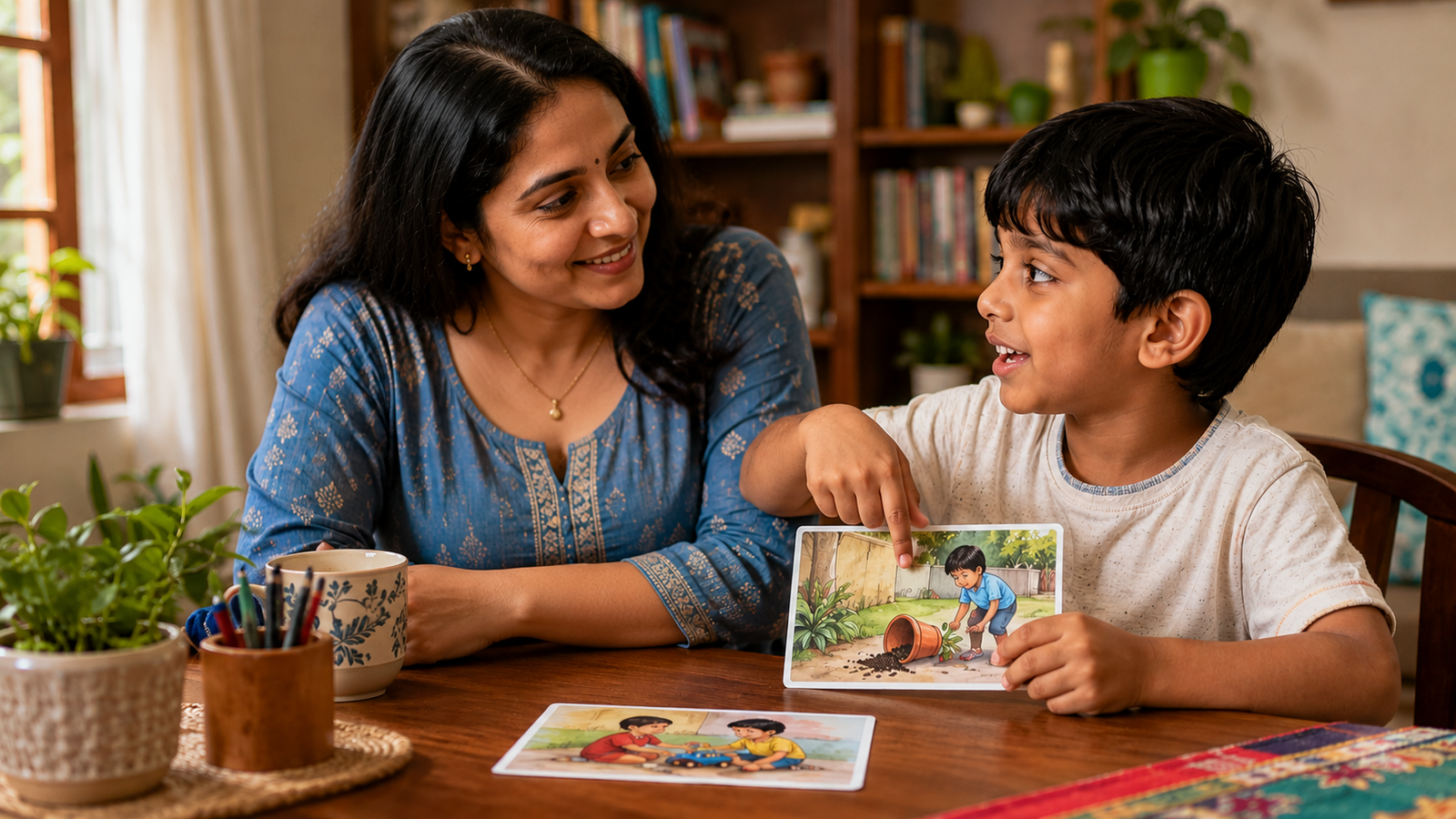
A picture of a child standing beside a fallen plant, for example, may lead to:
“Why is the pot on the floor?”
But that question begins with noticing the pot, the soil, the child’s expression, and what appears different from normal.
Step 2: Clarify
Clarifying questions help children seek information they have missed or not understood:
What does that word mean?
When did this happen?
Which one should I use?
Can you explain that again?
These are valuable independence questions.
A child who can say, “Which notebook should I bring?” or “Can you show me the second step again?” is less dependent on guessing or waiting for an adult to notice their confusion.
Step 3: Connect
Connection questions link new information with earlier events or existing knowledge:
What happened before this?
How are these things connected?
Have we seen something similar before?
Is this like what happened yesterday?
These questions can support comprehension because the child is no longer treating every event or fact as an isolated answer.
A story about a character forgetting an umbrella may remind the child of a recent rainy school morning. That connection gives the child more information to discuss and more questions to ask.
Step 4: Explain
Explanation questions explore reasons, causes, and motives:
Why did this happen?
Why did the person choose that?
What made the plant grow?
How did the floor become wet?
Children’s “why” questions are often genuine attempts to obtain explanations. Research examining young children’s conversations found that children continued seeking information when the answers they received did not adequately explain what they wanted to understand.
The goal is not to ask “why” repeatedly without direction. It is to make the question specific enough to investigate.
Step 5: Predict
Prediction questions use present information to consider possible consequences:
What might happen next?
What will happen if we skip this step?
What could go wrong?
What might the other person say?
A child might look at a wet floor and ask:
“Will someone slip if we leave it like this?”
That question combines observation with cause-and-effect reasoning.
Step 6: Evaluate and Imagine
These questions invite judgement, alternatives, and creativity:
Was that a good decision?
Is there another solution?
What could the character do differently?
How could the story end differently?
There may be several sensible answers. The child has to explain a viewpoint rather than retrieve a single fact.
Question Upgrade
“Why?” becomes more useful as: “Why do you think the child hid the toy from her brother?”
What Better Questions Sound Like at Home
Questioning becomes meaningful when it is connected to situations children recognise.
Packing the School Bag
Basic parent question:“Did you pack everything?”
Likely answer:“Yes.”
Try instead:“What will you need tomorrow, and what are you unsure about?”
The child may learn to ask:“Do I need my drawing book for the first period?”
The child is now identifying missing information rather than giving the answer they think the parent expects.
Helping a Grandparent
Basic parent question:“Can you help Ajji?”
Likely answer:“Okay.”
Try instead:“What could you ask before you start?”
The child may learn to ask:“Which plant needs water first?” or “Where should I keep these medicines?”
Helpfulness now includes understanding the task before beginning it.
Preparing for a Festival
Basic parent question:“Why did the diya go out?”
Likely answer:“I don’t know.”
Try instead:“What do you notice about the oil, wick, and breeze?”
The child may begin asking:“Does it need more oil?” or “Will it stay lit away from the window?”
Observation gives the question somewhere to come from.
A Disagreement Between Siblings
Basic parent question:“Who started it?”
Likely answer:“He did!”
Try instead:“What information would help us understand both sides?”
The child may learn to ask:“Did you know I was still using it?” or “Can we take turns?”
A question can help uncover another person’s perspective and create a path towards resolving the problem.
Try This Tonight: Look, Wonder, Build, Explore
This ten-minute routine needs only a picture, household object, story illustration, family photograph, or situation card.
Look
Observe the item together without explaining everything immediately.
Ask:
“What do you notice?”
Give your child time to study the details.
Wonder
Each person shares one thing they are curious about. The parent should participate too:
“I wonder why the boy is holding an empty bucket.”
This shows the child that uncertainty is safe. Adults do not always have to know everything before a conversation begins.
Build
Help turn the child’s idea into a specific question.
Child: “Bucket?”
Parent: “Are you wondering what is inside it, or why it is empty?”
Child: “Why is the bucket empty?”
The parent has supported the wording without supplying the entire thought.
Explore
Discuss possible answers and identify what remains unknown.
Parent: “Maybe he poured the water on the plant. What makes that possible?”
Child: “The soil looks wet.”
Parent: “What else could we ask?”
Child: “Where did he get the water?”
That follow-up question is important. The child has moved from responding to the adult towards directing part of the inquiry.
Harvard’s Center on the Developing Child calls responsive, back-and-forth exchanges like these “serve and return.” Such interactions support early language and social development.
The Parent’s Role: Less Quizzing, More Wondering
Children are more likely to take conversational risks when every exchange does not hide one correct answer.
Open-ended questions can support language development and critical thinking by inviting children to explain ideas, choices, and reflections.
Try these simple shifts:
Instead of: “What is the correct answer?”Try: “What are you wondering about?”
Instead of: “You already know this.”Try: “What information would help you?”
Instead of: “No, that is wrong.”Try: “What made you think that?”
Instead of: “Ask a better question.”Try: “Could we make that question more specific?”
Five prompts are enough for most situations:
What do you notice?
What are you wondering?
What information is missing?
What makes you think that?
What else could we ask?
Then pause.
Children may need several seconds to organise a question. Filling every silence can unintentionally teach them that the adult will eventually do the thinking.
Notice the Progress
A meaningful early milestone is one unprompted follow-up question – even when the wording is incomplete.
What Progress May Look Like
These stages are approximate, not developmental deadlines.
Early Questioners: Around Ages 4-5
Children may rely mainly on “who,” “what,” and “where.” They may ask about visible objects or repeat a question an adult has modelled.
Their grammar may be incomplete:
“Why boy sad?”
That is still a meaningful question. Respond to it first, then model a fuller version naturally:
“Yes, you are asking why the boy is feeling sad.”
Growing Investigators: Around Ages 6-7
Children may begin adding “why” and “how,” connecting events, seeking clarification, and predicting simple outcomes.
Their questions may move from:
“What is that?”
to:
“How does it work?”
Or from:
“What happened?”
to:
“Why did that happen afterwards?”
Independent Thinkers: Around Ages 8-10
Children may compare explanations, ask follow-up questions, consider evidence, question motives, or use questions to plan:
How do we know that is true?
Could there be another reason?
What information do I need before I decide?
What might happen if I choose the other option?
The goal is not constant argument. It is learning to seek reasons, evidence, and clarification.
When Parents Need a Starting Point Too
Knowing that questions matter does not necessarily make it easy to invent a meaningful discussion at the end of a busy day.
Picture-based situations reduce preparation because both parent and child have a visible starting point.
A simple activity can follow this sequence:
Observe the situation.
Identify what is already known.
Notice what information is missing.
Form a relevant question.
Discuss possible responses.
Ask a follow-up question.
The Learn to Ask Questions product family is designed around this kind of screen-free conversation.
The accessible Amazon listing information verifies that Learn To Ask Questions | Flashcards, Level 1 is a Level 1 set with 40 double-sided cards and six ways to play. It is the most straightforward starting option for families introducing structured question practice.
Learn To Ask Questions | Flashcards, Level 2 is listed as a separate 40-card set with six ways to play. It can offer additional situations after a child becomes comfortable with guided conversation or when a family wants a larger variety of discussion prompts.
The accessible listing information did not provide enough detail to verify exact differences in question type, scenario complexity, or difficulty between the levels. Those distinctions should therefore not be assumed without additional verified product information.
The Learn to Ask Questions | Level 1 & 2 Combo is listed with 80 cards and six ways to play. It may suit families who prefer both sets and a wider pool of conversations, although every family does not need to begin with the combo.
A single card can support noticing, clarification, explanation, prediction, and follow-up discussion. The value lies in the conversation – not in rushing through the pack or reaching one predetermined answer.
Questions Matter Beyond Academics
Inquiry skills can help children:
clarify an instruction from a teacher or parent;
ask for help instead of remaining stuck;
identify missing events in a story;
understand what a maths problem is asking;
explore causes during a science activity;
participate in conversations rather than only answer;
speak up when a situation feels unsafe or confusing;
check information before accepting it;
plan tasks and make more independent decisions.
Asking more questions does not guarantee higher marks or perfect judgement.
It gives children a method for meeting uncertainty: notice it, identify what is missing, and seek useful information.
Frequently Asked Questions
Why does my child answer questions but rarely ask any?
Answering follows a path created by someone else. Asking requires the child to notice a gap, decide what matters, form the sentence, and risk speaking. Begin by modelling “I wonder…” statements and offering question starters. Quiet reflection can still represent genuine curiosity, particularly when a child is thinking in more than one language or needs additional processing time.
Should I correct the grammar of my child’s questions?
Respond to the meaning first. When your child asks, “Why she crying?”, acknowledge the question and then model, “You are asking, ‘Why is she crying?’” Repeated correction before the question is heard can discourage a hesitant child. Grammar can develop through natural modelling, reading, and conversation while the child continues to feel that curiosity is welcome.
What if my child keeps asking the same question?
Repetition may mean the first answer was unclear, the child wants reassurance, or the subject remains interesting. Ask, “What part are you still wondering about?” You can also say, “What do you think so far?” When the answer is unavailable, admit it honestly and decide whether to observe more closely, ask someone knowledgeable, or look for information together.
How can I encourage questions without making everything a lesson?
Use ordinary moments and stop before the conversation becomes tiring. One prompt while packing a bag, watering a plant, reading, cooking, or visiting the vegetable market is enough. Share your own curiosity instead of interviewing the child. Some moments can remain simply enjoyable. Questioning works best when it feels like connection and exploration, not compulsory performance.
A Child Does Not Need an Impressive Question
A useful question may begin as one word, an uncertain pause, or:
“What is that?”
The goal is not to raise a child who challenges every instruction or produces clever questions on demand.
It is to create a home where noticing is valued, confusion can be admitted, and asking for clarity feels safe.
When children repeatedly hear “What are you wondering?” and discover that adults take their questions seriously, they learn something larger than a sentence pattern: when the world is unclear, surprising, or important, they are allowed to investigate.
References
Chouinard, M. M.“Children’s Questions: A Mechanism for Cognitive Development.” Monographs of the Society for Research in Child Development, 2007.
Park, A. T., Colantonio, J., and Mackey, A. P.“Question Asking Practice Fosters Aspects of Curiosity in Science Content in Young Children.” npj Science of Learning, 2025.
Frazier, B. N., Gelman, S. A., and Wellman, H. M.“Preschoolers’ Search for Explanatory Information Within Adult-Child Conversation.” Child Development, 2009.
Center on the Developing Child at Harvard University.“Serve and Return: Back-and-Forth Exchanges.”
Strasser, J.“Conversations With Children: Asking Questions That Stretch Children’s Thinking.” National Association for the Education of Young Children, 2019.
Leave a Reply