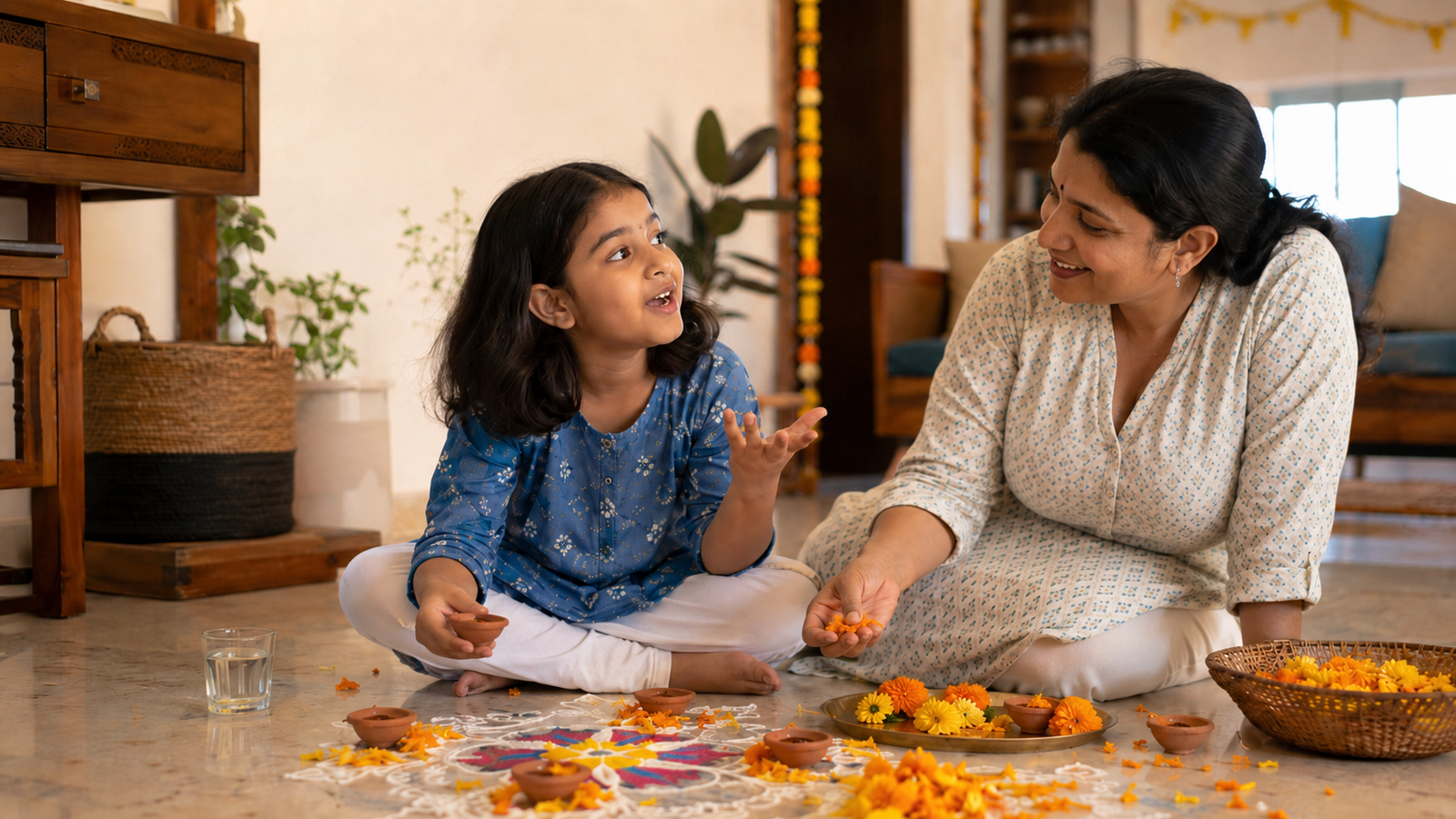
A child studies a picture of a family preparing for a celebration. Someone is hanging flowers. Another person is carrying a tray. A grandparent is stirring something in the kitchen.
The parent does not ask, “Which tense is this?”
Instead, she asks, “What is happening now?”
“The girl is hanging flowers.”
“What happened before this?”
“They cleaned the doorway.”
“What will they do next?”
“They will light the lamps.”
The child has moved through past, present, and future without opening a grammar workbook. Festivals offer familiar actions, memories, routines, and plans that can be described naturally. The language has a purpose: the child is discussing something recognisable.
Welcome to the Festival Language Studio
Imagine placing one festival picture in the middle of three playful language zones.
In Yesterday, the child recalls what already happened.
In Today, the child describes what is happening now – or what the family usually does.
In Tomorrow, the child talks about plans, preparations, and possibilities.
Parents do not need to begin with terms such as simple past or present continuous. Begin with time and action: What happened? What is happening? What usually happens? What will happen next?
The child gradually notices that the sentence changes when the time changes. This treats grammar as communication rather than a hunt for the correct label; language instruction is most useful when children can communicate meaning, not only pursue grammatical perfection.
Festival contexts also give sentence-building a cultural and emotional setting instead of leaving actions inside isolated exercises.
Zone One: Yesterday – Replay a Festival Memory
Yesterday is the zone of completed actions.
Choose a memory from a celebration familiar to your family: visiting relatives, preparing food, making a kolam, exchanging greetings, attending a community event, carrying flowers, listening to music, or decorating a room.
Ask, “What did we do first?”
A conversation may unfold like this:
Parent: What did we do in the morning?Child: We made sweets.Parent: Who helped you?Child: Grandma helped me.Parent: What happened after that?Child: I decorated the box.
Festival Memory Replay
Invite your child to choose one moment and describe where they were, who was present, what happened first, what they did, and how they felt.
When the child says, “We decorated,” add a little language without treating the answer as a mistake:
“Yes, we decorated the doorway with flowers.”
Expansion lets children hear a fuller sentence while keeping their idea intact. Communication guidance similarly recommends adding to what a child says and talking about pictures and everyday experiences.
You can then invite one more detail:
“When did we decorate it?”
“We decorated it in the evening.”
Zone Two: Today – Catch the Festival in Motion
Today is the busiest part of the studio.
Look closely at a festival scene and describe the actions in progress:
Mother is arranging the flowers.
The children are carrying the lamps.
Grandpa is telling a story.
My cousin is playing the dhol.
The family is preparing food.
We are decorating the room.
Then ask what the family usually does:
We visit our relatives.
Our family prepares this sweet every year.
We exchange greetings with our neighbours.
A picture can support two conversations: what is happening now and what commonly happens in the family’s tradition. Choose examples relevant to your own celebrations; no ritual, food, or dress is universal.
Action Detective
Ask the child to find five actions in a picture and turn each one into a complete sentence.
Begin simply:
“The girl is holding a plate.”
Then add playful missions:
Find an action involving sound.
Find an action involving food.
Find something one person is doing.
Find something several people are doing.
Find an action that requires careful movement.
The game develops observation alongside sentence formation. Picture talk connects words with actions and ideas, while oral-language practice supports communication.
For a humorous round, the adult can make an obviously incorrect observation:
“The musician is cooking the flowers.”
The child must identify what is wrong and repair the sentence:
“No, the musician is playing the dhol. The woman is arranging the flowers.”
The correction belongs to the game, not to criticism.
Zone Three: Tomorrow – Talk About Plans
Future language appears naturally when children are looking forward to something.
Ask:
What will we do tomorrow?
Who will visit us?
What will you wear?
What are we going to prepare?
What will happen after sunset?
A short dialogue might sound like this:
Parent: What will we do tomorrow morning?Child: We will decorate the house.Parent: What will you decorate?Child: I will decorate the doorway.Parent: What will you use?Child: I will use flowers.
Festival Planner
Invite the child to make three spoken plans:
one thing I will wear;
one thing I will help with;
one person I will meet;
one food I will eat;
one activity I am excited about.
The child can draw the plans or arrange them in order after speaking. The aim is to practise intention and expectation, not predict the celebration perfectly.
Festival-based grammar feels refreshingly different because plans already matter to the child; the language is attached to anticipation rather than an abstract rule.
The Festival Time-Travel Game
Now connect all three zones.
Choose one action: decorate, cook, visit, dance, light, carry, play, share, wear, or make.
Move it through time:
Yesterday, we decorated the room.
Try another:
Yesterday, Grandma made laddus.
The child is learning more than a changed verb. Each sentence communicates who is acting, what is happening, when and where it happens, and which details make the meaning clearer.
For extra play, say, “Yesterday, Grandpa danced with a giant laddu.” Ask what sounds unusual. The child may repair it:
“Grandpa danced while holding a plate of laddus.”
This is a thoughtfully specific bridge between grammar, visual storytelling, and children’s lived cultural experiences. The language stays structured, but the conversation remains imaginative.
From One Word to a Complete Sentence
Some children understand the scene but answer with one word.
Parent: What is she doing?Child: Decorating.Parent: Who is decorating?Child: The girl.Parent: Can we join those ideas?Child: The girl is decorating.Parent: What is she decorating?Child: The girl is decorating the doorway.Parent: What is she using?Child: The girl is decorating the doorway with flowers.
A reusable pattern is:
Who + action + object or place + extra detail
For example:
The boy is carrying a lamp carefully.
Grandma made sweets in the kitchen.
We will visit our relatives in the evening.
A short, clear sentence is useful progress. Sentence frames can support speaking by providing structure without supplying the answer.
Seven Days in the Studio
Keep each session to about five or ten minutes.
Day 1 – Spot the Actions
Choose one festival photograph or picture. Name the actions you can see.
Day 2 – Remember Yesterday
Share three sentences about a past celebration.
Day 3 – Describe the Scene in Motion
Say what different people are doing now.
Day 4 – Plan Tomorrow
Talk about an upcoming family activity or celebration.
Day 5 – Change the Time
Move one action through yesterday, today, and tomorrow.
Day 6 – Add One More Detail
Expand a sentence using who, where, when, what, or how.
Day 7 – Tell the Whole Festival Story
Combine several sentences into a short spoken narrative.
The studio can fit into a car journey, a family visit, or a few minutes with old photographs.
When a Picture Makes the Conversation Easier
Families can use photographs and real celebrations, but finding a clear scene with several actions is not always easy.
That is where Tenses Through Festivals can serve as a picture-led starting point. The product brings together English sentence formation, action words, past-present-future expressions, festival settings, observation, storytelling, and parent-child conversation.
A card can prompt: What is happening? What happened before? What might happen next? What does this person usually do? Can you add a place or time, or turn the actions into a story?
The distinctive idea is the combination: instead of unrelated sentences, language sits inside recognisable scenes involving preparation, food, decoration, music, visits, and shared traditions.
Tenses Through Festivals Flashcards, Level 1 can be used as a starting collection for families introducing picture-led sentence-building and conversations about time. The current listing presents the product around past, present, and future language through familiar Indian traditions and celebrations.
Tenses Through Festivals Flashcards, Level 2 offers an additional collection of visual situations and action-based conversation possibilities. It should not be assumed to be harder or intended for a particular age unless the family has separately verified that detail.
The Tenses Through Festivals Flashcards, Levels 1 & 2 Combo may suit families who want a broader pool of scenes for rotating activities, comparing actions, sorting by time, and creating longer stories.
Its refreshingly specific format combines grammar with Indian festival contexts, visual observation, speaking, and family interaction – a combination parents may not commonly encounter in standard worksheet-based resources.
Frequently Asked Questions
How can I teach tenses without making my child memorise grammar rules?
Begin with time-based questions rather than terminology: “What happened?”, “What is happening?”, and “What will happen next?” Use a familiar photograph or picture and model one sentence at a time. Once the child is comfortable expressing time through speech, grammatical names can be introduced gradually if they are useful.
What festival activities can help children practise English sentences?
Children can describe preparations, recall a previous celebration, plan an upcoming visit, find actions in a picture, compare family traditions, or narrate events in order. Families should choose festivals and practices familiar to the child rather than trying to cover every celebration.
Can children learn past, present, and future expressions through pictures?
Pictures provide visible people, objects, actions, and settings. A parent can ask what is happening in the scene, what may have happened before it, and what could happen next. This gives the child a concrete subject for sentences instead of requiring ideas and grammar at the same time.
What should I do when my child answers with only one word?
Accept the idea, then help expand it. If the child says “decorating,” ask who is decorating, what they are decorating, or what they are using. Join the answers gradually. Avoid beginning with “That is not a complete sentence,” which may make a hesitant speaker less willing to continue.
How are festival-based tense flashcards different from regular grammar worksheets?
Worksheets often begin with written rules, isolated sentences, or blanks. Festival-based picture cards begin with a recognisable scene and invite the child to observe, speak, remember, predict, and tell a story. The grammatical practice is still present, but it is carried by meaningful action and conversation.
Leave the Studio Open
The next time your child sees a festival photograph, choose one action.
Ask:
“What happened yesterday?”
Three questions are enough to begin.
English practice does not have to arrive as a worksheet. It can enter through flowers being hung, food being prepared, music being played, or a family making plans – before anyone calls it a lesson.
References
Cambridge University Press.Pedagogical Interventions to L2 Grammar Instruction.
Reading Rockets.Your Child’s Communication Development, Birth to Five.
Reading Rockets.Basics: Oral Language.
Colorín Colorado.Sentence Frames and Sentence Starters.
Leave a Reply